
Why Student Loan Interest Accrues and What It Costs You


Student loan interest accrues daily as a fee lenders charge for the use of borrowed money, calculated as a percentage of your outstanding principal balance. This process, formally called daily simple interest accrual, is the core mechanic that determines how much your loan truly costs over time. Understanding why student loan interest accrues puts you in a position to make smarter repayment decisions. The formula is straightforward: daily interest formula divides your annual rate by 365.25 to account for leap years, then multiplies by your current principal. Even a modest loan balance generates new interest charges every single day.
How does student loan interest accrue daily and when does it start?
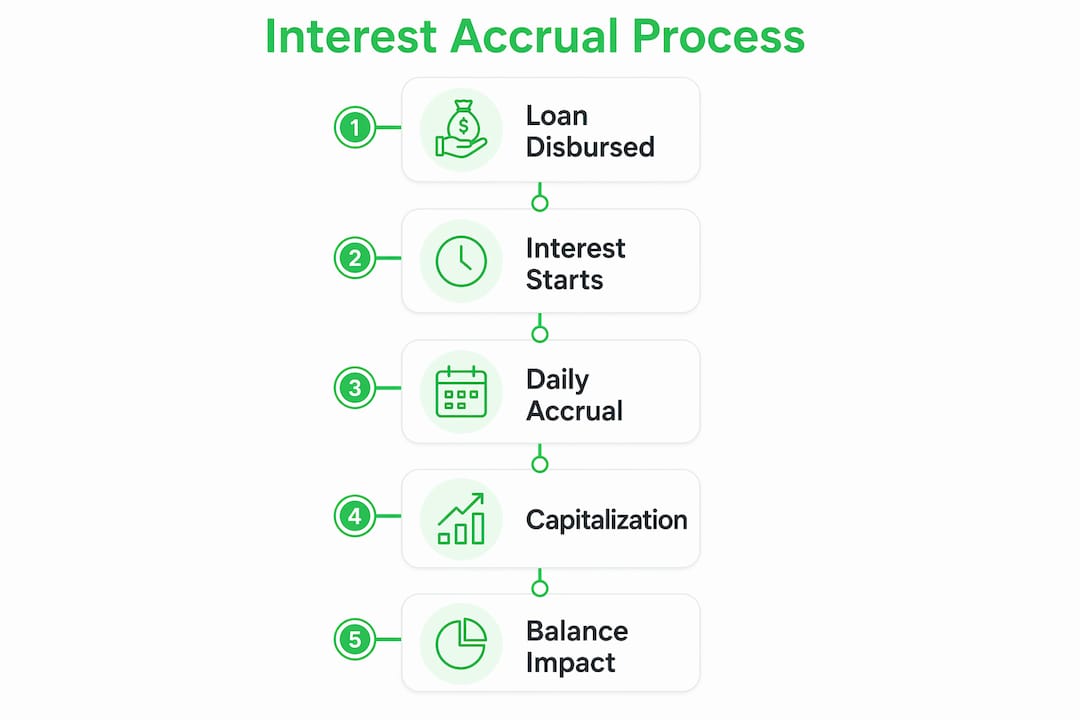
Interest accrual begins the moment your loan is disbursed, with one important exception. Federal Direct Subsidized loans do not accrue interest while you are enrolled at least half time, during your six-month grace period after leaving school, or during qualifying deferment periods. Every other federal and private loan starts accruing interest from day one of disbursement.
The daily accrual calculation works like this. Take your current principal, multiply it by your annual interest rate, then divide by 365.25. If you have a $30,000 loan at a 6% annual rate, you are generating roughly $4.92 in new interest every single day. That amount does not sound alarming in isolation, but it adds up to about $1,796 per year before you make a single payment.
Common borrower misunderstandings about “no interest” periods are worth addressing directly:
Subsidized loans during school: Interest does not accrue, so your balance stays flat while you are enrolled.
Unsubsidized loans during school: Interest accrues the entire time, even though no payment is due.
Grace periods: Subsidized loans remain interest-free; unsubsidized loans continue accruing.
Deferment: Subsidized loans are protected; unsubsidized and private loans keep accruing.
Forbearance: All loan types accrue interest, including subsidized loans.
Pro Tip: If you have unsubsidized loans, paying even small amounts toward interest while you are still in school prevents that interest from being added to your principal balance later.
What is interest capitalization and how does it affect your balance?

Capitalization is the process by which unpaid interest is added to your principal, permanently raising the base on which future interest is calculated. This is the single most financially damaging event in a student loan’s life cycle. Once interest capitalizes, you are no longer paying interest on your original loan amount. You are paying interest on a larger number.
Capitalization is triggered by specific events, not randomly. The most common triggers are:
End of your grace period: When repayment begins, any unpaid accrued interest capitalizes.
End of deferment or forbearance: All interest that built up during the pause gets added to principal.
Leaving an Income-Driven Repayment (IDR) plan: Switching plans can trigger capitalization of outstanding interest.
Defaulting on your loan: Default almost always triggers immediate capitalization.
Here is a simple illustration of the financial impact:
Scenario | Original Principal | Accrued Interest | New Principal After Capitalization |
4 years in school (unsubsidized, 6%) | $30,000 | $7,200 | $37,200 |
12-month deferment (6%) | $37,200 | $2,232 | $39,432 |
Repayment begins | $39,432 | $0 | $39,432 |
The difference between your original $30,000 and the $39,432 you now owe is entirely the result of capitalization. Capitalized interest permanently raises the daily interest calculation, meaning every future payment costs more than it would have on the original balance.
Pro Tip: Accrued interest is tracked separately from your principal until capitalization occurs. You have a window to pay off that accrued interest before it capitalizes, which avoids interest-on-interest compounding entirely.
Why do lenders charge interest on student loans?
Interest is not arbitrary. Lenders charge interest to compensate for three distinct economic realities: inflation, default risk, and opportunity cost. Each one is a legitimate reason why borrowing money is never free.
Inflation: A dollar today is worth more than a dollar in ten years. Lenders need interest to ensure the money they get back holds real purchasing power.
Default risk: Not every borrower repays on time or in full. Interest rates price in the statistical likelihood that some loans will not be fully recovered.
Opportunity cost: Money lent to you cannot be invested elsewhere. Interest compensates the lender for giving up other potential returns.
“Interest is the price of credit. It reflects the lender’s cost of funds, the risk of the loan, and the expected rate of inflation over the loan term.”
Federal student loan interest rates are set by Congress each year, tied to the 10-year Treasury note yield. Private lenders set their own rates based on creditworthiness, market conditions, and loan term. This is why federal vs. private loan interest rates can differ significantly, even for the same borrower. Understanding this distinction helps you evaluate your repayment options with clear eyes.
How does interest accrual impact your repayment strategy?
Interest accrual runs like a meter that never stops. Payments are applied first to fees, then to accrued interest, and finally to principal. This payment application order means that if your monthly payment barely covers the interest that has built up, your principal barely moves. That is how borrowers can make years of payments and feel like they are getting nowhere.
Here is what this means in practice for your repayment approach:
Pay more than the minimum: Any amount above the minimum payment goes directly to principal after interest is covered, reducing future accrual.
Make early extra payments: Extra payments early in the loan reduce principal faster, which lowers the daily interest calculation for every remaining day of the loan.
Avoid unnecessary deferment: Interest accrues during deferment on most loans. Every month in deferment is a month of interest that may capitalize later.
Pay interest during forbearance: If you must pause payments, paying the interest that accrues prevents it from being added to your principal when the forbearance ends.
Time your payments strategically: Paying a few days before your due date, rather than on it, reduces the number of days interest has to accrue before your payment is applied.
Pro Tip: If you are on an IDR plan and your monthly payment does not cover all accrued interest, ask your servicer whether your plan includes an interest subsidy. Some IDR plans, like SAVE, have provisions that cover a portion of unpaid interest to prevent runaway balance growth.
Sporadic or inconsistent payments are particularly damaging. Payments that do not consistently cover accrued interest fail to reduce principal, leaving the balance flat or growing. Consistency matters more than the occasional large payment. A reliable monthly payment that covers interest plus a portion of principal beats an irregular strategy every time.
Key takeaways
Student loan interest accrues daily on your outstanding principal, and capitalization is the event that permanently raises your balance and increases every future interest charge.
Point | Details |
Daily accrual formula | Multiply your principal by your annual rate, then divide by 365.25 to find your daily interest charge. |
Subsidized loan protection | Subsidized loans do not accrue interest during enrollment, grace periods, or qualifying deferment. |
Capitalization raises principal | Unpaid interest added to principal increases every future daily interest charge permanently. |
Payment application order | Payments cover fees and accrued interest before reducing principal, so minimum payments slow progress. |
Early payments save money | Extra payments reduce principal sooner, lowering total interest accrued over the life of the loan. |
What I have learned from watching borrowers ignore this
Most borrowers I have worked with understand that student loans have interest. Very few understand that interest accrues every single day, including weekends, holidays, and the years they spent in school. That gap in understanding is where the real financial damage happens.
The most common mistake I see is treating deferment as a financial break. It is a payment break, not an interest break. Borrowers who defer for 12 months and then return to repayment are often shocked to find their balance is higher than when they left. They did nothing wrong in a technical sense, but they did not understand the impact of interest during paused payments. That surprise is entirely preventable.
The second mistake is waiting until repayment begins to think about interest. If you have unsubsidized loans, the interest clock started the day your first disbursement hit. A borrower who spends four years in school with $30,000 in unsubsidized loans at 6% has already generated thousands in accrued interest before they attend a single graduation ceremony. Paying even $25 a month toward that interest during school makes a measurable difference at capitalization.
My honest advice: check your loan servicer account right now and look at your accrued interest balance. That number is separate from your principal. You can pay it off before it capitalizes. Most borrowers do not know that window exists. Use it.
— Ellis
Titanprep can help you stay on top of your loans
Student loan rules and repayment programs change frequently, and staying current matters. Titanprep tracks important student loan updates so you do not have to monitor every policy shift on your own. Whether you are managing accruing interest, preparing for a repayment plan change, or trying to understand how recent federal updates affect your balance, Titanprep provides clear guidance and document support. The team helps borrowers organize paperwork for IDR plans, PSLF applications, and other federal programs. Titanprep is not affiliated with the U.S. Department of Education, and eligibility for any federal program is determined by your servicer. Learn more about lowering your payments and keeping your file in order.
FAQ
Why does student loan interest accrue every day?
Student loans use a daily simple interest formula that charges a percentage of your outstanding principal each day. This is how lenders are compensated for the ongoing use of borrowed money.
Do subsidized loans ever accrue interest?
Federal Direct Subsidized loans do not accrue interest during enrollment, grace periods, or qualifying deferment. They do accrue interest during forbearance, just like all other loan types.
What triggers interest capitalization on student loans?
Capitalization is triggered by the end of a grace period, the end of deferment or forbearance, switching repayment plans, or defaulting on the loan. Each event adds unpaid accrued interest to your principal balance permanently.
How can I reduce the total interest I pay on my student loans?
Making extra payments early in the loan term reduces your principal faster, which lowers the daily interest calculation going forward. Paying accrued interest before capitalization also prevents interest-on-interest growth.
Does my monthly payment reduce my principal right away?
Payments are applied first to fees, then to all accrued interest, and finally to principal. If your payment does not fully cover accrued interest, your principal does not decrease at all that month.
Recommended
Comments