
Why Did My Student Loan Payment Increase in 2026?


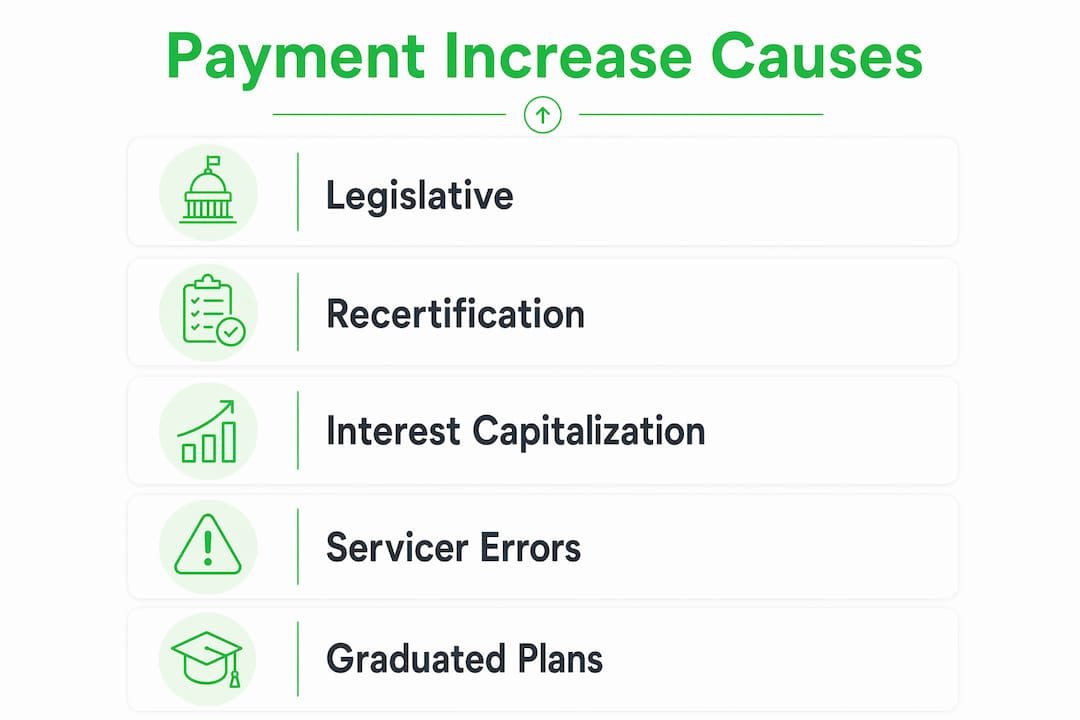
Federal student loan payments increase when legislative changes, income recertification updates, or accrued interest alter the terms of your repayment plan. If you opened your billing statement and asked why did my student loan payment increase, the answer almost certainly traces back to one of three causes: the collapse of the SAVE plan affecting 7.2 million borrowers, a missed Income-Driven Repayment (IDR) recertification deadline, or interest capitalization after a period of forbearance. Understanding which cause applies to your situation is the first step toward fixing it.
Why did my student loan payment increase under the new 2026 rules?
The single largest driver of payment increases in 2026 is the One Big Beautiful Bill Act, which phases out the SAVE plan and restricts repayment options to two plans: the Tiered Standard Plan and the Repayment Assistance Plan (RAP). Borrowers must complete their transition by July 1, 2028, but the disruption is already hitting monthly bills right now.
The SAVE plan was designed to keep payments low for borrowers with modest incomes. Its elimination means millions of people who were paying based on a percentage of their discretionary income are now being moved to plans with higher fixed obligations. Borrowers moving from older income-driven plans to new requirements may see payments jump by $400 or more per month. That is not a small adjustment. For many households, it represents a significant budget disruption.
Here is what specifically changed for borrowers in this transition:
The SAVE plan was placed in administrative forbearance due to legal challenges, pausing payments temporarily but also pausing progress toward forgiveness.
When forbearance ended, borrowers were moved to new plans without always receiving clear notice from their loan servicers.
The new RAP calculates payments differently than IDR plans, often resulting in higher monthly amounts for mid-income earners.
Consolidation after July 1, 2026 treats loans as new, stripping borrowers of access to traditional IDR protections and raising payments further.
The regulatory environment has drastically reduced repayment flexibility, making an immediate strategy review critical for every borrower in transition. If you have not reviewed your repayment plan since 2024, your current payment may no longer reflect the plan you originally enrolled in.
How missing IDR recertification causes payment spikes
IDR plans require you to update your income and family size every year. This process is called recertification, and missing the deadline has immediate, costly consequences. When you miss it, your servicer automatically moves you to the Standard Repayment Plan, which uses fixed payments calculated on your total loan balance rather than your income.

The payment difference is stark. Borrowers on IDR plans often pay between $150 and $300 per month. After a missed deadline, Standard Plan payments can jump to $600 to $1,000 or more monthly. That shift happens without any warning beyond the original recertification notice, which many borrowers overlook or never receive.
Your income data also matters even when you do recertify on time. If your income increased since your last tax filing, your servicer will recalculate your payment upward. Joint filers may see inflated payments if their spouse’s income is included in the calculation. Here is how to stay ahead of recertification:
Log into your servicer’s portal and confirm your next recertification date.
Submit updated income documentation, such as a recent pay stub, if your income has decreased since your last tax return.
Set a calendar reminder 90 days before your recertification deadline.
Confirm with your servicer in writing that your recertification was received and processed.
Pro Tip: If your income dropped recently, do not wait for your annual recertification. Contact your servicer and request an early recalculation using current pay stubs. This can lower your payment immediately rather than waiting months for the scheduled update.
What happens to your balance after forbearance ends
Interest capitalization is one of the least understood reasons why loan payments go up. During forbearance or deferment, interest continues to accrue on your balance even though you are not making payments. When the pause ends, that unpaid interest gets added to your principal. This is called capitalization, and it permanently raises the balance on which your future payments are calculated.
The numbers add up quickly. A $50,000 loan at 6% interest can accrue approximately $4,500 in interest over 18 months of forbearance. Once that $4,500 is capitalized, your new principal becomes $54,500. Every future payment is now calculated on that higher balance, which means your monthly obligation rises even if your repayment plan and interest rate stay exactly the same.
Here is a simple illustration of how capitalization affects payments:
Scenario | Loan Balance | Monthly Payment (10-year Standard) |
Before forbearance | $50,000 | Approximately $555 |
After 18-month forbearance (6% interest) | $54,500 | Approximately $605 |
Difference | +$4,500 | +$50 per month |
That $50 monthly increase may seem modest, but it compounds over a 10-year term into roughly $6,000 in additional payments. Borrowers who went through the SAVE plan forbearance period should check their current principal balance against their pre-forbearance balance to understand exactly how much capitalization affected them. The end of forbearance consistently catches borrowers off guard when they see their new payment amount.
Other common reasons your payment went up
Legislative changes and recertification are the biggest culprits, but several other factors can cause your student loan payment to increase without any obvious trigger.
Graduated repayment plans schedule automatic payment increases every two years without any action required from you. Each increase is built into the plan’s structure, and payments can rise up to three times the starting amount over the 10-year term. If you enrolled in a graduated plan years ago and forgot about it, a scheduled increase may be the entire explanation.
Servicer errors are more common than most borrowers realize. Misapplied income data, incorrect plan placements, and autopay misconfigurations all cause unexpected payment increases. These errors are especially common during transitions from the SAVE plan to new repayment options, when servicers are processing large volumes of account changes simultaneously.
If you suspect your payment increase is an error, take these steps:
Log into your servicer’s portal and compare your current plan details against what you originally enrolled in.
Request a written explanation of how your new payment was calculated.
Ask your servicer to recalculate your payment using your most recent income documentation.
Dispute the error in writing and keep a copy of all correspondence.
Pro Tip: If you suspect a servicer error, turn off autopay immediately. Leaving autopay active when an incorrect amount is being charged leads to unauthorized withdrawals, and refund processes are slow and uncertain. Disable it first, then dispute the error.
Many payment increases attributed to policy changes are actually servicer processing errors. If your payment jumped and nothing significant changed in your income or repayment plan, treat it as a potential error until your servicer proves otherwise.
How to lower your student loan payments right now
You have real options for managing or reducing your payment, even in the current regulatory environment. The key is acting quickly, because some options narrow after July 1, 2028.
Switch to an income-driven repayment plan. If you are currently on the Standard Plan, moving to the RAP or another eligible IDR plan can significantly reduce your monthly payment based on your income and family size. Use the repayment plan change process through your servicer’s portal or StudentAid.gov.
Submit updated income documentation. If your income decreased since your last tax return, submit current pay stubs to your servicer and request a recalculation. You do not have to wait for your annual recertification window.
Apply for deferment or forbearance strategically. These options pause payments but allow interest to accrue. Use them only as a short-term measure while you arrange a more sustainable repayment plan, since capitalization will raise your balance when the pause ends.
Avoid consolidating loans after July 1, 2026, unless necessary. Consolidation under the new rules treats your loans as new originations, which limits your plan options and can raise your payments. Review the 2026 payment changes before making any consolidation decisions.
Contact your servicer directly. Ask specifically whether your current plan is the most affordable option for your income level. Servicers are required to provide this information, and many borrowers are on higher-payment plans simply because they never asked about alternatives.
Key takeaways
Student loan payment increases in 2026 are primarily driven by the elimination of the SAVE plan, missed IDR recertification deadlines, and interest capitalization after forbearance periods.
Point | Details |
SAVE plan elimination | Over 7 million borrowers face payment increases of $400 or more per month during the transition to new plans. |
Missed recertification | Skipping your annual IDR update triggers an automatic move to the Standard Plan, often doubling or tripling your payment. |
Interest capitalization | Unpaid interest added to your principal after forbearance permanently raises your monthly payment amount. |
Servicer errors | Incorrect income data or plan placements are common during transitions; verify your payment calculation in writing. |
Consolidation risk | Consolidating after July 1, 2026, removes access to traditional IDR protections and typically raises payments. |
What I have seen borrowers get wrong about payment increases
I have spent years watching borrowers react to unexpected payment increases with panic, and the most common mistake is accepting the new number without question. The assumption that a higher bill must be correct because it came from a federal servicer is simply not accurate. Servicers process millions of accounts, and errors during large-scale transitions like the SAVE plan wind-down are routine, not rare.
The second mistake I see is waiting. Borrowers receive a notice, feel overwhelmed, and delay taking action for weeks or months. By then, autopay has withdrawn the incorrect amount multiple times, and the refund process has become a months-long ordeal. The moment you notice a payment increase that does not match a life change you made, that is the moment to act.
What I find most encouraging is that borrowers who engage directly with their servicers, ask specific questions about their plan placement, and submit updated income documentation almost always find a path to a lower payment. The system is complicated right now, but it is not unworkable. Staying informed about recent federal changes and treating your loan account like an active financial obligation rather than a set-and-forget bill is the single most effective thing you can do.
— Ellis
How TitanPrep helps you manage student loan payment increases
When your payment changes unexpectedly, the paperwork and deadlines can feel like a second job. TitanPrep is a document preparation and support service that helps borrowers organize, submit, and track paperwork for federal programs including IDR applications, PSLF submissions, and recertification filings. TitanPrep is not affiliated with the U.S. Department of Education, and eligibility for any federal program is determined by your servicer or the Department. What TitanPrep does is help you stay organized, meet deadlines, and maintain clear records of every submission. Visit TitanPrep’s student loan updates page for current information on repayment changes, or explore how TitanPrep works to see how the service supports borrowers through transitions like the one happening right now.
FAQ
Why did my student loan payment increase suddenly?
The most common causes are the elimination of the SAVE plan, a missed IDR recertification deadline, or interest capitalization after forbearance. Contact your servicer and request a written explanation of how your new payment was calculated.
Can a servicer error cause my payment to go up?
Yes. Misapplied income data and incorrect plan placements are common during large-scale transitions. If your payment increased without a corresponding change in your income or repayment plan, treat it as a potential error and dispute it in writing.
What is interest capitalization and why does it raise my payment?
Interest capitalization occurs when unpaid interest accrued during forbearance or deferment is added to your principal balance. A $50,000 loan at 6% can accrue roughly $4,500 over 18 months, permanently raising the balance on which your payments are calculated.
How can I lower my student loan payments after an increase?
Switch to an income-driven repayment plan, submit updated income documentation to your servicer, or apply for deferment as a short-term measure. Avoid consolidating loans after July 1, 2026, unless you fully understand the impact on your plan eligibility.
When do student loan payments increase on a graduated repayment plan?
Graduated repayment plans schedule automatic increases every two years. Payments can rise up to three times the starting amount over the 10-year repayment term, with no action required from the borrower to trigger each increase.
Recommended
Comments