
Student Loan Processing Delays: What to Do Now


Student loan processing delays occur when your federal Income-Driven Repayment (IDR) or Public Service Loan Forgiveness (PSLF) application sits in a queue longer than expected, leaving your payment status uncertain and your credit at risk. The industry term for this situation is “application processing backlog,” and it affects hundreds of thousands of borrowers at any given time. What makes this particularly stressful is that delays do not pause your payment obligations. Your loan servicer will keep billing you at your prior amount until the application is manually processed and updated. Knowing exactly what to do about loan issues like these, starting today, is the difference between staying protected and falling into delinquency.
Why are student loan processing delays happening right now?
The current backlog is a system-wide operational problem, not a sign that your application was submitted incorrectly. As of February 28, 2026, the federal IDR backlog stood at over 576,000 pending applications, down from nearly 2 million in April 2025. That improvement is real progress, but it still means more than half a million borrowers are waiting. Understanding the scale of the problem helps you set realistic expectations for the length of loan processing time.
Several factors drive these delays. Federal Student Aid and loan servicers handle high application volumes that require manual eligibility reviews, income verification, and cross-referencing with employer certification records for PSLF. The PSLF Buyback program has added its own backlog on top of standard IDR processing. High volume backlogs in 2026 reflect operational challenges that require borrowers to treat delays as a workflow issue needing active management, not passive waiting.

Here is a general picture of what borrowers are experiencing in 2026:
Application type | Typical processing time | Notes |
IDR plan application | 4 to 12 weeks | Longer during peak volume periods |
IDR annual recertification | 2 to 8 weeks | May extend if income docs are missing |
PSLF certification | 6 to 16 weeks | Employer verification adds time |
PSLF Buyback request | 12 to 24+ weeks | Separate backlog from standard PSLF |
These timelines are estimates based on current backlog trends. Your actual wait may be shorter or longer depending on your servicer and application completeness.
What steps should you take during a student loan processing delay?
The most important thing to understand about student loan processing delays and what to do is this: staying passive is the highest-risk strategy. Borrowers who assume automatic protection during delays often end up with credit damage. Active communication with your servicer is the single most protective action you can take.
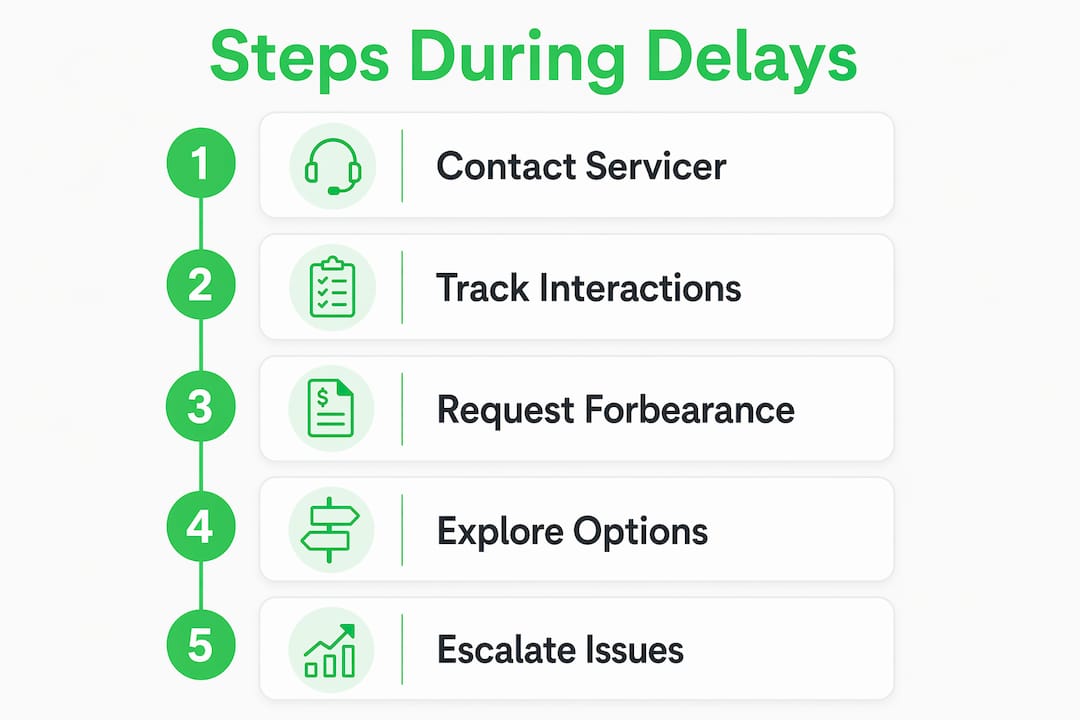
Follow these steps in order:
Log into your loan servicer portal weekly. Check for status updates, document requests, or changes to your payment due date. Servicers like Mohela, Aidvantage, and Nelnet each have online portals where application status is updated. Do not rely on email notifications alone.
Disable autopay temporarily. Billing and credit reporting can lag behind processing decisions, which means autopay could withdraw the wrong amount. Pause it until you receive written confirmation of your new payment amount.
Call your servicer and request forbearance or deferment. If you cannot afford your current billed amount while waiting, ask your servicer about a temporary forbearance. This pauses your payment obligation and protects you from delinquency. Get the approval in writing or note the representative’s name, the date, and the confirmation number.
Keep paying your billed amount unless you receive written guidance otherwise. This is the safest default position. Best practice during high backlog periods is to keep up payments until written servicer guidance changes your obligation. Stopping payments without authorization is how borrowers accidentally enter delinquency.
Document every interaction. Write down dates, representative names, call reference numbers, and what was discussed. Save copies of every email and portal message. This documentation becomes critical if you need to escalate later.
Pro Tip: Create a simple spreadsheet with columns for date, contact method, representative name, and outcome. If you ever need to file a formal complaint, this log is your strongest evidence.
You can also explore your repayment plan options to understand whether switching plans while your application is pending might reduce your immediate payment burden.
How do you escalate a delay that is not moving forward?
If weeks pass with no update and your servicer cannot give you a clear timeline, it is time to escalate. Effective escalation requires precise documentation, appropriate complaint categorization, and persistence. Generic complaints get generic responses.
Here is how to escalate effectively:
Federal Student Aid Feedback Center: Submit a formal complaint at studentaid.gov. The FSA Feedback Center allows formal complaints with case number tracking, but your complaint must include specific facts: your loan servicer’s name, the date you submitted your application, the dates you contacted your servicer, and the resolution you are requesting. Vague complaints rarely produce results.
FSA Ombudsman Group: The Student Loan Ombudsman is a federal resource designed for borrowers who cannot resolve issues through normal servicer channels. Contact them through studentaid.gov/feedback-center or by phone. They can intervene directly with servicers on your behalf.
Consumer Financial Protection Bureau (CFPB): If your servicer is engaging in misconduct, such as misapplying payments or providing false information, file a complaint at consumerfinance.gov/complaint. The CFPB routes complaints to servicers and requires a response within 15 days.
State attorney general or legal aid: If federal channels fail and you are facing imminent default, your state attorney general’s office or a nonprofit legal aid organization may be able to assist. This is a last resort but a real one.
Pro Tip: Always reference your case number in every follow-up communication. Servicers and federal agencies track complaints by case number, and referencing it signals that you are organized and persistent, which tends to accelerate responses.
For guidance on disputing loan servicing errors, Titanprep has detailed resources on documentation and complaint submission best practices.
What financial risks come with processing delays?
Processing delays create real financial exposure if you do not manage them actively. The risks go beyond inconvenience.
Delinquency: Missing even one payment can trigger a delinquency record on your credit report. USA.gov advises contacting your loan servicer first when payment problems arise, because failing to pay can cause delinquency and default.
Default: Federal student loans enter default after a specific period of nonpayment. The default threshold is less than 271 days past due, meaning you have a window to act before the most severe consequences kick in. Default triggers wage garnishment, tax refund offset, and loss of eligibility for future federal aid.
Credit damage: Even pre-default delinquency appears on your credit report and can lower your score significantly. Servicers report missed payments to credit bureaus, and that record can follow you for years.
Loss of program eligibility: Entering default while waiting for IDR or PSLF approval can disqualify you from those programs entirely, forcing you to rehabilitate or consolidate your loans before reapplying.
If you find yourself approaching delinquency while waiting on a delayed application, shift your focus immediately from forgiveness processing to collections protection. Transitioning from delay management to delinquency protection requires knowing DOE time thresholds and requesting relief right away rather than waiting for your application to resolve.
Temporary relief options like forbearance, deferment, and loan consolidation can all be applied while your application is pending. They are not perfect solutions, but they protect you from the worst outcomes while the system catches up.
Comparing your options during a processing delay
Not every relief option works the same way. Here is a structured comparison to help you decide which path fits your situation:
Option | Effect on payments | Interest accrual | Credit impact | Can apply while pending? |
Forbearance | Pauses payments | Yes, interest accrues | No negative impact if approved | Yes |
Deferment | Pauses payments | Depends on loan type | No negative impact if approved | Yes |
Income-Driven Repayment | Lowers payments based on income | Yes, may capitalize | Positive if payments made | Application in progress |
Loan consolidation | Resets repayment terms | Yes, may increase total | Neutral to slightly negative | Yes, but restarts PSLF count |
Loan rehabilitation | Removes default status | Yes, accrues during process | Positive after completion | Only if already in default |
Forbearance is the fastest option to request and the most commonly granted during processing delays. IDR plans like SAVE, PAYE, and IBR offer the most long-term payment relief, but they require the application to be processed first. You can learn more about income-driven repayment options to understand which plan fits your income and loan type before your application resolves.
Key takeaways
Protecting yourself during student loan processing delays requires paying your billed amount, requesting forbearance if needed, documenting every servicer interaction, and escalating through the FSA Feedback Center or CFPB if no progress occurs within several weeks.
Point | Details |
Delays do not pause payments | Keep paying your billed amount until you receive written confirmation of a change. |
IDR backlog is system-wide | Over 576,000 applications were pending as of February 2026, so delays are not your fault. |
Forbearance protects you | Request it immediately if you cannot afford current payments while your application is pending. |
Document everything | Log every call, email, and portal update with dates and reference numbers for escalation. |
Escalate with specifics | FSA Feedback Center and CFPB complaints require precise facts to produce results. |
What I have learned from helping borrowers through delays
Working with borrowers stuck in processing backlogs, I have seen the same mistake repeated more than any other: waiting. Borrowers assume that because they submitted their application, they are protected. They are not. The federal system does not automatically pause your billing cycle because your IDR or PSLF application is in queue. That assumption has cost people real money and real credit score points.
The second most common mistake is giving up on escalation too early. A single complaint to your servicer that goes unanswered feels like a dead end. It is not. The FSA Feedback Center, the Ombudsman Group, and the CFPB are genuinely effective when you approach them with specific documentation and a clear resolution request. I have seen servicers respond within days once a formal complaint with a case number is in the system.
The backlog is improving. The drop from nearly 2 million pending applications in April 2025 to around 576,000 in February 2026 is meaningful progress. But “improving” does not mean “resolved,” and it certainly does not mean you should wait passively. The borrowers who come through delays without credit damage or financial setbacks are the ones who stayed organized, kept paying, and pushed back through official channels when needed. That approach is available to you right now.
— Ellis
How Titanprep helps borrowers manage processing delays
Titanprep specializes in helping borrowers stay organized and on track when federal student loan applications stall. From preparing and submitting IDR and PSLF paperwork to tracking deadlines and maintaining records of servicer communications, Titanprep’s document preparation services are built for exactly the kind of situation you are in right now. The client portal lets you upload documents, monitor your file status, and keep everything in one place so nothing falls through the cracks. For the latest updates on federal student loan programs and what they mean for your application, visit Titanprep’s student loan updates page. If you are dealing with a specific servicer complaint, Titanprep also offers targeted servicer complaint support to help you escalate effectively.
FAQ
What should I do first if my student loan application is delayed?
Contact your loan servicer immediately to check your application status and request a forbearance if you cannot afford your current payment. Keep paying your billed amount until you receive written confirmation of any change.
How long does student loan processing typically take in 2026?
IDR applications currently take 4 to 12 weeks, while PSLF certifications can take 6 to 16 weeks or longer. PSLF Buyback requests face a separate backlog and may take 24 weeks or more.
Will a processing delay hurt my credit score?
A delay itself does not hurt your credit, but missing payments while waiting will. Request forbearance from your servicer to pause payments legally and avoid any negative credit reporting during the wait.
Where do I file a formal complaint about a student loan delay?
Submit a detailed complaint to the FSA Feedback Center at studentaid.gov, including specific dates, payment amounts, and your requested resolution. You can also file with the CFPB at consumerfinance.gov/complaint for servicer misconduct.
Can I switch repayment plans while my IDR application is pending?
Yes. You can request forbearance or deferment while your application is in process. Loan consolidation is also available, though it may reset your PSLF payment count, so weigh that carefully before proceeding.
Recommended
Comments