
How to Qualify for PSLF: 2026 Eligibility Guide


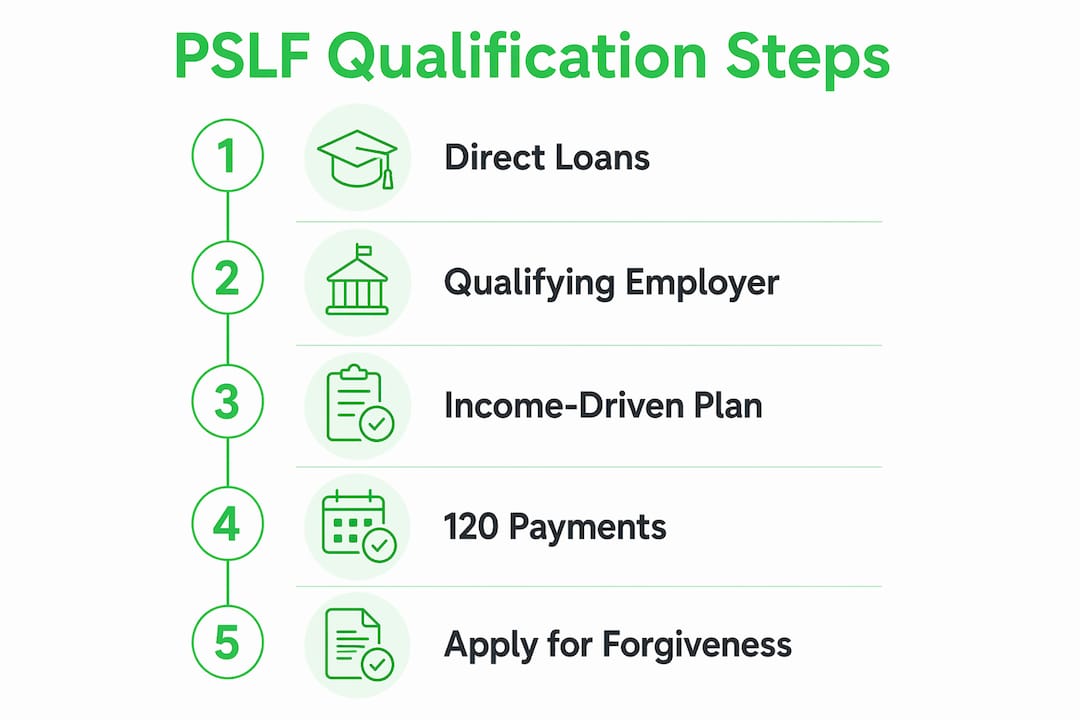
Public Service Loan Forgiveness (PSLF) is defined as a federal program that cancels your remaining federal student loan balance after you make 120 qualifying payments while working full-time for an eligible public service employer. To qualify for PSLF, you must meet four specific criteria: hold federal Direct Loans, work full-time for a qualifying employer, repay under a qualifying plan, and make 120 on-time payments. This guide walks you through each requirement, the 2026 rule updates that affect eligibility, and the exact steps to apply and stay on track.
What loans and repayment plans qualify for PSLF?
Only federal Direct Loans are eligible for PSLF. These include Direct Subsidized Loans, Direct Unsubsidized Loans, Direct PLUS Loans, and Direct Consolidation Loans. If you have older Federal Family Education Loans (FFEL) or Perkins Loans, you must consolidate into a Direct Loan to become eligible. The catch is that consolidation resets your payment count to zero, so timing matters enormously. Consolidating early in your career preserves the most progress toward forgiveness.
Your repayment plan also determines whether your payments count. The table below compares your main options:
Repayment Plan | Qualifies for PSLF? | Strategic Value |
Income-Based Repayment (IBR) | Yes | Lowers monthly payment; maximizes forgiven balance |
Pay As You Earn (PAYE) | Yes | Caps payments at 10% of discretionary income |
Income-Contingent Repayment (ICR) | Yes | Useful if IBR or PAYE are unavailable |
REPAYE / RAP | Yes | New plan replacing REPAYE starting 2026 |
Standard 10-Year Plan | Yes | Qualifies, but rarely leaves a balance to forgive |
Income-driven repayment plans such as IBR, PAYE, ICR, and RAP minimize your monthly payment and maximize the amount forgiven after 120 payments. The Standard 10-Year Plan technically qualifies, but most borrowers who follow it will have paid off their loan in full by payment 120, leaving nothing to forgive. Experts recommend avoiding the Standard Plan for PSLF unless your loan balance is very small relative to your income.
Starting July 2026, the Saving on a Valuable Education (SAVE) plan has faced legal challenges that may affect its availability. Check studentaid.gov for the most current repayment plan options before enrolling.
Pro Tip: If you have a mix of Direct and non-Direct Loans, consolidate the non-Direct Loans into a single Direct Consolidation Loan as early as possible. Waiting until year eight of your career to consolidate means losing eight years of qualifying payment credit.
Which employers and employment conditions meet PSLF eligibility?
Your employer is the second major factor in PSLF eligibility requirements. The following employer types qualify:
U.S. federal, state, local, or tribal government agencies at any level
501©(3) nonprofit organizations, regardless of the services they provide
Other nonprofits that provide qualifying public services such as public health, public safety, early childhood education, or public interest law
AmeriCorps and Peace Corps positions
For-profit companies, labor unions, and partisan political organizations do not qualify, regardless of the work you perform. A nurse employed by a private hospital does not qualify. The same nurse employed by a government-owned hospital does qualify. The distinction is the employer’s status, not your job title or duties.
Full-time employment is defined as at least 30 hours per week or your employer’s own definition of full-time, whichever is greater. If you work part-time at two qualifying employers, you can combine your hours across both to meet the 30-hour threshold. Both employers must independently qualify for PSLF credit to count.
A significant change takes effect July 1, 2026: employers engaged in activities with a substantial illegal purpose will be excluded from qualifying. This rule is aimed at organizations whose primary activities conflict with federal law. If your employer’s status is uncertain, verify it using the PSLF Help Tool at studentaid.gov before assuming your payments count.
Pro Tip: Do not assume your employer qualifies just because it is a nonprofit. Use the official PSLF Help Tool to search your employer’s name and confirm its status. Employer eligibility can change, and discovering a disqualification after years of payments is a painful and avoidable outcome.
How to make and track the 120 qualifying monthly payments
Meeting the payment requirement is where many borrowers lose progress through avoidable errors. Follow these rules precisely:
Make payments in full and on time. Each payment must be for the full required amount and submitted no more than 15 days late. A payment that is 16 days late does not count toward your 120.
Be enrolled in a qualifying repayment plan at the time of payment. Payments made while on a non-qualifying plan, such as a graduated or extended repayment plan, do not count even if you later switch to an income-driven plan.
Be employed full-time at a qualifying employer at the time of payment. Your employment status is evaluated at the time each payment is made, not retroactively.
Avoid deferment and forbearance when possible. Payments made during most deferment or forbearance periods do not count. The exception is COVID-19 administrative forbearance, which was granted qualifying payment credit under a temporary policy.
Know that payments do not need to be consecutive. If you leave a qualifying employer for two years and then return, your earlier qualifying payments remain on your record. You simply pause progress rather than erase it.
Submit the Employment Certification Form annually. The U.S. Department of Education recommends annual certification to confirm your employer qualifies and to track your payment count. Waiting until payment 120 to certify for the first time creates serious risk of discovering problems too late.
Stay employed through the review period. After submitting your final forgiveness application, remain employed full-time at a qualifying employer throughout the review. Administrative forbearance is available during this waiting period so you are not penalized for payments made while your application is under review.
Partial payments, payments made during a grace period, and payments made under the wrong repayment plan are the three most common reasons borrowers discover their payment count is lower than expected. Checking your count annually through your loan servicer or studentaid.gov prevents this surprise.
Step-by-step guide to the PSLF application process
The PSLF application process involves two ongoing tasks: certifying your employment and eventually applying for forgiveness. Here is how to handle both:
Certifying your employment

The PSLF Help Tool at studentaid.gov is your primary resource. Use it to search for your employer, generate the Employment Certification Form, and submit it electronically. Your employer’s authorized official, typically someone in human resources or your direct supervisor, must sign the form. You can submit it online through the Help Tool, by mail to your loan servicer, or through your employer’s HR portal if one exists.
Your loan servicer, currently MOHELA for most PSLF borrowers, processes the certification and updates your qualifying payment count. After each certification, review your count carefully. If the number does not match your records, contact MOHELA directly and document every communication.
Applying for forgiveness
Once you reach 120 qualifying payments, submit the PSLF application through studentaid.gov. You must still be employed full-time at a qualifying employer when you apply. The review period typically takes several months. During this time, you can request administrative forbearance so you are not required to make additional payments while waiting.
If your servicer refuses to certify payments you believe qualify, or if you receive an unexpected denial, you can file a complaint with the Federal Student Aid Ombudsman Group or contact your congressional representative’s office for assistance. Escalation is sometimes necessary and is entirely appropriate.
Pro Tip: Keep a personal spreadsheet logging every payment date, amount, and your employment status at the time. Your servicer’s records and your own records should match. If they do not, your documentation is what protects you.
Key takeaways
Qualifying for PSLF requires Direct Loans, a qualifying employer, an income-driven repayment plan, and 120 on-time payments made while employed full-time at an eligible organization.
Point | Details |
Loan type matters | Only federal Direct Loans qualify; consolidate FFEL or Perkins Loans early to avoid losing payment credit. |
Employer status is decisive | Government agencies and 501©(3) nonprofits qualify; verify your employer annually using the PSLF Help Tool. |
Choose IDR plans | Income-driven repayment plans maximize your forgiven balance compared to the Standard 10-Year Plan. |
Certify employment every year | Annual Employment Certification Form submission confirms progress and catches errors before they compound. |
Stay employed through review | Maintain qualifying employment during the application review period to avoid disqualification at the finish line. |
What I have learned after watching borrowers navigate PSLF
After working with public service borrowers for years, the single most consistent mistake I see is waiting too long to certify employment. Borrowers assume their payments are counting, submit their first certification at payment 80, and discover that 20 of those payments were made under the wrong repayment plan or while their employer had a gap in qualifying status. That is a painful and expensive discovery.
The second pattern I see is borrowers consolidating loans at the wrong time. Consolidating FFEL Loans into a Direct Consolidation Loan is necessary for eligibility, but doing it after accumulating years of qualifying payments under a Direct Loan resets everything. If you have a mix of loan types, consolidate before you start counting payments, not after.
The 2026 employer exclusion rule for organizations with a substantial illegal purpose is worth watching closely. Most public service workers will not be affected, but if your nonprofit operates in a legally contested space, verify your employer’s status now rather than after another year of payments.
My honest advice: treat PSLF like a compliance program, not a passive benefit. Check your payment count every year. Certify your employment every year. Keep your own records. The program works, but it rewards borrowers who stay organized and engaged throughout the entire ten-year process.
— Ellis
How Titanprep can help you stay on track for PSLF
Staying organized across ten years of payments, employer certifications, and servicer communications is where many borrowers lose ground. Titanprep is a document preparation and support service that helps you organize and submit the paperwork connected to federal student loan programs, including PSLF. Through the Titanprep client portal, you can upload documents, track submission deadlines, and maintain records of your communications with your loan servicer. Titanprep also helps you prepare Employment Certification Forms and monitors important filing dates so nothing falls through the cracks. For a clear starting point, explore the top federal forgiveness programs and see where PSLF fits your situation. You can also stay current with the latest student loan updates as 2026 rules continue to evolve.
FAQ
What loans are eligible for PSLF?
Only federal Direct Loans qualify for PSLF, including Direct Subsidized, Unsubsidized, PLUS, and Consolidation Loans. FFEL and Perkins Loans must be consolidated into a Direct Consolidation Loan first, which resets your qualifying payment count to zero.
Who qualifies as a PSLF employer?
Qualifying employers include U.S. federal, state, local, and tribal government agencies, and 501©(3) nonprofit organizations. For-profit companies, labor unions, and partisan political organizations do not qualify, and starting July 1, 2026, organizations with a substantial illegal purpose are also excluded.
Do PSLF payments need to be consecutive?
No. Qualifying payments do not need to be made consecutively. If you leave a qualifying employer and later return, your previous qualifying payments remain on your record and you simply resume accumulating progress.
How do I track my qualifying payment count?
Submit the Employment Certification Form annually through the PSLF Help Tool at studentaid.gov. Your loan servicer, currently MOHELA for most PSLF borrowers, will update your qualifying payment count after each certification.
Can I qualify for PSLF working part-time?
You can qualify if you work part-time at two or more qualifying employers and your combined hours total at least 30 per week. Each employer must independently meet PSLF eligibility requirements for those hours to count.
Recommended
Comments