
New Student Loan Laws 2026: What Borrowers Must Know


The new student loan laws 2026 defines a fundamental shift in how federal borrowers borrow and repay, effective July 1, 2026. Under the One Big Beautiful Bill Act, repayment choices narrow to two plans, Graduate PLUS loans disappear, and Parent PLUS borrowing faces strict annual and lifetime caps. Whether you are a current borrower managing existing debt or a prospective student planning your first loan, these changes affect your financial path directly. This article breaks down every major change, explains who is affected and how, and gives you clear next steps to stay on track.
What are the new repayment options under the 2026 laws?
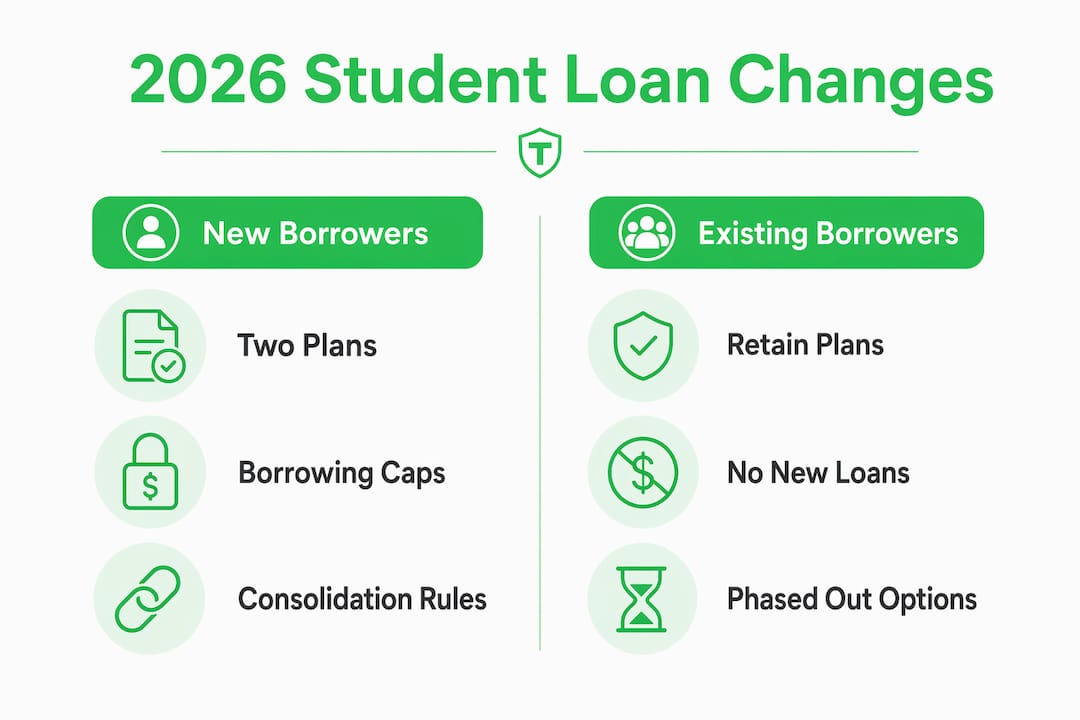
Starting July 1, 2026, repayment for new federal loans is limited to exactly two plans: the Tiered Standard Repayment Plan and the Repayment Assistance Plan (RAP). This is not a minor update. It replaces a system that previously offered more than a dozen repayment paths with a much narrower set of choices.
Tiered Standard Repayment Plan
The Tiered Standard plan works like a traditional fixed repayment schedule, with loan terms ranging from 10 to 25 years depending on your total debt. Payments are fixed and predictable, which makes budgeting straightforward. The repayment term scales with your balance, so borrowers with higher debt loads get longer windows to repay. This plan suits borrowers with stable incomes who want to pay off their loans on a defined schedule without worrying about annual income recertification.

Repayment Assistance Plan (RAP)
The RAP is the income-driven option under the new rules. It calculates your monthly payment as a percentage of your income, and it is specifically designed to prevent negative amortization, meaning your balance will not grow because your payments are too small to cover interest. That is a meaningful protection that older income-driven plans did not always guarantee. The tradeoff is that forgiveness under RAP comes after 30 years of qualifying payments, not the 10 or 20 years that some legacy plans offered.
What happens to legacy income-driven plans?
Legacy plans including ICR, PAYE, and SAVE are phased out for new borrowers starting July 1, 2026. If you already have federal loans and do not take out any new loans or consolidate after that date, you may retain access to your current repayment plan. The moment you borrow again or consolidate, the new rules apply to all of your federal loans. This distinction matters enormously, and we cover it in detail in the section on existing borrowers below.
Pro Tip: If you are currently enrolled in SAVE, PAYE, or ICR and plan to return to school, talk to your loan servicer before July 1 to understand exactly how additional borrowing will affect your current plan enrollment. You can also review repayment plan options to compare your current plan against RAP before making any decisions.
How have student loan borrowing limits changed in 2026?
The 2026 law changes do not just reshape repayment. They also set hard caps on how much graduate, professional, and parent borrowers can take out in federal loans. These limits represent a significant reduction in available federal financing for many borrowers.
New limits for graduate and professional students
Graduate PLUS loans are eliminated entirely for new borrowers starting July 1, 2026. In their place, the law establishes new annual and aggregate borrowing limits through standard Unsubsidized Loans. The specific caps vary by program type, with professional degree students in fields like medicine and law receiving higher limits than general graduate students. This matters because Graduate PLUS loans previously had no annual cap beyond the cost of attendance. The new fixed limits may leave some graduate students with a gap between their federal aid and their actual school costs.
Parent PLUS loan caps
Parent PLUS loans are now capped at $20,000 per year with a $65,000 lifetime limit, effective July 1, 2026. For families at expensive private universities, this cap creates a real financing gap that previously did not exist. Parent PLUS loans once covered the full cost of attendance minus other aid. Now families must plan for the difference through other means, including private loans, savings, or institutional aid.
The table below summarizes the key borrowing changes:
Borrower type | Key change |
Graduate students | Graduate PLUS eliminated; new annual unsubsidized caps apply |
Professional students (law, medicine) | Higher unsubsidized caps than general graduate students |
Parent PLUS borrowers | Capped at $20,000/year and $65,000 lifetime |
Undergraduate students | No major changes to borrowing limits |
Pro Tip: If you are a parent planning to borrow for a child starting college in fall 2026 or later, calculate your total expected borrowing need now. If it exceeds $65,000, you will need a plan for the remaining balance before enrollment begins.
How do the 2026 changes affect borrowers with existing loans?
If you already have federal student loans, the July 1, 2026 cutoff creates two distinct borrower groups with very different sets of rules. Understanding which group you fall into is the most important thing you can do right now.
Here is how the rules apply depending on your situation:
You have existing loans and take no new action. You keep access to your current repayment plan, including legacy income-driven options like ICR or PAYE, as long as you do not borrow again or consolidate after July 1, 2026.
You take out a new federal loan after July 1, 2026. All of your federal loans must then be repaid under only the two new plans. This applies even to loans you took out years ago. The new borrowing triggers a full transition.
You consolidate your loans after July 1, 2026. Consolidation counts as new borrowing under the 2026 rules. This means consolidating after the cutoff removes your access to legacy repayment plans and limits you to Tiered Standard or RAP. Think carefully before consolidating if you are currently enrolled in a plan you want to keep.
You are pursuing Public Service Loan Forgiveness (PSLF). The 2026 regulations affect PSLF eligibility in ways tied to which repayment plan you are on. If you consolidate or take new loans, your qualifying payment count and plan eligibility may change. Review your PSLF progress with your servicer before making any moves. You can also read the latest forgiveness program guidance to understand how the 2026 rules interact with PSLF.
You have a default history. Borrowers who previously rehabilitated their loans and thought that option was exhausted should know that a new rehabilitation opportunity exists under the 2026 rules. This is one of the less publicized provisions of the law and could open a path back to good standing for borrowers who assumed they had no options left.
What practical steps should borrowers take now?
The July 1, 2026 effective date is not a distant deadline. If you have federal loans or plan to borrow, the decisions you make in the coming weeks and months will shape your repayment for years. Here is what to do:
Review your current repayment plan and loan history. Log into StudentAid.gov and confirm which plan you are on, what your current balance is, and whether you have any loans in deferment, forbearance, or default. Knowing your starting point is non-negotiable before making any decisions.
Decide whether to consolidate before or after July 1. If consolidation makes sense for your situation, doing it before July 1 preserves your access to legacy repayment plans. Doing it after locks you into the new two-plan system. There is no universal right answer, but the timing has permanent consequences. Review your repayment timeline to see how consolidation timing affects your payoff schedule.
Evaluate your borrowing needs carefully if you are returning to school. The elimination of Graduate PLUS loans and the new Parent PLUS caps mean federal aid may not cover your full cost of attendance. Build a realistic budget before you enroll, not after.
Contact your loan servicer directly. Your servicer can confirm your current plan eligibility, walk you through the RAP versus Tiered Standard comparison for your specific balance and income, and flag any issues with your account before the transition date.
Do not wait for automatic assignment. If you take a new loan after July 1 and do not actively choose a repayment plan, your servicer will assign one for you. That assigned plan may not be the best fit for your income or goals. Active selection is always better than default assignment.
Key takeaways
The July 1, 2026 student loan law changes split all federal borrowers into two groups, and the repayment plan you qualify for depends entirely on whether you borrow or consolidate after that date.
Point | Details |
Two plans only | New borrowers after July 1, 2026 choose between Tiered Standard and RAP only. |
Legacy plan access | Existing borrowers keep legacy plans only if they do not borrow or consolidate after July 1. |
Parent PLUS caps | Parent PLUS loans are now capped at $20,000/year and $65,000 lifetime. |
Consolidation risk | Consolidating after July 1 counts as new borrowing and removes legacy plan access. |
Rehabilitation opportunity | Borrowers with prior default history may qualify to rehabilitate loans again under 2026 rules. |
Why timing is the most underestimated factor in 2026 loan planning
I have spent years watching borrowers make loan decisions based on what sounds right rather than what the rules actually say. The 2026 changes make that habit more costly than ever.
The detail that concerns me most is how quietly the consolidation trigger works. Most borrowers think of consolidation as a neutral administrative step. Under the new rules, it is a one-way door. The moment you consolidate after July 1, you lose access to every legacy repayment plan you were enrolled in. I have seen borrowers consolidate to simplify their accounts and accidentally reset their PSLF qualifying payment count to zero. That same risk now carries an additional layer: you also lose your repayment plan options permanently.
The RAP is a genuinely better design than SAVE in one important way. It prevents negative amortization, which means your balance cannot spiral upward while you make income-driven payments. That was a real problem with some legacy plans. But the 30-year forgiveness timeline under RAP is significantly longer than what some borrowers were counting on under PAYE or SAVE. If you were five years into a 20-year forgiveness clock, switching to RAP effectively resets your timeline. That is not a reason to avoid RAP. It is a reason to understand exactly where you stand before July 1.
The rehabilitation provision for borrowers with prior defaults is the most overlooked part of this law. Many borrowers in default assume they have exhausted every option. The 2026 rules create a second chance at rehabilitation that most people do not know exists. If you or someone you know has a default history, this is worth investigating immediately.
— Ellis
How TitanPrep helps you stay organized through the 2026 changes
The 2026 federal student loan law changes involve real deadlines, plan eligibility decisions, and paperwork that can easily fall through the cracks. TitanPrep is a document preparation and support service that helps borrowers organize, submit, and track applications for programs like Income-Driven Repayment, Public Service Loan Forgiveness, and borrower discharge options. The TitanPrep client portal lets you upload documents, monitor your file status, and stay on top of submission deadlines. For a full overview of what has changed and what it means for your loans, visit the student loan updates page. TitanPrep is not affiliated with the U.S. Department of Education, and eligibility for any federal program is determined solely by your loan servicer or the Department.
FAQ
What are the two new repayment plans for 2026?
The two plans are the Tiered Standard Repayment Plan and the Repayment Assistance Plan (RAP). All new federal borrowers after July 1, 2026 must use one of these two options.
Does the July 1, 2026 cutoff affect existing borrowers?
Existing borrowers keep access to their current repayment plans as long as they do not take out new federal loans or consolidate after July 1, 2026. Any new borrowing or consolidation after that date applies the new two-plan rules to all of their federal loans.
What is the new Parent PLUS loan limit in 2026?
Parent PLUS loans are capped at $20,000 per year with a $65,000 lifetime limit starting July 1, 2026. Families who need more than $65,000 in total Parent PLUS borrowing will need to find alternative financing for the difference.
Does consolidation after July 1, 2026 count as new borrowing?
Yes. Consolidating federal loans on or after July 1, 2026 is treated as new borrowing under the updated rules. This removes access to legacy income-driven repayment plans and limits repayment to Tiered Standard or RAP.
Can borrowers in default rehabilitate their loans under the 2026 rules?
Yes. The 2026 law includes a provision allowing borrowers who previously rehabilitated their loans to do so again. This is a new opportunity for borrowers who assumed rehabilitation was no longer available to them.
Recommended
Comments