
Why Student Loan Errors Occur and How to Fix Them
- TitanPrep Official

- Jul 21
- 7 min read

Student loan errors are defined as inaccuracies in your loan account caused by servicer recordkeeping failures, inadequate federal oversight, and complex repayment transitions. These mistakes affect billing amounts, repayment plan assignments, and credit reports, often without borrowers realizing it. Understanding why student loan errors occur is the first step toward protecting yourself. The problem has grown sharper since february 2025, when the Office of Federal Student Aid suspended key accuracy reviews, shifting the burden of error detection directly onto borrowers.
Why student loan errors occur: the federal oversight gap
The single biggest driver of loan account mistakes today is the collapse of federal monitoring. The Office of Federal Student Aid stopped quarterly accuracy reviews for student loan servicers in february 2025, citing staffing shortages. Without those audits, errors that would previously have triggered penalties now go undetected.
The staffing situation is severe. The FSA workforce dropped 46%, falling from 1,433 employees to 777 between january and december 2025. Fewer staff means fewer people reviewing whether servicers are doing their jobs correctly. That gap creates direct risk for every borrower.
The consequences of halted oversight were visible even before the suspension. Before the reviews stopped, four out of five servicers failed to meet accuracy standards, generating roughly $850,000 in financial penalties. Two servicers had recordkeeping problems serious enough to trigger the maximum allowed penalty. That record shows servicer errors were already widespread when oversight was active.
The Government Accountability Office has flagged the oversight gap as a serious risk to borrowers. Without ongoing financial penalties, servicers face reduced accountability, which increases the likelihood of recurring mistakes. Borrower satisfaction surveys cannot replace accuracy audits, because borrowers often cannot tell when they have received wrong information.
Key oversight failures driving the current environment:
Quarterly accuracy reviews suspended since february 2025
Call quality monitoring halted alongside accuracy checks
FSA headcount reduced by nearly half in under 12 months
Financial penalty mechanisms effectively paused
GAO findings on oversight gaps not yet addressed
What are the most common types of student loan errors?
Servicer errors fall into predictable categories. Understanding the specific types helps you spot problems faster in your own account.
Billing and payment errors are the most frequent. One servicer failed to send timely billing statements to 2.5 million borrowers. That scale of failure is not a glitch. It reflects a systemic process breakdown that affects real payment histories and account balances.
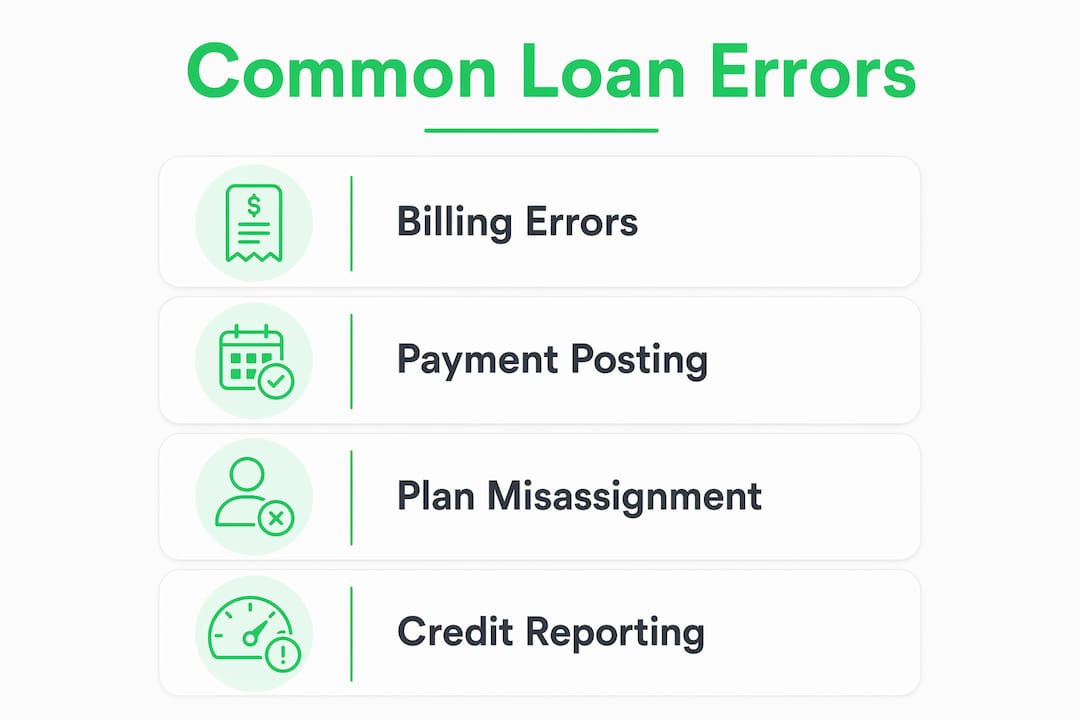
Repayment plan misassignment is another major cause of student loan discrepancies. Borrowers who miss a 90-day window during a repayment plan transition risk automatic enrollment in a standard plan, which often carries higher monthly payments. Many borrowers do not realize this has happened until they see a larger bill. Understanding servicer responsibilities in plan transitions helps you know what to expect and when to push back.
Payment processing delays cause a separate set of problems. When payments are delayed or misapplied, your account may show a missed payment even when you paid on time. The Consumer Financial Protection Bureau found that servicers engaged in deceptive billing practices, incorrect due dates, and unauthorized account debits. These failures directly affect income-driven repayment applications and accounts with multiple loans.
Common error types to watch for:
Inaccurate billing statements or wrong due dates
Payments applied to the wrong loan or period
Incorrect repayment plan assignment after a transition
Delays in processing income-driven repayment applications
Unauthorized account debits or incorrect payment amounts
Pro Tip: After every payment, log into your servicer account and confirm the payment was applied correctly. Screenshot the confirmation page and save it with the date. This takes two minutes and creates a record that is hard to dispute.
Average call wait times with servicers rose above 70 minutes, with 50% of calls abandoned before reaching a representative. Long wait times mean errors go unreported and unresolved for months.
How do loan errors affect your credit and finances?
Loan errors do not stay inside your servicer account. They spread outward and create real financial damage.
Inaccurate servicer records can place you in the wrong repayment status, bill you incorrect amounts, or delay refunds you are owed. Call quality lapses increase the risk of wrong information being given to borrowers, often unnoticed until financial harm has already occurred. By the time you catch the mistake, you may have overpaid, missed a forgiveness credit, or accumulated unnecessary interest.
Credit reporting is a separate concern. If a servicer reports a missed or late payment that was actually their processing error, that inaccuracy appears on your credit report. Correcting it requires a formal dispute process with both the servicer and the credit bureaus. The process takes time and documentation, and the damage to your credit score can affect loan approvals, rental applications, and interest rates on other accounts.
One often-overlooked cause of apparent errors is interest capitalization. When a loan exits forbearance or deferment, unpaid interest capitalizes and adds to your principal balance. This can look like a servicer error when it is actually a standard loan mechanic. Understanding loan interest mechanics helps you tell the difference between a genuine mistake and a contractual feature of your loan.
Refinancing federal loans into private loans creates a different kind of permanent error. Borrowers who refinance permanently lose access to income-driven repayment plans and forgiveness programs. Many borrowers only realize this after their payment burden increases significantly. That is a mistake with no correction path.
How to identify, dispute, and fix student loan errors
Fixing a loan error requires a clear, documented process. Verbal complaints rarely produce results. Written records do.
Check your account on StudentAid.gov. Your federal loan data lives here, independent of your servicer. Compare the balance, payment history, and repayment plan shown on StudentAid.gov against what your servicer shows. Any gap between the two is worth investigating.
Document every communication. Write down the date, the representative’s name, and a reference number for every call. Follow up every phone conversation with a written email or letter summarizing what was discussed. This creates a paper trail that protects you if the servicer later denies the conversation.
Dispute errors in writing. Send a formal written dispute to your servicer. State the specific error, include supporting documents, and request a written response. Keep a copy of everything you send. The burden of correcting errors now falls on borrowers, so your documentation is your only leverage.
Escalate to the CFPB or Department of Education. If your servicer does not resolve the issue, file a formal complaint with the Consumer Financial Protection Bureau or the Department of Education. A written complaint creates an official record and often prompts faster servicer action. Titanprep’s guide on disputing student loan debt walks through this escalation process in detail.
Monitor your credit reports. Pull your credit reports from Equifax, Experian, and TransUnion. If a loan error appears as a late or missed payment, dispute it directly with the credit bureau and include your servicer documentation as evidence.
Pro Tip: Set a calendar reminder every 90 days to log into StudentAid.gov and verify your repayment plan, balance, and payment count. Missing a 90-day deadline during a plan transition can cost you a more affordable repayment option.
If your payments feel too high and you suspect a plan error, reviewing your income-driven repayment options can clarify whether you are in the right plan for your income and family size.
Key Takeaways
Student loan errors occur primarily because of servicer recordkeeping failures and the suspension of federal oversight, making borrower documentation and proactive account monitoring the most effective defense available today.
Point | Details |
Federal oversight suspended | FSA halted quarterly accuracy reviews in february 2025, removing the main check on servicer errors. |
Servicers have a poor track record | Four out of five servicers failed accuracy standards before oversight stopped, generating $850,000 in penalties. |
Errors affect credit reports | Misapplied payments and wrong repayment statuses can appear on credit reports, causing score damage. |
Documentation is your defense | Keep written records of every communication, dispute, and payment confirmation to protect your account. |
Escalation works | Filing formal complaints with the CFPB or Department of Education creates an official record and prompts faster resolution. |
The burden has shifted, and borrowers need to know it
I have spent years watching borrowers assume their servicer is managing their account correctly. That assumption was always risky. Now it is genuinely dangerous.
The suspension of accuracy reviews did not just reduce oversight. It removed the financial consequence for getting things wrong. Servicers that previously faced penalties for recordkeeping failures now operate in an environment where those penalties are effectively paused. The incentive structure has changed, and borrowers are the ones absorbing the risk.
What I have found is that servicer mistakes are rarely isolated. They tend to be systemic. One processing failure affects thousands of accounts at once. That means if you are experiencing an error, there is a good chance other borrowers in the same situation are too. That pattern matters because it tells you the error is not your fault and is unlikely to self-correct.
The most important mindset shift is this: treat your loan account like a financial account you manage yourself, not one that is managed for you. Verify balances independently on StudentAid.gov. Do not rely solely on what your servicer tells you on a phone call. Keep every document. The borrowers who come through this period without lasting damage are the ones who treated their own records as the source of truth.
— Ellis
Titanprep can help you stay on top of loan changes
Staying organized with your student loans has never been more important, and Titanprep is built to help you do exactly that. Titanprep assists borrowers with preparing and submitting paperwork for federal programs like Income-Driven Repayment and Public Service Loan Forgiveness, tracks deadlines, and stores records of your submissions and communications. If you are trying to make sense of recent changes to your account or repayment plan, the latest student loan updates page covers what borrowers need to know right now. Titanprep does not guarantee outcomes. Eligibility for any federal program is determined by the U.S. Department of Education or your loan servicer.
FAQ
Why do student loan errors occur so frequently?
Student loan errors occur because servicers have poor recordkeeping practices and federal oversight has been suspended since february 2025. Without accuracy audits and financial penalties, mistakes go unchecked and unresolved.
How do I know if my loan account has an error?
Compare your balance and repayment plan on StudentAid.gov against what your servicer shows. Any discrepancy between the two is a sign of a potential error worth investigating.
Can a student loan error hurt my credit score?
Yes. If a servicer incorrectly reports a missed or late payment, it appears on your credit report and can lower your score. You must dispute the error with both the servicer and the credit bureau to correct it.
What should I do if my servicer won’t fix an error?
File a formal written complaint with the Consumer Financial Protection Bureau or the Department of Education. A written complaint creates an official record and typically prompts faster action from the servicer.
Does interest capitalization count as a loan error?
No. When a loan exits forbearance or deferment, unpaid interest capitalizes and adds to your principal balance. This is a standard loan mechanic, not a servicer mistake, though it can look like one if you are not expecting it.
Recommended
Comments