
Why Repayment Plans Differ: A 2026 Borrower's Guide


Student loan repayment plans differ because they are designed to match the wide range of borrower incomes, debt levels, and financial goals while also keeping the federal loan program financially sustainable. The U.S. Department of Education built this variation into the system intentionally. A teacher earning $38,000 a year needs a very different payment structure than an engineer earning $120,000. Starting july 1, 2026, the federal system simplifies to two main plans, the Repayment Assistance Plan (RAP) and the Tiered Standard Plan, making it more important than ever to understand what drives these differences.
Why repayment plans differ: the core reason
Repayment plans exist on a spectrum between two competing goals. The first goal is keeping monthly payments affordable for borrowers with low or unpredictable incomes. The second goal is recovering the full cost of the loan for borrowers who can afford it. The Department of Education balances these two objectives by offering plans with different payment formulas, repayment terms, and eligibility rules.
This is not a flaw in the system. It is the point. A single fixed payment amount would be unaffordable for millions of borrowers and unnecessary for others. The variation in repayment options reflects the variation in borrower circumstances across the country.

What are the main types of student loan repayment plans?
Federal student loan repayment plans fall into two broad categories: fixed plans and income-driven plans. Fixed plans set your payment based on your loan balance and a set repayment term. Income-driven plans calculate your payment as a percentage of your income.
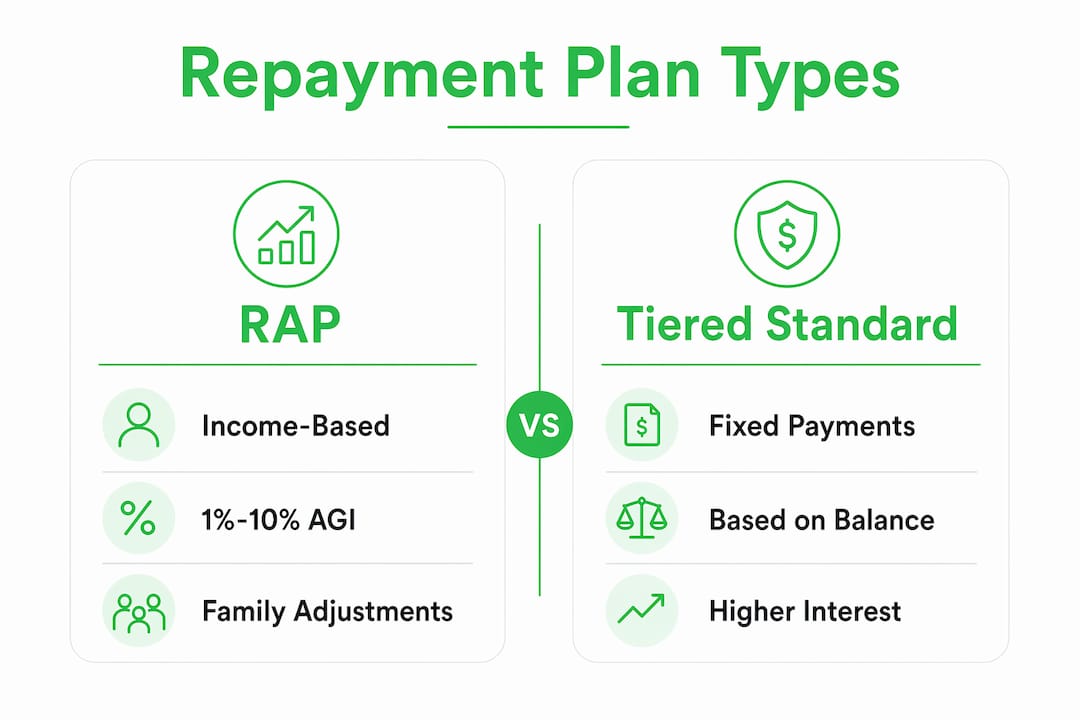
Starting july 1, 2026, new borrowers choose between two options. RAP charges 1%–10% of your adjusted gross income (AGI) with no poverty-line exclusion. The Tiered Standard Plan sets fixed payments over terms ranging from 10 to 25 years, depending on your total balance. Legacy plans, including Income-Based Repayment (IBR), Pay As You Earn (PAYE), and Income-Contingent Repayment (ICR), remain available to existing borrowers through july 1, 2028, as long as they do not take new loans or consolidate after july 1, 2026.
Feature | RAP | Tiered Standard Plan |
Payment basis | 1%–10% of AGI | Fixed amount by balance |
Repayment term | Up to 30 years | 10–25 years |
Dependent deduction | $50 per qualifying dependent | None |
Interest subsidy | 50% on unpaid interest (first 5 years) | None |
Best for | Low or variable income | Stable, higher income |
The structural difference between these two plan types is the single biggest reason understanding loan repayment variations matters. Choosing the wrong category can cost you thousands of dollars over the life of your loan.
What factors influence why repayment options vary for individual borrowers?
Your personal financial profile determines which plans you qualify for and which one actually makes sense for you. These are the key factors that shape your options:
Debt-to-income ratio. This is the primary driver of plan selection. Borrowers whose debt exceeds their annual income generally fit RAP better. Those with lower debt relative to their income benefit from the Tiered Standard Plan, which gets them out of debt faster and at lower total cost.
Loan type and origination date. Not all federal loans qualify for every plan. Loan type and origination date directly affect your eligibility, especially for legacy plans. Direct Loans qualify for more options than older FFEL loans.
Family size and dependents. Under RAP, each qualifying dependent reduces your monthly payment by $50. A borrower with three children pays $150 less per month than a single borrower at the same income level. Family size lowers repayment burden in a concrete, calculable way.
Career path and income trajectory. If you expect your income to grow significantly, starting on RAP and switching to a fixed plan later may make sense. If your income is already stable and high, the Tiered Standard Plan minimizes total interest paid.
Consolidation history. Consolidating loans after july 1, 2026, locks you out of legacy plans permanently. It also resets your forgiveness timeline, which can cost you years of qualifying payments toward programs like Public Service Loan Forgiveness (PSLF).
These factors do not operate in isolation. Your debt-to-income ratio, family size, and career stage interact to create a repayment picture that is unique to you. That is why there is no single correct answer when it comes to customizing repayment plans.
How do repayment plans affect total loan cost and payment flexibility?
The monthly payment you see is not the full story. The plan you choose determines how much interest accumulates over time, and that number can be dramatically larger than your original loan balance.
Lower monthly payments on income-driven plans typically result in higher total interest paid over the life of the loan. This is the most common misunderstanding borrowers have. Paying less each month feels like saving money. Over 20 or 30 years, it often means paying far more. Fixed plans cost more each month but minimize total interest because you pay down principal faster.
Here is how the trade-offs break down:
Fixed plans offer payment predictability and lower total cost, but require a stable income that can absorb the higher monthly amount.
RAP offers flexibility when income is low, but unpaid interest can accumulate. The 50% interest subsidy under RAP during the first five years prevents your balance from growing, which is a meaningful protection for new graduates.
Switching plans mid-repayment can trigger interest capitalization, where unpaid interest gets added to your principal. That increases the balance you owe interest on going forward.
Forgiveness timelines vary by plan. RAP offers forgiveness after 20 or 25 years depending on loan type. PSLF requires 10 years of qualifying payments regardless of plan, but only on qualifying income-driven plans.
Pro Tip: Use the Loan Simulator on the Federal Student Aid website to compare your total cost across plans before committing. Plug in your actual income and family size for an accurate projection.
Understanding these trade-offs is the foundation of finding your best repayment option. Monthly affordability and long-term cost are both real concerns. The right plan balances both for your specific situation.
How and why should you reassess your repayment plan over time?
Your repayment plan is not permanent. Switching plans is allowed, and for many borrowers it is the right move as income and life circumstances change. Here is a clear process for reviewing your plan:
Review your plan annually. Income recertification under RAP happens every year. If your income rises significantly, your RAP payment increases. At some point, the Tiered Standard Plan may become cheaper overall. Check your numbers each year.
Track major life events. Marriage, divorce, a new child, a job change, or a salary increase all affect the math. A new dependent reduces your RAP payment by $50 per month. A salary jump may make a fixed plan more attractive.
Calculate the capitalization impact before switching. Switching from an income-driven plan to a fixed plan can trigger capitalization of accrued interest. If you have $5,000 in unpaid interest, that amount gets added to your principal the moment you switch. Know this number before you make the move.
Check consolidation consequences. Consolidating loans resets your forgiveness clock and may eliminate legacy plan eligibility. Never consolidate without understanding the full impact on your repayment timeline.
Contact your loan servicer directly. Servicers can walk you through your current options and run payment estimates. Keep records of every call and submission.
Pro Tip: Set a calendar reminder each year, one month before your income recertification deadline. Late recertification can push you off an income-driven plan entirely and trigger a much higher payment.
Borrowers who reassess their repayment plan regularly consistently make better decisions than those who set a plan and forget it. The 2026 reforms make annual review even more critical because the rules governing legacy plans are actively changing.
Key Takeaways
No single repayment plan works for every borrower. The right choice depends on your income, debt level, family size, and long-term goals, and it should be revisited every year.
Point | Details |
Two plan categories | Fixed plans minimize total interest; income-driven plans lower monthly payments at higher long-term cost. |
2026 reform impact | New borrowers after july 1, 2026, choose between RAP and the Tiered Standard Plan only. |
Debt-to-income ratio | This is the primary factor in determining which plan fits your financial situation. |
Switching has costs | Changing from income-driven to fixed plans can capitalize unpaid interest and raise your principal. |
Annual review is required | Income changes, family size, and policy shifts all affect which plan is best for you each year. |
What I’ve learned from watching borrowers navigate plan changes
Borrowers consistently underestimate how much the choice of repayment plan shapes their financial life for decades. The 2026 simplification to two main plans is genuinely helpful. Fewer options reduce confusion. But simplification does not mean the decision is simple.
The most common mistake I see is treating the monthly payment as the only number that matters. A borrower who locks in a low RAP payment at age 24 and never revisits it at 34, when their salary has doubled, ends up paying far more in total interest than necessary. The plan that protected them early becomes expensive if they stay on it too long.
The 2026 reforms also create a real deadline pressure around legacy plans. Borrowers on IBR or PAYE who are close to forgiveness need to be especially careful about consolidation. One administrative move can reset years of qualifying payments. That is not a hypothetical risk. It happens regularly.
My honest advice: treat your repayment plan like a budget. Review it once a year, update it when your life changes, and do not assume your servicer will flag the best option for you. They process paperwork. You have to make the call.
— Ellis
How Titanprep can help you stay on top of repayment changes
The 2026 repayment overhaul brings real deadlines and real consequences for borrowers who miss them. Titanprep is a document preparation and support service that helps borrowers organize and submit paperwork for federal programs including income-driven repayment applications and PSLF. Titanprep is not affiliated with the U.S. Department of Education. Through its client portal, you can upload documents, track submission status, and store records of communications with your servicer. If you want to understand how the process works and get organized before key 2026 deadlines, Titanprep provides the structure to help you stay on track. You can also review the latest student loan updates affecting borrowers right now.
FAQ
Why do student loan repayment plans differ from borrower to borrower?
Repayment plans differ because they are designed to match different income levels, debt amounts, and financial goals. The U.S. Department of Education built variation into the system to balance affordability for low-income borrowers with full repayment for those who can manage it.
What are the two main repayment plans after july 1, 2026?
New federal borrowers after july 1, 2026, choose between the Repayment Assistance Plan (RAP), which bases payments on 1%–10% of AGI, and the Tiered Standard Plan, which sets fixed payments over 10–25 years based on loan balance.
Does family size affect my repayment plan payment?
Yes. Under RAP, each qualifying dependent reduces your monthly payment by $50. A borrower with two children pays $100 less per month than a borrower at the same income with no dependents.
Can switching repayment plans hurt me financially?
Switching from an income-driven plan to a fixed plan can trigger interest capitalization, adding unpaid interest to your principal balance immediately. Calculate the capitalization amount before making any switch.
What happens to legacy income-driven plans like IBR and PAYE?
Legacy plans remain available to existing borrowers through july 1, 2028, provided they do not take new loans or consolidate existing loans after july 1, 2026. After that date, legacy plans sunset completely.
Recommended
Comments