
Why Refinance Student Loans: A 2026 Borrower's Guide


Refinancing student loans means replacing one or more existing loans with a new private loan at a different interest rate and repayment term. Borrowers choose to refinance student loans primarily to reduce their interest rate, lower monthly payments, or simplify multiple loan balances into one. Federal undergraduate loan rates sit at 6.39%, while PLUS loans reach 8.94%. Private refinancing rates can drop as low as 3.67% for borrowers with excellent credit. That gap represents real money saved over time. The critical trade-off is permanent: refinancing federal loans into a private loan strips away every federal protection you currently hold.
Why refinance student loans: the core financial case

The primary reason borrowers refinance is to pay less interest over the life of the loan. Private refinancing rates can fall as low as 3.67%, with rates of 4%–5% common for borrowers with strong credit profiles. On a $50,000 balance, dropping from 6.39% to 4.5% saves thousands of dollars in total interest paid. That kind of reduction is the clearest argument for refinancing.
The advantages of refinancing student loans go beyond the interest rate alone. Here are the four most common financial and practical benefits:
Lower total interest cost. A meaningfully lower rate reduces what you pay over the full loan term, not just each month.
Simplified repayment. Consolidating several loans into one monthly payment removes the complexity of tracking multiple servicers and due dates.
Customizable repayment term. You can choose a shorter term to pay off debt faster or a longer term to reduce your monthly obligation, depending on your goals.
Cosigner release. Refinancing can release a cosigner from the original loan, but only if the borrower qualifies independently under strict income and credit standards.
Pro Tip: Administrative simplicity is a useful benefit, but it should never be the primary reason to refinance. Meaningful interest savings must accompany any consolidation decision.
What factors should you consider before refinancing?
Refinancing is not the right move for every borrower. The decision depends on your financial stability, credit profile, and whether you currently rely on or expect to need federal loan benefits.
Credit score and income. Lenders require excellent credit and stable, high income to approve refinancing at competitive rates. Borrowers with variable income, freelance work, or recent job changes face higher denial rates and less favorable terms.
Federal benefit eligibility. If you qualify for Public Service Loan Forgiveness (PSLF) or an income-driven repayment (IDR) plan, refinancing permanently ends that eligibility. Losing federal protections is irreversible.
Size of the rate reduction. A rate drop of less than 1.5% rarely justifies the loss of federal benefits. Dropping from 6.39% to 6.0% saves roughly $7 per month on a $30,000 balance. That is not enough to offset the value of federal safety nets.
Employment stability. Federal loans offer deferment and forbearance options if you lose your job. Private refinanced loans typically require fixed payments regardless of your employment status.
Pro Tip: Before applying to any lender, pull your credit report and check your score. Borrowers with scores above 750 consistently qualify for the lowest rates. A few months of credit repair before applying can make a measurable difference in your rate offer.
Borrowers often underestimate the value of federal protections, treating refinancing as a simple interest rate calculation rather than a risk management decision. That framing is a costly mistake.
How does refinancing affect federal benefits?
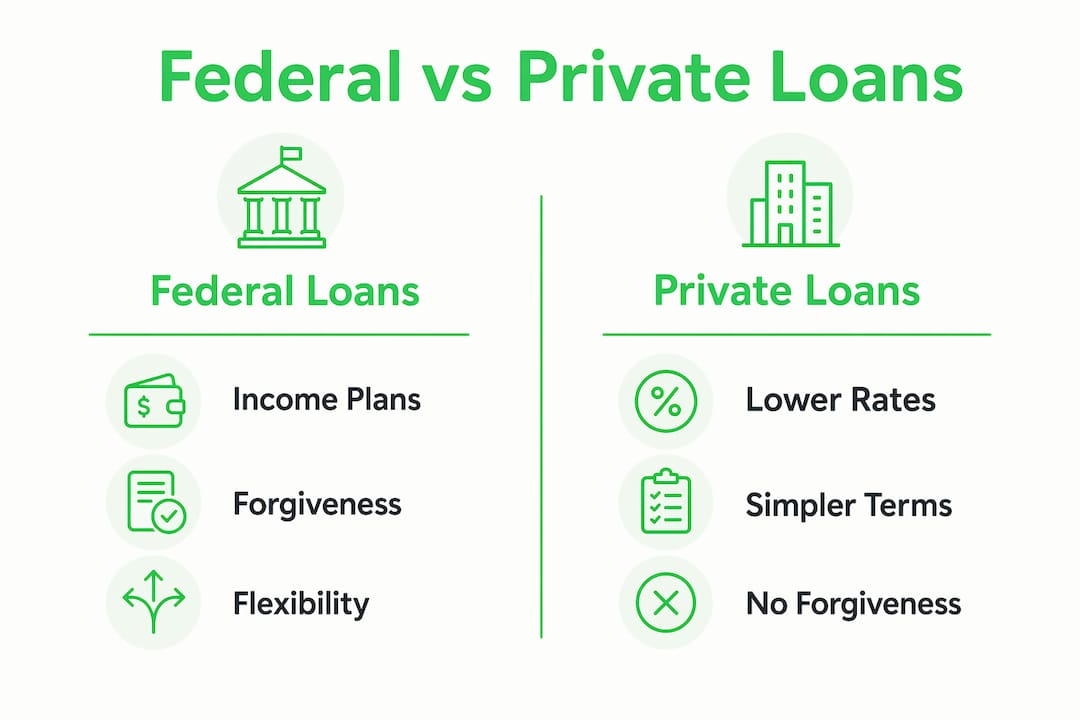
Refinancing federal loans into a private loan is a permanent, one-way decision. You cannot undo it. Every federal protection attached to your original loans disappears the moment refinancing closes.
The federal benefits you give up include:
Income-Driven Repayment (IDR). Federal IDR plans adjust your monthly payment based on your income and family size. Private refinanced loans require fixed payments with no income adjustment.
Public Service Loan Forgiveness (PSLF). PSLF offers tax-free forgiveness after 120 qualifying payments for borrowers in public service roles. Refinancing forfeits this eligibility permanently.
Deferment and forbearance. Federal loans allow you to pause payments during financial hardship. Most private lenders offer limited or no equivalent options.
Disability discharge. Federal loans can be discharged if you experience a total and permanent disability. Private loans rarely carry this protection.
Refinancing federal loans is not just a financial transaction. It is a permanent trade of government-backed security for a lower interest rate. Make sure the rate savings justify what you are giving up.
The end of the SAVE plan and changes to IDR forgiveness taxability from 2026 onward have shifted the calculus somewhat. Fewer borrowers will see large forgiveness amounts under IDR, which reduces one argument for keeping federal loans. Still, PSLF remains tax-free and fully intact for qualifying borrowers. The federal safety net still has real value for the right borrower.
Federal benefit | Available with federal loans | Available after refinancing |
Income-Driven Repayment | Yes | No |
Public Service Loan Forgiveness | Yes | No |
Deferment and forbearance | Yes | Limited or none |
Disability discharge | Yes | Rarely |
When does refinancing make financial sense?
Refinancing makes financial sense under a specific set of conditions. Meeting all of them is the standard, not just one or two.
Your rate reduction is at least 1.5%. Anything less rarely produces savings large enough to justify the loss of federal protections. A drop from 6.39% to 4.5% on a $50,000 loan saves a meaningful amount over a 10-year term.
You do not need or qualify for federal forgiveness programs. If PSLF or IDR forgiveness is not part of your financial plan, the trade-off costs you less.
You have a stable income and a fully funded emergency fund. Without a financial cushion, losing access to deferment or forbearance creates real risk.
You plan to keep the same repayment term or shorten it. Real financial efficiency comes from securing a lower rate while keeping the repayment term equal or shorter. Extending your term to lower monthly payments often increases total interest paid over time.
A break-even analysis must account for more than just interest savings. Break-even calculations should factor in the probability of needing federal protections and the dollar value of those lost benefits. A borrower with a 20% chance of needing IDR over the next decade faces a very different calculation than one with a stable career and no interest in forgiveness programs.
Scenario | Refinancing outcome |
Rate drops 2%+, no forgiveness plans, stable income | Strong case to refinance |
Rate drops less than 1.5%, any IDR or PSLF eligibility | Keep federal loans |
Variable income, recent job change | Wait until income stabilizes |
Cosigner removal needed, strong credit | Refinancing may be worth it |
The loan forgiveness application process is worth reviewing before you make any final decision. Understanding what you stand to lose makes the comparison concrete rather than abstract.
Key takeaways
Refinancing student loans saves money only when the rate reduction is large enough and the borrower has no need for federal protections like IDR, PSLF, or deferment.
Point | Details |
Rate threshold matters | Seek a rate reduction of at least 1.5% before refinancing to justify the trade-offs. |
Federal benefits are lost permanently | Refinancing federal loans removes access to IDR, PSLF, deferment, and disability discharge forever. |
Income stability is required | Borrowers with variable or unstable income face higher denial rates and greater financial risk. |
Term length affects total cost | Keeping the same or shorter repayment term prevents total interest from rising despite a lower rate. |
Break-even analysis is essential | Calculate the value of lost federal benefits against total interest saved before deciding. |
The part most borrowers skip
Most articles on refinancing focus on the interest rate math. That math matters, but it is not the hardest part of the decision. The hardest part is honestly assessing how likely you are to need federal protections in the next five to ten years.
I have seen borrowers refinance at a 2% lower rate and feel great about it, only to face a job loss two years later with no deferment option and no income-based payment adjustment available. The monthly savings they locked in did not come close to covering the financial stress of a fixed payment they could not pause. That is the scenario most borrowers do not model.
The other mistake I see regularly is treating consolidation as a reason to refinance. Combining five loans into one is genuinely useful. But if the interest rate barely moves, you are paying for simplicity with your federal safety net. That is a bad trade for most borrowers.
My honest recommendation: if you work in public service, teach, or work for a nonprofit, do not refinance federal loans under any circumstances. PSLF is tax-free forgiveness after 120 payments. No private rate reduction comes close to matching that value. For everyone else, run the full break-even analysis, include the value of federal protections, and get quotes from multiple lenders before committing.
— Ellis
How Titanprep supports your refinancing decision
Making the right call on refinancing requires knowing exactly what federal benefits you currently hold and what you would give up. Titanprep helps borrowers organize and evaluate their federal loan status, including eligibility for IDR, PSLF, and discharge programs, before making any irreversible decisions. If you are unsure whether refinancing is right for you, start by reviewing the latest student loan updates that affect 2026 borrowers. Titanprep also helps clients prepare and submit federal program applications, track deadlines, and maintain records with loan servicers. Understanding your federal options clearly is the first step toward any sound refinancing decision.
FAQ
What is the main reason to refinance student loans?
The primary reason is to secure a lower interest rate, which reduces total interest paid over the life of the loan. Borrowers also refinance to simplify multiple loan payments into one or to release a cosigner.
Should I refinance my student loans if I work in public service?
No. Refinancing federal loans permanently eliminates eligibility for Public Service Loan Forgiveness, which offers tax-free forgiveness after 120 qualifying payments. That benefit is worth far more than most interest rate reductions.
What credit score do I need to refinance student loans?
Most lenders require excellent credit, typically a score above 700, with the best rates reserved for borrowers above 750. Stable, high income is equally important for approval.
Does refinancing student loans hurt your credit?
Applying for refinancing triggers a hard credit inquiry, which causes a small, temporary dip in your credit score. The long-term impact is minimal if you make consistent on-time payments on the new loan.
What happens to federal benefits when I refinance?
You permanently lose access to income-driven repayment, PSLF, deferment, forbearance, and disability discharge. These protections cannot be restored once you refinance federal loans into a private loan.
Recommended
Comments