
Why Pay Off Student Loans Early: 2026 Guide
- TitanPrep Official

- Jul 21
- 8 min read

Paying off student loans early is defined as making payments above your required monthly minimum to reduce your principal balance faster than your repayment schedule requires. The core benefit is straightforward: less principal means less interest accrues daily, which cuts your total loan cost and gets you to debt freedom sooner. Borrowers using servicer portals like Aidvantage or MOHELA can often set up extra payments directly online. Strategies like the debt avalanche method and lump sum payments are the most effective tools for accelerating payoff. Before you commit to early repayment, though, you need to understand both the financial gains and the real trade-offs.
How does paying off student loans early save you money?
Interest on federal student loans accrues daily based on your outstanding principal balance. Every dollar you pay above the minimum reduces that principal, which shrinks the amount interest is calculated on the next day. Over a 10-year repayment term, even small extra payments compound into significant savings.
The mechanics matter here. Federal student loans use simple daily interest, not compound interest. Your daily interest charge equals your principal multiplied by your annual interest rate divided by 365. Reduce the principal, and you reduce every future daily charge automatically.

Lump sum vs. monthly extra payments
Payment Method | Interest Savings | Best For |
Lump sum early in loan term | Maximum savings | Borrowers with a windfall or tax refund |
Extra monthly payments | Strong savings, more flexible | Borrowers with steady extra cash flow |
Minimum payments only | No savings | Borrowers in forgiveness programs |
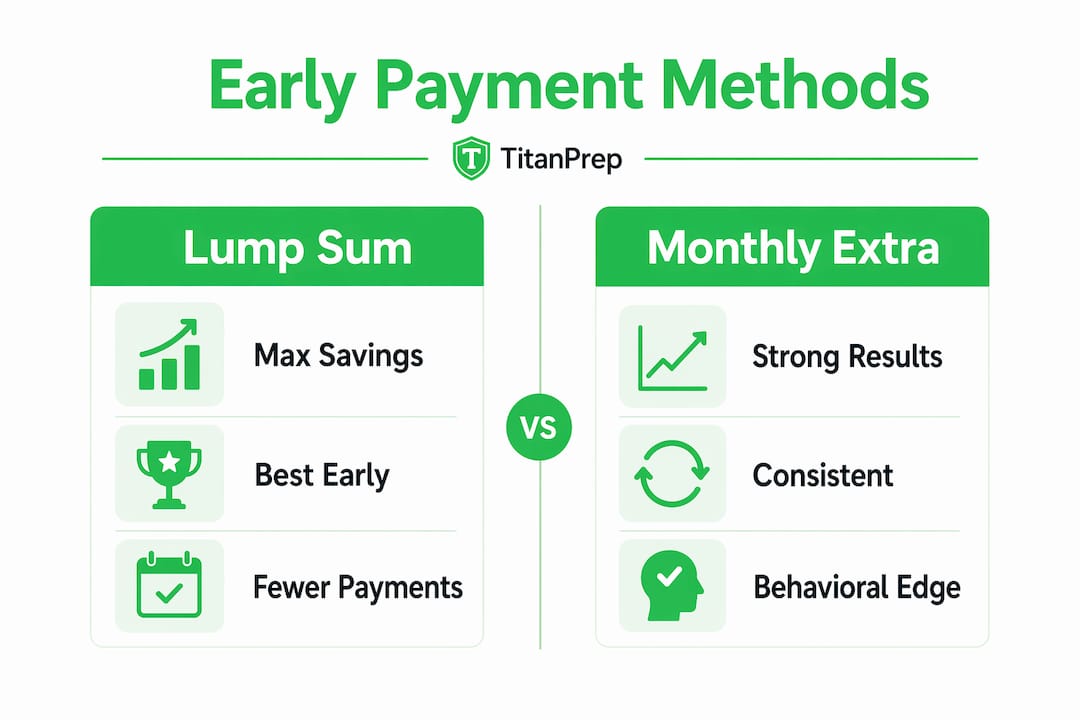
A lump sum payment early saves about 90% of total possible interest savings compared to spreading the same amount across monthly payments. That gap exists because front-loaded interest means your early payments carry the highest interest charges. Eliminating principal at the start of your loan term removes the most expensive interest days.
If a lump sum is not realistic, consistent monthly overpayments still deliver strong results. The behavioral advantage of monthly extra payments is that they build a habit. Many borrowers find that automating an extra $100 per month feels less disruptive than reserving a large sum.
Pro Tip: Always instruct your loan servicer in writing to apply extra payments to principal only. Most servicers apply payments as “paying ahead” by default, which advances your next due date but does not reduce your principal or save you any interest.
The advance-due-date trap is one of the most common and costly mistakes borrowers make. Your account looks current, your balance barely moves, and you feel like you are making progress when you are not. A single written instruction to your servicer fixes this permanently.
What are the financial trade-offs of early repayment?
Early repayment is not always the highest-return move available to you. Before you send extra money to your loan servicer, check these four priorities first.
Employer 401(k) match: Employer matches provide a 50% to 100% immediate return on your contribution. No loan interest savings can beat a guaranteed 50% or 100% return. Contribute at least enough to capture the full match before paying extra on loans. Learning to automate investments early in your career makes this step nearly effortless.
Emergency fund: CFP professionals treat an emergency fund as a prerequisite for aggressive loan repayment. Even $500 to one month of expenses in savings protects you from a scenario where a car repair or medical bill forces you onto a high-interest credit card. Without that buffer, early payoff can actually increase your total debt.
High-interest consumer debt: Credit card rates average around 22.83%, far above any federal student loan rate. Pay off credit card balances before accelerating student loan payments. The math is not close.
Investment returns vs. loan interest rate: When your loan interest rate exceeds 5%, paying down principal often beats keeping money in a high-yield savings account. Below 5%, the comparison becomes less clear, and investing the difference may produce better long-term results.
Pro Tip: Think of your financial priorities as a ranked list, not a competition. Capture the employer match first, build a small emergency fund second, eliminate high-interest debt third, and then direct extra money toward student loans. Following this order consistently produces better outcomes than any single aggressive strategy.
The opportunity cost question is personal. A borrower with a 3% subsidized loan and a strong employer match should probably invest before overpaying on loans. A borrower with a 7% unsubsidized loan and no employer match should almost certainly prioritize the loan.
Who should NOT pay off student loans early?
Early payoff is the wrong move for a specific group of borrowers. If you qualify for a federal forgiveness program, accelerating payments can cost you thousands of dollars you would never have owed.
Public Service Loan Forgiveness (PSLF) borrowers: PSLF discharges remaining balances after 120 qualifying payments for borrowers in public service jobs. Paying extra does not count as additional qualifying payments. It simply reduces the balance that would have been forgiven tax-free. Every extra dollar you pay is a dollar you gave away.
Income-Driven Repayment (IDR) forgiveness borrowers: IDR plans forgive remaining balances after 20–25 years of qualifying payments. If your balance is large relative to your income, you may owe far less in total payments than your full loan balance. Early payoff eliminates that benefit permanently.
Borrowers facing potential financial hardship: Aggressively paying off federal loans eliminates access to income-driven repayment adjustments, forbearance, and forgiveness options permanently. Once a federal loan is paid off, those protections disappear. Private loans carry no such protections at all, which is a key reason many borrowers prioritize federal loan management over private loan payoff.
Before you accelerate payments, check your eligibility for PSLF or IDR forgiveness. The most popular forgiveness programs have specific requirements that are worth reviewing carefully. If you qualify, staying on the minimum payment schedule is the financially correct choice. Experts warn that for borrowers eligible for forgiveness, accelerating payments leads to unnecessary overpayment.
You can review the full landscape of current options in the 2026 forgiveness program guide to confirm whether your loans and employment qualify before making any payoff decisions.
What strategies maximize early payoff benefits?
If early repayment is the right move for your situation, the method you choose determines how much you actually save. These five steps give you the most effective path forward.
Use the avalanche method for multiple loans. List all your loans by interest rate, highest to lowest. Direct every extra dollar to the highest-rate loan while paying minimums on the rest. This approach minimizes total interest paid across your entire portfolio. It is mathematically superior to any other sequencing strategy.
Consider the snowball method if motivation is a problem. The snowball method targets your smallest balance first regardless of interest rate. You pay off individual loans faster, which provides a psychological win. Research on behavioral finance shows that visible progress increases follow-through. If the avalanche method feels abstract, the snowball method keeps you moving.
Time extra payments strategically. Interest accrues daily, so paying early in the month reduces the number of days interest calculates on a higher balance. If you receive a paycheck on the 1st and the 15th, making a payment on both dates instead of one larger payment at month-end reduces your average daily balance and saves a small but real amount of interest each month.
Direct all extra payments to principal only. Contact your servicer by phone or in writing and confirm that any amount above your required payment applies to principal. Most servicers apply extra payments to future dues by default. Confirm this instruction is on file and verify it on your next statement.
Reallocate specific budget categories to loan payments. Identify one recurring expense you can reduce or eliminate, such as a streaming subscription, a dining-out budget line, or a gym membership you rarely use. Redirect that exact dollar amount to your loan as a fixed extra payment. Treating it as a non-negotiable bill prevents it from disappearing into general spending.
Building smart money habits around consistent extra payments produces more total savings than occasional large payments made without a system.
Key takeaways
Early repayment saves money on interest, but only when you have captured your employer match, built an emergency fund, and confirmed you are not eligible for loan forgiveness.
Point | Details |
Interest accrues daily | Reducing principal faster cuts every future daily interest charge automatically. |
Employer match comes first | A 50%–100% employer match beats any interest savings from early loan payoff. |
Designate payments as principal-only | Servicers default to advancing due dates, not reducing principal, without explicit instruction. |
Forgiveness changes the math | PSLF and IDR borrowers should avoid early payoff to preserve tax-free forgiveness benefits. |
Avalanche method saves the most | Targeting the highest-rate loan first minimizes total interest across all your loans. |
The case for knowing your situation before you pay extra
I have seen borrowers make the same mistake repeatedly. They get a tax refund, feel motivated, and send a large payment to their loan servicer without checking two things: whether their servicer applied it to principal, and whether they were quietly eligible for PSLF.
The first problem is fixable with a phone call. The second is not. Once you pay off a loan that would have been forgiven, that money is gone. No appeal, no recourse. The forgiveness window closes permanently.
My honest recommendation is this: treat early repayment as a reward for completing a checklist, not a first move. Confirm your forgiveness eligibility. Capture your full employer match. Keep three months of expenses in savings. Then, and only then, throw every extra dollar at your highest-rate loan.
The psychological relief of reducing debt is real and worth something. Watching a balance drop is motivating in a way that an investment account balance rarely is. But that psychological benefit should not override a decision that could cost you tens of thousands of dollars in forgiven debt.
If you are unsure where you stand on forgiveness eligibility, get clarity before you pay a single extra dollar. The loan forgiveness application process is more accessible than most borrowers realize, and knowing your options takes less time than you think.
— Ellis
How Titanprep can help you stay on track
Managing student loan repayment paperwork is one of the most overlooked parts of the process. Missed deadlines and misfiled documents can cost you forgiveness credit or delay your repayment plan enrollment. Titanprep helps borrowers organize, submit, and track paperwork for federal programs including IDR and PSLF, so nothing falls through the cracks. You can check the latest policy changes and repayment updates on the student loan updates page to stay current as rules shift in 2026. If you have had issues with your loan servicer, Titanprep also provides support for Aidvantage servicer complaints and related documentation. Staying organized is the foundation of any repayment strategy that actually works.
FAQ
Does paying off student loans early hurt your credit score?
Paying off a student loan closes the account, which can cause a small, temporary dip in your credit score due to reduced account diversity. The long-term impact on your score is generally neutral to positive as your debt-to-income ratio improves.
Can you pay off federal student loans early without a penalty?
Federal student loans carry no prepayment penalties. You can pay any amount above your minimum at any time without fees or penalties from the Department of Education or your servicer.
Is it wise to pay off student loans early if you qualify for PSLF?
No. Borrowers pursuing Public Service Loan Forgiveness should make minimum qualifying payments and avoid extra payments. Early payoff eliminates the remaining balance that would have been discharged tax-free after 120 qualifying payments.
How do you make sure extra payments go to principal?
Contact your loan servicer directly and request in writing that all payments above the required minimum be applied to principal only. Verify the instruction appears correctly on your next billing statement, since servicers default to advancing your due date instead.
What is the fastest way to pay off student loans?
The avalanche method, directing all extra funds to your highest-interest loan while paying minimums on others, produces the fastest total payoff and the greatest interest savings across your full loan portfolio.
Recommended
Comments