
What Is Loan Forbearance? A Borrower's Guide
- TitanPrep Official

- Jul 21
- 8 min read

Loan forbearance is a temporary agreement between a borrower and a lender that allows you to pause or reduce your loan payments during a period of financial hardship. It does not erase your debt. Your balance stays intact, and interest continues to accrue throughout the pause, which means you will owe more when payments resume. Federal Student Aid and the Consumer Financial Protection Bureau (CFPB) both recognize forbearance as a short-term relief tool for student loans, mortgages, and personal loans. Understanding exactly how it works before you request it can save you from a much larger bill later.
What is loan forbearance and how does it work?
Loan forbearance is defined as a lender-approved pause or reduction in your required loan payments, typically lasting up to 12 months. That duration is not automatic. Your lender sets the terms, and approval is never guaranteed.

During forbearance, interest keeps building on your outstanding balance. If you have a $30,000 student loan at 6% interest and pause payments for 12 months, you accumulate roughly $1,800 in interest. That amount does not disappear. It gets added to your principal through a process called capitalization, which means you then pay interest on a larger balance going forward.
Two types of forbearance exist for federal student loans. Discretionary forbearance is granted at your loan servicer’s judgment based on your financial situation. Mandatory forbearance is granted automatically in specific circumstances, such as serving in a medical or dental internship or qualifying for certain teaching programs. Loan servicers grant mandatory forbearance without requiring borrower action, though interest still accrues.
For mortgages, the timeline differs. Mortgage forbearance generally lasts up to six months initially, with possible extensions, compared to the 12-month window common for student loans. The core mechanics remain the same: payments pause, interest builds, and you must repay everything eventually.
Pro Tip: Keep making your regular payments until your servicer officially confirms forbearance approval in writing. Stopping payments before approval can result in delinquency, which does damage your credit.
Term | Detail |
Maximum duration | Up to 12 months for student loans; up to 6 months initially for mortgages |
Interest accrual | Continues throughout the forbearance period |
Capitalization | Unpaid interest is added to principal after forbearance ends |
Approval | Discretionary forbearance requires lender approval; mandatory forbearance is automatic |
Payment options | Full pause or partial payment reduction, depending on lender terms |
Loan forbearance vs. deferment: what is the difference?
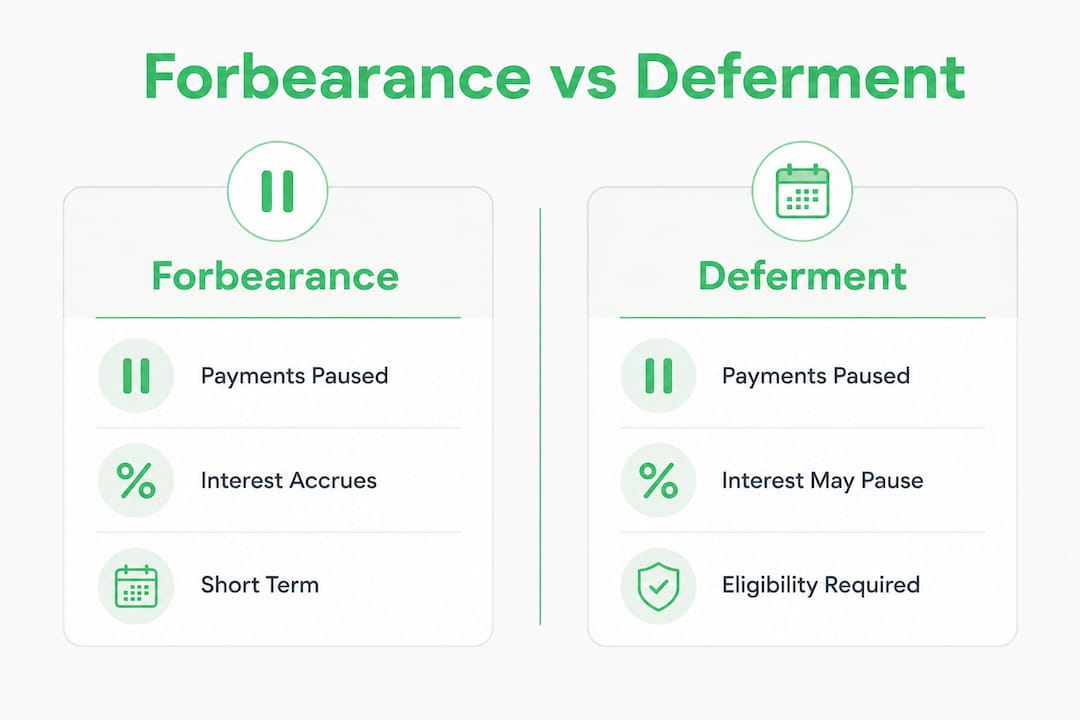
Deferment is defined as a temporary postponement of loan payments, similar to forbearance, but with one critical distinction: on subsidized federal student loans, interest does not accrue during deferment. That single difference can save you hundreds or thousands of dollars over the life of your loan.
Forbearance almost always accrues interest regardless of your loan type. Deferment can be financially preferable where available because interest stops on certain subsidized loans, unlike forbearance. If you qualify for deferment, it is almost always the better choice.
Feature | Forbearance | Deferment |
Payments paused | Yes | Yes |
Interest on subsidized loans | Accrues | Does not accrue |
Interest on unsubsidized loans | Accrues | Accrues |
Eligibility | Financial hardship, lender discretion | Specific criteria (enrollment, unemployment, military) |
Application required | Yes | Yes |
Best for | Short-term emergencies | Longer hardship with qualifying status |
Deferment eligibility is tied to specific life situations: returning to school at least half-time, active military duty, unemployment, or economic hardship. Forbearance has a broader eligibility range, which is why more borrowers end up using it. As of june 2024, 21% of federal student loan debt, equal to $302 billion of the $1.4 trillion total, sat in deferment or forbearance status. That figure shows just how many borrowers rely on these tools during financial difficulty.
Pro Tip: Before requesting forbearance, ask your loan servicer directly whether you qualify for deferment. One phone call could protect you from months of unnecessary interest charges.
What are the financial implications of loan forbearance?
The biggest financial risk of forbearance is interest capitalization. When your forbearance period ends, any unpaid interest gets added to your principal balance. You then pay interest on that larger number for the rest of your loan term. This is how capitalization increases total loan cost in a compounding way that many borrowers do not anticipate.
Here is a concrete example. You have $40,000 in federal student loans at 7% interest. After 12 months of forbearance, you have accrued $2,800 in interest. That amount capitalizes, making your new principal $42,800. Every future payment now builds on that higher base. Over a 10-year repayment term, that capitalization adds meaningful cost.
A common misconception is that forbearance functions like loan forgiveness. It does not. Forbearance only delays payments. Your full debt remains, and the interest clock never stops. Borrowers who confuse the two often feel blindsided when their balance is higher after forbearance than before.
Credit reporting is another area worth understanding clearly. Approved forbearance does not appear as a negative mark on your credit report. However, lenders reviewing your credit history may view forbearance usage as a signal of financial risk. It will not hurt your credit score directly, but it can affect how future lenders perceive your file.
Key financial risks to track during and after forbearance:
Your loan balance will be higher when payments resume than when they paused
Interest capitalization means you pay interest on interest going forward
Extended forbearance periods compound these costs significantly
Missing payments before official approval creates delinquency, which does harm your credit
How do you apply for loan forbearance?
Applying for forbearance is a straightforward process, but it requires documentation and follow-through. Borrowers must formally request forbearance by contacting their loan servicer and providing evidence of financial hardship. Approval is at the lender’s discretion for discretionary forbearance.
Follow these steps to apply:
Contact your loan servicer directly. Call or log into your servicer’s online portal. For federal loans, your servicer may be Aidvantage, MOHELA, Nelnet, or EdFinancial.
Explain your hardship clearly. Be specific about your situation. Servicers evaluate requests based on documented need.
Submit required documentation. This may include proof of income loss, medical bills, or other evidence of financial difficulty.
Continue making payments until you receive written confirmation. Stopping payments before approval is official puts your account at risk of delinquency.
Review the forbearance agreement terms. Confirm the duration, interest terms, and what happens when the period ends.
Common qualifying hardships include:
Job loss or significant reduction in income
Medical expenses or disability
Natural disaster affecting your finances
Military deployment
Enrollment in a qualifying internship or residency program
Mandatory forbearance applies automatically in some cases, such as AmeriCorps service or certain teacher loan forgiveness qualifying periods. In those situations, your servicer places your account in forbearance without a formal request from you.
What are the alternatives to forbearance for student loan hardship?
Income-Driven Repayment (IDR) plans are the most effective long-term alternative to forbearance for federal student loan borrowers. IDR plans cap your monthly payment at a percentage of your discretionary income, which can bring payments down to zero if your income is low enough. Unlike forbearance, IDR keeps you in active repayment status, which counts toward loan forgiveness timelines under programs like Public Service Loan Forgiveness (PSLF).
Switching to an IDR plan after forbearance can reduce your monthly burden without the compounding interest cost that forbearance creates. If your income is low, your IDR payment may be $0 per month, and that month still counts toward forgiveness. Forbearance months do not count toward forgiveness under most programs.
Other alternatives worth considering:
Extended Repayment Plan: Stretches your repayment term up to 25 years, lowering monthly payments without pausing them
Graduated Repayment Plan: Starts with lower payments that increase over time, useful if you expect income to grow
Loan Consolidation: Combines multiple federal loans into one, potentially lowering your monthly payment
PSLF: If you work for a qualifying nonprofit or government employer, 120 qualifying payments lead to full forgiveness of your remaining balance
Forbearance makes sense when you face a genuine short-term crisis and need immediate relief. For anything lasting more than a few months, IDR plans almost always produce a better financial outcome. The CFPB advises using forbearance sparingly because the long-term cost increase can undermine your repayment goals. You can also use the StudentAid.gov loan calculator to model what different repayment options will cost you over time before making a decision.
Key takeaways
Loan forbearance pauses your payments temporarily, but interest keeps accruing and capitalizes at the end, making it a costly tool that works best as a short-term bridge before switching to a more sustainable repayment option.
Point | Details |
Forbearance definition | A temporary pause or reduction in loan payments approved by your lender during financial hardship. |
Interest never stops | Interest accrues throughout forbearance and capitalizes onto your principal when it ends. |
Deferment is often better | On subsidized loans, deferment pauses interest too, making it the lower-cost option when you qualify. |
IDR plans outperform forbearance | Income-Driven Repayment caps payments by income and counts toward forgiveness, unlike forbearance. |
Apply carefully | Keep making payments until your servicer confirms approval in writing to avoid delinquency. |
Why i think borrowers reach for forbearance too quickly
From where I sit, forbearance is one of the most misunderstood tools in the student loan system. Borrowers reach for it first because it sounds simple: stop paying for a while and deal with it later. The problem is that “later” always costs more than expected.
What I have seen repeatedly is that borrowers who jump into forbearance without exploring IDR plans end up with balances that are hundreds or thousands of dollars higher than when they started. That extra debt is real, and it compounds. The months spent in forbearance also do not count toward PSLF or IDR forgiveness timelines, which means you are not just paying more. You are also falling behind on the clock.
My honest advice: treat forbearance as a last resort, not a first response. Call your servicer before you miss a payment. Ask specifically about deferment eligibility and IDR options. If forbearance is truly your only option, use it for the shortest time possible and switch to an IDR plan the moment your situation stabilizes. Monitor your balance closely after payments resume. That first statement after forbearance ends often surprises people, and you want to catch any errors or unexpected capitalization right away.
— Ellis
How Titanprep helps you stay on top of student loan changes
Student loan policy shifts constantly, and keeping up with your options is genuinely difficult. Titanprep is a document preparation and support service that helps federal student loan borrowers organize paperwork, track deadlines, and submit applications for programs like IDR and PSLF. Titanprep is not affiliated with the U.S. Department of Education, but it does help you stay organized so nothing falls through the cracks.
If you are coming off forbearance or trying to figure out your next step, check the latest student loan updates on the Titanprep site. You can also review what the SAVE Plan repeal means for your repayment options going forward. Taking a proactive step now is always better than reacting after a missed deadline.
FAQ
What does loan forbearance mean exactly?
Loan forbearance is a formal agreement with your lender to temporarily pause or reduce your loan payments during financial hardship. It does not reduce the amount you owe, and interest continues to accrue throughout the pause.
Does forbearance hurt your credit score?
Approved forbearance does not appear as a negative payment on your credit report. However, lenders may view forbearance usage as a sign of financial risk when reviewing your credit history.
What is the difference between loan forbearance and loan deferment?
Forbearance always accrues interest on all loan types, while deferment pauses interest on subsidized federal student loans. Deferment is the lower-cost option when you qualify for it.
How long does student loan forbearance last?
Federal student loan forbearance typically lasts up to 12 months per request. You may be able to request additional periods, but each requires a new application and lender approval.
Is loan forbearance a good option for managing hardship?
Forbearance provides immediate relief but increases your total loan cost through interest capitalization. Income-Driven Repayment plans are usually a better long-term solution if your hardship is expected to last more than a few months.
Recommended
Comments