
What Is Loan Discharge? Your 2026 Borrower Guide


Loan discharge is the cancellation of a borrower’s obligation to repay all or part of their federal student loan debt due to specific qualifying circumstances authorized under the Higher Education Act. The U.S. Department of Education administers these programs through Federal Student Aid, and eligibility depends entirely on your situation, not your payment history. If you have experienced a qualifying event such as a school closure, total and permanent disability, or school misconduct, you may be eligible to have your loans canceled without completing years of repayment. Understanding what loan discharge means and how it works is the first step toward knowing whether you qualify.
What is loan discharge and who qualifies?
Loan discharge cancels a borrower’s repayment obligation when a specific statutory condition is met. The Higher Education Act authorizes the Secretary of Education to grant discharge in particular circumstances, though the law does not provide a single formal definition of the term. What matters practically is that discharge removes your debt based on what happened to you, not based on how long or how faithfully you have repaid.
The qualifying events recognized under federal law include:
Death of the borrower. Loans are discharged when the borrower passes away, and parent PLUS Loans are discharged upon the death of the student for whom the loan was taken.
Total and permanent disability (TPD). Borrowers who are totally and permanently disabled may qualify, sometimes through automatic identification by the Social Security Administration or the Department of Veterans Affairs.
School closure. If your school closed while you were enrolled or shortly after you withdrew, you may qualify for a closed school discharge.
Borrower defense to repayment. If your school engaged in misconduct or violated state law, you can apply for discharge based on that wrongdoing.
False certification. If the school falsely certified your eligibility for a loan, you may qualify for relief.
Unauthorized disbursement. If loan funds were disbursed without your authorization, discharge may apply.
Failure to refund. If your school failed to return loan funds it was required to refund after you withdrew, that portion of your loan may be dischargeable.
Each of these discharge pathways has its own documentation requirements and application process. Federal Student Aid emphasizes that discharge programs are event-based, meaning your qualifying circumstance is what opens the door, not your repayment record.
Pro Tip: Review your loan history and school records before assuming you do not qualify. Many borrowers discover they attended a school that later closed or faced federal sanctions, which can retroactively open discharge eligibility.
How does loan discharge differ from forgiveness and cancellation?
These three terms are often used interchangeably, but they describe different relief mechanisms with different triggers and requirements. Discharge is triggered by specific qualifying events such as disability or school misconduct, while forgiveness is earned through qualifying service or a set number of income-driven repayment payments. Cancellation sometimes overlaps with discharge in everyday usage, but in federal program language it most often refers to relief tied to employment in public service or teaching.

The table below summarizes the key differences:
Feature | Loan discharge | Loan forgiveness | Loan cancellation |
Primary trigger | Qualifying hardship or event | Service or payment milestones | Employment-based service |
Tied to repayment history | No | Yes | Yes |
Common programs | TPD, closed school, borrower defense | Public Service Loan Forgiveness, IDR forgiveness | Teacher Loan Cancellation |
Application required | Usually yes | Yes | Yes |
Timeline | Varies by program | 10 to 25 years typically | 1 to 5 years of service |
The distinction matters because applying under the wrong program wastes time and can delay real relief. A borrower who attended a school that closed does not need to make 120 qualifying payments under Public Service Loan Forgiveness. They need to apply for a closed school discharge directly. You can review cancellation versus discharge rules to understand which path fits your situation.
What is the process to apply for a student loan discharge?
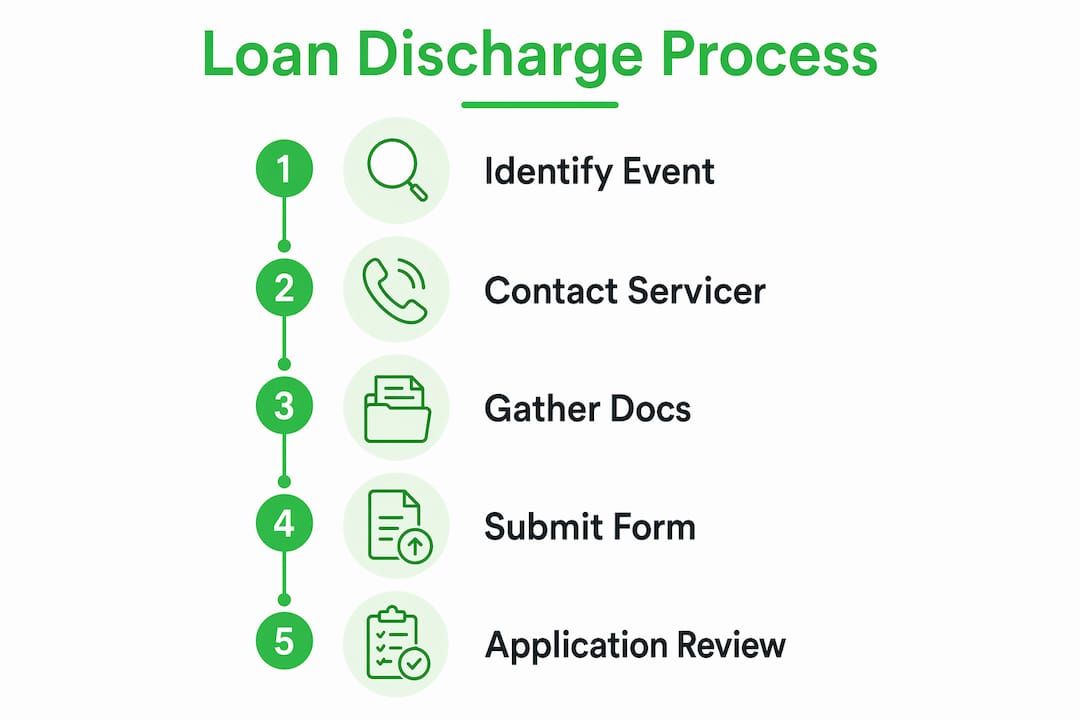
The loan discharge process starts with identifying which discharge type applies to your circumstances. Once you know your category, the steps are straightforward, though documentation requirements vary.
Identify your qualifying event. Review the list of eligible circumstances above and match your situation to the correct program. If you are unsure, Federal Student Aid’s website and your loan servicer are the starting points.
Contact your loan servicer. Your servicer manages your account and will direct you to the correct discharge application form. For TPD discharge, you may be directed to the TPD servicer specifically designated by the Department of Education.
Gather supporting documentation. Discharge requires evidence of the qualifying event. For disability, this means medical certification from a physician or documentation from the Social Security Administration or Veterans Affairs. For school closure, you will need enrollment records and school closure dates. For borrower defense, you need evidence of the school’s misconduct.
Submit your application. Applications are submitted through Federal Student Aid portals or directly to your servicer. Borrower defense applications go through the Department of Education’s dedicated online portal.
Await a decision and monitor your account. Processing times vary. During this period, you may be placed in forbearance so payments are paused while your application is reviewed.
Understand post-discharge conditions. Some programs, especially TPD discharge, include a post-discharge monitoring period during which your income and disability status are checked. If you fail to meet the conditions during this period, your loans can be reinstated.
Pro Tip: Keep copies of every document you submit and every communication you receive from your servicer. If your application is delayed or denied, having a complete paper trail makes it far easier to appeal or resubmit.
Automatic discharge is available in limited situations. Borrowers identified by the Social Security Administration as meeting disability criteria may receive TPD discharge without submitting a separate application. Even so, staying informed about your account status is your responsibility.
Can student loans be discharged through bankruptcy?
Bankruptcy discharge of student loans is possible but rare. The Bankruptcy Code permits discharge of Direct Loans only when the borrower proves undue hardship, a legal standard that is deliberately difficult to meet. This is a separate legal process from the administrative discharge programs offered by the Department of Education.
To pursue bankruptcy discharge, you need to understand several key points:
The undue hardship standard is strict. Courts typically apply the Brunner test, which requires you to prove that you cannot maintain a minimal standard of living while repaying the loans, that your financial situation is unlikely to improve, and that you have made good-faith efforts to repay.
It requires an adversary proceeding. You cannot simply list student loans in a bankruptcy filing. You must file a separate lawsuit within the bankruptcy case, which involves legal filings and often litigation.
Success rates are low. Most borrowers who attempt bankruptcy discharge do not succeed because the burden of proof is high and the process is costly.
Federal discharge options are usually more accessible. If you qualify for a Department of Education discharge program such as TPD or borrower defense, that path is almost always faster and less expensive than bankruptcy.
If you are considering bankruptcy as a route to student loan relief, consult a qualified attorney who specializes in student loan law before proceeding. The administrative discharge options from Federal Student Aid are the more practical starting point for most borrowers.
Common misconceptions about loan discharge
Several misunderstandings about discharge cause borrowers to either miss out on relief they qualify for or waste time pursuing options that do not apply to them.
Discharge is not the same as forgiveness. Forgiveness requires meeting service or payment requirements over time. Discharge is triggered by a specific qualifying event and is not tied to how long or how much you have repaid.
Discharge is rarely automatic. Most discharge programs require you to submit an application with supporting documentation. Applications are not automatic except in limited disability cases where the Social Security Administration or Veterans Affairs identifies you directly.
Private student loans are not covered. Federal discharge programs apply to loans under the William D. Ford Federal Direct Loan Program and certain other federal loan types. Private loans lack these federal protections, so borrowers with private loans need to check directly with their private lender for any available options. You can compare your options further by reviewing federal versus private loan relief.
Discharge can sometimes be reversed. TPD discharge in particular includes a monitoring period. If you earn income above a certain threshold or no longer meet the disability criteria during that period, your loans can be reinstated. Discharge approval is not always permanent.
The general meaning of discharged debt does not apply here. Borrowers should not assume that the bankruptcy concept of discharged debt translates directly to federal student loan discharge. The Department of Education’s discharge pathways are administratively distinct from bankruptcy proceedings.
Key takeaways
Loan discharge cancels your federal student loan repayment obligation based on a qualifying event, not your payment history, making it one of the most direct forms of relief available to borrowers facing hardship or school-related issues.
Point | Details |
Discharge definition | Discharge cancels all or part of your federal loan debt due to a specific qualifying event. |
Eligibility triggers | Qualifying events include disability, school closure, borrower defense, and false certification. |
Discharge vs. forgiveness | Forgiveness requires service or payments; discharge is triggered by hardship or school issues. |
Application is required | Most discharge programs require documentation and a formal application through Federal Student Aid. |
Private loans are excluded | Federal discharge programs cover federal loans only; private loans have no equivalent federal protections. |
Why getting this right early matters more than most borrowers realize
From working with borrowers navigating federal student loan programs, the single most costly mistake I see is waiting. Borrowers who experienced a qualifying event years ago often continue making payments because they did not know discharge was an option. By the time they find out, they have paid thousands of dollars they did not legally owe.
The second most common problem is misidentifying the right program. Applying for Public Service Loan Forgiveness when you actually qualify for a closed school discharge adds years to your timeline unnecessarily. These are not interchangeable programs, and the Department of Education does not automatically redirect you to the better option.
What I find most underappreciated is the documentation burden. Even when a borrower clearly qualifies, incomplete paperwork is the most frequent reason applications stall or get denied. Medical certifications need to meet specific standards. School closure dates need to align with your enrollment records. Borrower defense claims need documented evidence of misconduct, not just a general complaint.
My honest advice: treat your discharge application like a legal filing, not a form. Every piece of documentation matters, every deadline counts, and staying organized throughout the process is what separates approvals from denials. If you are unsure where to start, resources like financial literacy coaching can help you build the foundational knowledge to approach this process with confidence.
— Ellis
How TitanPrep supports borrowers pursuing loan discharge
TitanPrep is a document preparation and support service that helps federal student loan borrowers stay organized through the discharge and forgiveness application process. The team assists with gathering and submitting paperwork for programs including total and permanent disability discharge, closed school discharge, and borrower defense to repayment, where applicable. TitanPrep also tracks deadlines, stores records securely, and monitors submission status through its client portal. If you want to understand your options and keep your application on track, start by reviewing how TitanPrep works or explore the top forgiveness programs guide to see which federal programs may apply to your situation. TitanPrep does not guarantee outcomes. Eligibility is determined solely by the U.S. Department of Education or your loan servicer.
FAQ
What does loan discharge mean for student borrowers?
Loan discharge means the U.S. Department of Education cancels all or part of your federal student loan debt because a specific qualifying event occurred, such as a school closure or permanent disability. You are no longer required to repay the discharged amount.
What types of loan discharge are available?
Federal discharge types include total and permanent disability discharge, closed school discharge, borrower defense to repayment, false certification discharge, unauthorized disbursement discharge, and death discharge. Each type has its own eligibility criteria and application process.
Can private student loans be discharged?
Federal discharge programs generally do not apply to private student loans. Private loans are not covered under the William D. Ford Federal Direct Loan Program, so borrowers with private loans must contact their lender directly to ask about any available relief options.
How do you apply for a student loan discharge?
You apply by identifying your qualifying event, contacting your loan servicer for the correct application form, gathering supporting documentation, and submitting your application through Federal Student Aid or the relevant portal. Most programs are not automatic and require documented evidence.
Is bankruptcy a realistic way to discharge student loans?
Bankruptcy discharge of student loans is rare because borrowers must prove undue hardship through a separate legal proceeding called an adversary proceeding. Federal administrative discharge programs are faster and more accessible for most borrowers who qualify.
Recommended
Comments