
What Is Default on Student Loans: 2026 Guide


Student loan default is defined as the failure to make scheduled loan payments for a set period, causing the full loan balance to become immediately due and triggering collection actions. For federal loans, default occurs after 270 days of missed payments. Private lenders typically declare default after 120–180 days, depending on the loan agreement. Understanding what is default on student loans is the first step toward protecting your credit, your income, and your financial future.
What is default on student loans and how does it differ from delinquency?
Delinquency and default are two different stages of the same problem. Delinquency begins the day after you miss your first payment. Default is what happens when delinquency goes unresolved for too long.
For federal student loans, the U.S. Department of Education classifies a loan as delinquent from the first missed payment. After 90 days of missed payments, your loan servicer reports the delinquency to the three major credit bureaus. That report alone can damage your credit score before default even occurs.

The loan officially enters default status at 270 days of nonpayment for most federal loans. Private lenders move faster. Most declare default between 120 and 180 days, and the exact threshold depends on your loan contract. The difference matters because federal and private loans follow entirely different collection rules once default is declared.
Here is how the timeline breaks down:
Day 1: First missed payment. Loan becomes delinquent.
Day 90: Federal loan servicer reports delinquency to credit bureaus.
Day 120–180: Most private lenders declare default and begin collection.
Day 270: Federal loans officially enter default. Full balance becomes due.
After default: Collections begin. For federal loans, this requires no court order. For private loans, the lender must sue first.
Guaranty agencies also play a role in older Federal Family Education Loan (FFEL) Program loans. These agencies may take over collection once a loan defaults, adding another layer to an already complex process.
What are the consequences of student loan default?
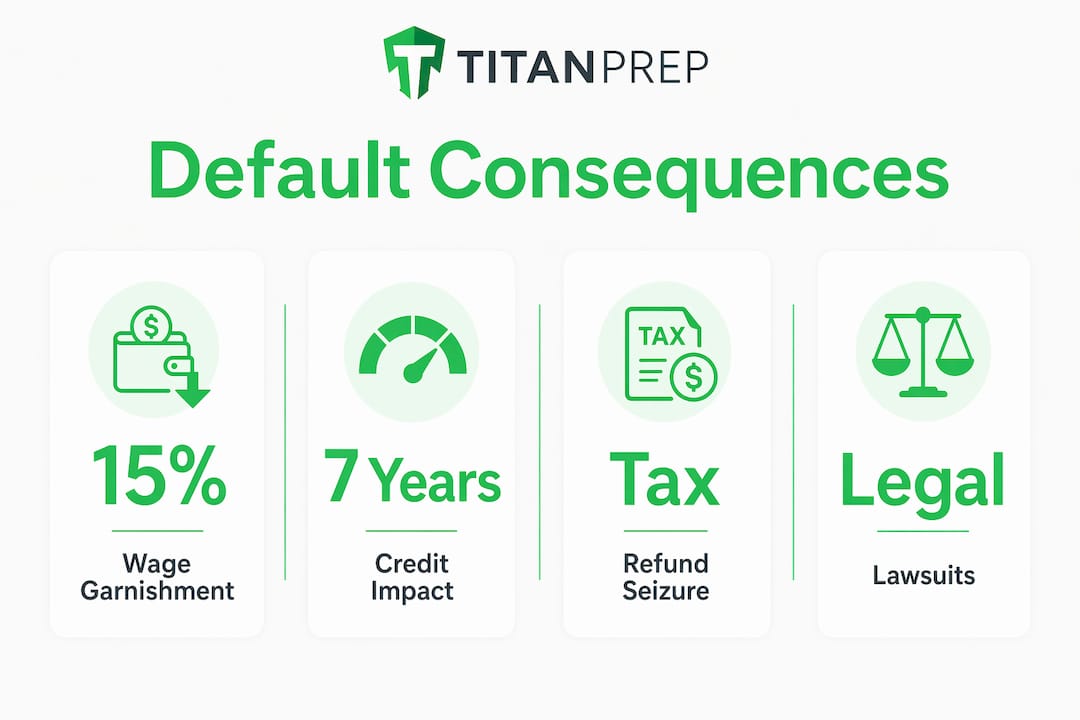
Default on a federal student loan triggers consequences that most borrowers do not expect. The government does not need a court order to collect. That distinction separates federal loan default from nearly every other type of consumer debt.
The U.S. Department of Education can garnish up to 15% of your disposable pay, seize your federal tax refund, and intercept Social Security benefits. All of this happens administratively, without filing a lawsuit. Borrowers can stop garnishment by responding within 30 days of notice and arranging a repayment plan.
Federal wage garnishment does include one protection. Garnishment must leave you with at least $217.50 per week, a floor based on 30 times the federal minimum wage. That protection exists, but it does not eliminate the financial strain of losing a portion of every paycheck.
Private loan defaults follow a different path. Private lenders must file a lawsuit and obtain a court judgment before garnishing wages or seizing assets. State statutes of limitations apply, typically ranging from 3 to 10 years. However, once a judgment is obtained, collection can be aggressive.
The credit consequences affect both loan types equally. Defaulted loans stay on your credit report for seven years from the date of default. That seven-year window can block you from getting a mortgage, a car loan, or even certain jobs. The debt itself does not disappear when the credit entry does.
Additional costs pile up fast:
Collection fees: Federal collectors can add significant fees to your balance.
Legal costs: Private lenders pass attorney fees and court costs to borrowers after a judgment.
Lost eligibility: Federal loan default disqualifies you from new federal student aid.
No statute of limitations: Federal collections face no time limit for involuntary actions like garnishment, unlike private loans.
One common fear worth addressing directly: default on student loans is never a criminal offense. You will not be arrested for failing to pay. Ignoring a court summons in a private loan lawsuit is a separate matter and can lead to legal penalties, but the debt itself carries no criminal consequence.
How to get out of student loan default
Three paths exist for exiting federal student loan default: loan rehabilitation, loan consolidation, and full repayment. Each has trade-offs, and the right choice depends on your financial situation and credit goals.
Loan rehabilitation is the most credit-friendly option. Here is how it works:
Contact your loan servicer or the Default Resolution Group at the U.S. Department of Education.
Agree on a monthly payment amount based on your income.
Make nine consecutive, on-time payments within a 10-month window.
Your loan exits default, and the default notation is removed from your credit report.
Rehabilitation takes time, but it is the only option that actually removes the default record from your credit history. The nine-payment rehabilitation process also restores your eligibility for federal student aid, income-driven repayment plans, and loan forgiveness programs. New 2026 regulations now allow borrowers to pursue a second rehabilitation if they default again after completing the first one. That change reflects a meaningful expansion of borrower protections.
Loan consolidation is faster. You combine your defaulted loan into a new Direct Consolidation Loan. The default exits your account, but the record of it stays on your credit report. You must either agree to repay under an income-driven repayment plan or make three consecutive payments before consolidating. Consolidation works well when you need to restore federal aid eligibility quickly.
Full repayment clears the default immediately but requires paying the entire outstanding balance at once. For most borrowers, this is not realistic.
Pro Tip: Contact the Default Resolution Group before your loan is assigned to a private collection agency. Early contact gives you more options and may reduce collection fees added to your balance.
Exploring your loan forgiveness options after exiting default can also open new paths forward, especially if you work in public service or qualify for income-driven forgiveness.
How to avoid student loan default
The most effective way to avoid default is to contact your loan servicer before you miss a payment. Waiting increases your balance through fees and reduces your options. Acting early keeps every door open.
Federal student loan borrowers have several tools available before the 270-day threshold:
Income-Driven Repayment (IDR): Plans like Income-Based Repayment (IBR) and Pay As You Earn (PAYE) cap your monthly payment at a percentage of your discretionary income. Payments can be as low as $0 per month if your income qualifies.
Deferment: Pauses payments temporarily for qualifying situations like unemployment, economic hardship, or returning to school. Interest may still accrue on unsubsidized loans.
Forbearance: Reduces or pauses payments for up to 12 months at a time. Interest accrues on all loan types during forbearance.
Loan servicer communication: Your servicer can walk you through options, adjust your payment plan, and flag programs you may not know about.
Waiting to act increases debt through collection fees and lost program access. Borrowers who contact their servicer early can lower payments or pause obligations before the 270-day default threshold is crossed. That window is your best protection.
Pro Tip: Set a calendar reminder to check your loan account status every 60 days. Catching a missed payment early, before 90 days, prevents the delinquency from appearing on your credit report.
Understanding the differences between federal and private loans also matters here. Private loans offer fewer protections and shorter default timelines, so proactive management is even more critical if you carry private debt.
Key takeaways
Student loan default is a serious but recoverable situation. The most important step is acting before the 270-day federal threshold or the 120-to-180-day private loan window closes.
Point | Details |
Default timeline | Federal loans default at 270 days; private loans default at 120–180 days. |
Federal collection power | The government can garnish wages and seize tax refunds without a court order. |
Credit report impact | Default stays on your credit report for seven years from the date of default. |
Best exit option | Loan rehabilitation removes the default notation and restores federal aid eligibility. |
Best prevention tool | Contact your servicer early and apply for income-driven repayment before missing payments. |
The part most borrowers find out too late
The borrowers I see struggling most with default share one thing in common: they waited. They missed a payment, felt embarrassed, and avoided opening their mail. By the time they reached out for help, their loan had been assigned to a collection agency, fees had been added to their balance, and their tax refund had already been seized.
Default is not a moral failure. Life happens. Job loss, medical emergencies, and family crises all disrupt payment schedules. What makes the difference is whether you treat the first missed payment as a signal to act or a reason to hide.
The 2026 rehabilitation regulations are genuinely good news. Allowing a second rehabilitation opportunity means the government has acknowledged that one mistake should not permanently close the door on recovery. That policy shift reflects a more realistic view of how financial hardship works.
My honest advice: do not wait for a garnishment notice to take default seriously. Call your servicer when you know you cannot make next month’s payment. Ask about IDR, deferment, and forbearance. If you have already defaulted, contact the Default Resolution Group directly. The path back is real, but it requires you to take the first step.
Ignoring default does not make it smaller. Federal student debt carries no statute of limitations for involuntary collections. The government can collect decades from now. Acting today is always better than waiting.
— Ellis
How Titanprep can help you stay organized
Recovering from default or avoiding it entirely requires keeping track of deadlines, paperwork, and communications with your loan servicer. That is where Titanprep comes in. Titanprep is a document preparation and support service that helps borrowers organize and submit applications for programs like Income-Driven Repayment, Public Service Loan Forgiveness, and certain discharge options. The service tracks deadlines, stores documents securely, and maintains records of your submissions. If you want to understand how Titanprep works and whether it fits your situation, the process is straightforward to review. Titanprep is not affiliated with the U.S. Department of Education, and eligibility for any federal program is determined by your servicer or the Department directly.
FAQ
What does default mean for student loans?
Default means you have failed to make payments for a set period, causing your full loan balance to become immediately due. Federal loans default after 270 days; private loans default after 120–180 days.
How long does default stay on your credit report?
A defaulted student loan stays on your credit report for seven years from the date of default, regardless of whether the debt is later repaid.
Can the government garnish my wages without a court order?
Yes. For federal student loans, the U.S. Department of Education can garnish up to 15% of your disposable pay without filing a lawsuit. Private lenders must obtain a court judgment first.
What is loan rehabilitation and how does it work?
Loan rehabilitation requires nine consecutive, on-time monthly payments. After completing the program, your loan exits default and the default notation is removed from your credit report.
Can I rehabilitate a federal loan more than once?
Under 2026 federal regulations, borrowers may now pursue a second rehabilitation if they default again after completing an initial rehabilitation. This expanded protection took effect in 2026.
Recommended
Comments