
What Is a Loan Servicer? Your 2026 Guide


A loan servicer is defined as the company the U.S. Department of Education assigns to handle billing, payments, and other administrative services on your federal student loans. The servicer is not your lender. It does not own your loan. Think of it as your account manager for everything that happens after your loan is disbursed. Knowing what a loan servicer does, how to find yours, and how to work with them effectively is the foundation of managing your federal student loan repayment in 2026.
What does a federal loan servicer do?
A federal loan servicer handles the day-to-day administration of your loan from the moment repayment begins. The U.S. Department of Education assigns servicers to manage billing and repayment support. That means your servicer is your first call for almost every loan-related question you have.
The core responsibilities of a federal loan servicer include:
Collecting and processing monthly payments on your loan account
Maintaining accurate loan balances and records, including interest accrual
Helping you apply for repayment plans, such as Income-Driven Repayment (IDR)
Processing deferment and forbearance requests when you need temporary relief
Answering questions about your account, balance, and repayment options
Reporting your payment history to the major credit bureaus each month
Updating your personal and contact information when you request changes
Your servicer collects payments and maintains loan records but does not set the terms of your loan. The legal terms, interest rate, and ownership of the loan stay with the lender or the federal government. This distinction matters because borrowers sometimes contact their servicer expecting to renegotiate loan terms. That is not within the servicer’s authority.
Pro Tip: Save your servicer’s phone number and portal login separately from your StudentAid.gov credentials. You will need both, and they are different accounts.

How do I find my loan servicer?
Finding your assigned servicer is straightforward once you know where to look. The StudentAid.gov dashboard is the primary tool for identifying your federal loan servicer. Log in with your FSA ID, and your servicer’s name and contact information will appear alongside your loan details.
Follow these steps to locate your servicer:
Go to StudentAid.gov and log in using your FSA ID username and password.
Select “My Aid” from your dashboard to view all your federal loans.
Click on each loan to see the servicer assigned to that specific loan.
Note the servicer name and contact details for each loan separately.
Create an account directly on your servicer’s portal to manage payments and paperwork.
One detail that catches many new borrowers off guard: servicer assignment may lag for first-time borrowers. If you just took out your first federal loan, your servicer may not appear on the dashboard right away. Check back regularly so you are ready when repayment begins.
You cannot choose your federal loan servicer. The Department of Education makes that assignment. Student borrowers and parent borrowers are often assigned to different servicers, even within the same household. If you have multiple federal loans, you may also find yourself dealing with more than one servicer. Each loan-servicer relationship is separate, so treat them that way when submitting paperwork or making payments.
A loan servicer transfer, where your loan moves from one servicer to another, is relatively rare for federal loans. When it does happen, the Department of Education notifies you in advance. Your loan terms do not change during a transfer. Your payment history carries over. The main action you need to take is updating your autopay setup with the new servicer.
Practical tips for working with your loan servicer
Your servicer is the operational gateway to every repayment option available to you. Treating that relationship seriously protects your credit, your repayment progress, and your eligibility for programs like Public Service Loan Forgiveness (PSLF).
Here is what works in practice:
Update your contact information immediately when you move, change your phone number, or get a new email address. Missed notices from your servicer can lead to missed deadlines.
Use your servicer’s online portal for payments, repayment plan applications, and document uploads. Phone calls are useful, but the portal creates a record.
Submit repayment plan requests early. All repayment paperwork including deferment and forbearance requests must go through your servicer. Processing takes time, so do not wait until the last minute.
Document every interaction. Write down the date, the representative’s name, and what was discussed after every phone call. If something goes wrong later, that record is your evidence.
Check your loan balance and payment history monthly. Errors in servicer records do happen. Catching them early is far easier than disputing months of incorrect data.
If you believe your servicer made an error, contact them in writing first. If the issue is not resolved, you can file a complaint with the Federal Student Aid Ombudsman Group. That office exists specifically to help borrowers resolve disputes with servicers.
Pro Tip: Set a calendar reminder to log into your servicer portal every 30 days. Regular check-ins catch problems before they become serious.
Servicer communication and portal use should be a regular part of your repayment routine, not something you do only when a problem arises. Borrowers who stay engaged with their servicer are far less likely to miss a deadline or fall into delinquency. You can also learn more about changing your repayment plan through your servicer if your financial situation changes.
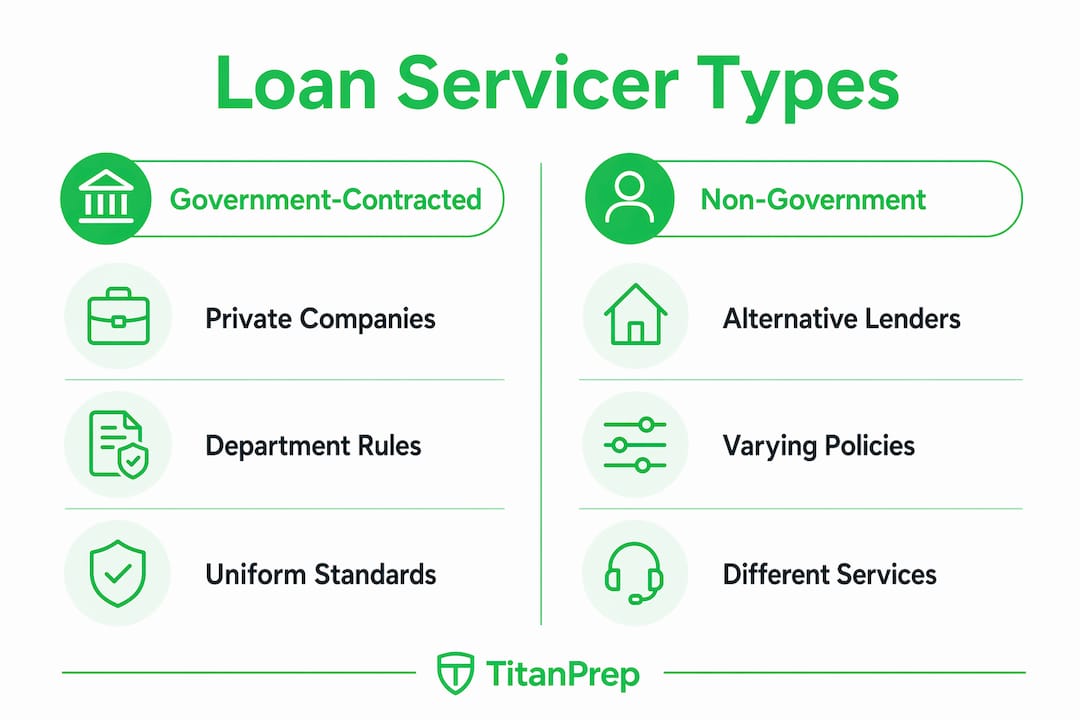
What are the types of loan servicers for federal loans?
Loan servicing covers all administration of a loan after it is funded, from payment collection through payoff. For federal student loans, this work is performed by companies operating under contract with the U.S. Department of Education. These are not banks or lenders. They are specialized servicers hired to manage the administrative side of federal loan portfolios.
Servicer type | Who they are | Borrower impact |
Government-contracted servicer | Private companies under federal contract | Assigned by the Department of Education; no borrower choice |
Third-party specialized servicer | Companies focused solely on loan administration | Handle large volumes; follow uniform federal regulations |
Original lender servicing | Lender manages its own loan portfolio | Less common for federal loans; same regulatory standards apply |
All federal loan servicers follow the same regulatory requirements set by the Department of Education. That means the core services you receive, including repayment plan options, deferment processing, and credit reporting, are consistent regardless of which servicer you are assigned. The practical difference between servicers tends to show up in customer service quality and portal usability, not in the programs available to you.
Borrowers sometimes assume that a larger or more well-known servicer offers better options. That is not accurate for federal loans. Your eligibility for IDR, PSLF, or forbearance is determined by federal program rules, not by your servicer’s size or reputation. The role of servicers in student loans is administrative, not discretionary.
Key Takeaways
A loan servicer is the assigned company that manages billing, payments, and repayment support for your federal student loan. It is your primary contact for everything related to repayment, but it does not own your loan or set its terms.
Point | Details |
Servicer vs. lender | Your servicer manages the loan daily but does not own it or set its terms. |
Finding your servicer | Log into StudentAid.gov to see which servicer is assigned to each of your loans. |
No borrower choice | The Department of Education assigns servicers; you cannot select or switch on your own. |
Multiple servicers possible | Different federal loans may be assigned to different servicers, each requiring separate management. |
Documentation matters | Record every servicer interaction and submit all repayment paperwork through the correct servicer portal. |
What I have learned about working with loan servicers
Your servicer is the most underestimated relationship in your entire repayment process. Borrowers spend hours researching forgiveness programs and repayment plans, then lose eligibility because they missed a deadline their servicer tried to notify them about.
The biggest misconception I see is treating the servicer as an obstacle rather than a resource. Your servicer is the operational account manager for your loan. Every application for IDR, every deferment request, every PSLF certification form runs through them. If you do not have a working relationship with your servicer portal, you are flying blind.
A common mistake is confusing the servicer with the loan owner. The servicer administers the loan daily, but the legal terms and ownership sit with the lender or the federal government. Calling your servicer to dispute your interest rate is a dead end. Calling them to apply for a lower payment plan is exactly the right move.
Check your servicer assignment early, especially if you are a new borrower. The assignment lag is real, and borrowers who wait until their first bill arrives often scramble to set up accounts and submit paperwork at the same time. Get ahead of it. Log into StudentAid.gov now, find your servicer, create your portal account, and set up autopay before repayment begins.
— Ellis
How Titanprep can help you stay on top of your servicer
Managing servicer communications, repayment deadlines, and paperwork submissions takes consistent attention. Titanprep is a document preparation and support service that helps borrowers organize, submit, and track paperwork related to federal student loan programs, including IDR applications, PSLF certifications, and servicer correspondence.
Titanprep is not affiliated with the U.S. Department of Education or any loan servicer. The service works alongside your existing servicer relationship to help you stay organized and avoid missed deadlines. If you are dealing with a servicer dispute or need help understanding your options, check out the latest student loan updates to stay informed. Borrowers facing specific servicer issues can also find practical guidance on handling servicer complaints through Titanprep’s resources.
FAQ
What is a loan servicer for federal student loans?
A federal loan servicer is the company the U.S. Department of Education assigns to manage billing, payments, and repayment support for your federal student loan. The servicer is your primary contact for all account-related questions but does not own your loan.
Can I choose or change my federal loan servicer?
You cannot choose your federal loan servicer. The Department of Education assigns one, and you generally cannot switch servicers on your own unless a loan transfer occurs.
How do loan servicers get paid?
Servicers earn a servicing fee by retaining a small percentage of the outstanding loan balance, typically 0.25 to 0.5 percentage points per payment. This fee is paid by the loan holder, not directly by the borrower.
What happens during a loan servicer transfer?
During a servicer transfer, your loan moves from one servicer to another. Your loan terms do not change, your payment history carries over, and the Department of Education notifies you in advance. You will need to update your autopay with the new servicer.
Why do I have more than one loan servicer?
Borrowers with multiple federal loans may be assigned to more than one servicer. Each loan can be assigned independently, so treat each servicer relationship separately when submitting paperwork or making payments.
Recommended
Comments