
What Is a Federal Direct Loan? Your Clear Guide
- TitanPrep Official

- May 26
- 8 min read

If you’re trying to figure out how to pay for college, understanding what is a federal direct loan is one of the most practical steps you can take. Many borrowers sign their loan paperwork without fully grasping the differences between loan types, and that gap in knowledge can cost real money over time. Federal direct loans are not all the same, and knowing exactly what you have changes how you borrow, how much interest you pay, and what repayment options are available to you.
Table of Contents
Key takeaways
Point | Details |
Federal government is the lender | The U.S. Department of Education lends directly to you, not a private bank. |
Two main student loan types | Subsidized and unsubsidized direct loans differ in eligibility and interest treatment. |
Interest subsidy saves money | Subsidized loans cover your interest during school and grace periods; unsubsidized loans do not. |
Enrollment status matters | Dropping below half-time enrollment can trigger interest accrual on subsidized loans. |
Loan type affects repayment options | Knowing your exact loan type is critical when applying for forgiveness or income-driven repayment programs. |
What is a federal direct loan and how it works
A federal direct loan is made through the William D. Ford Federal Direct Loan Program, where the U.S. Department of Education acts as the lender. The word “direct” is not just a label. It signals that the money comes straight from the federal government to you, bypassing private banks or financial institutions entirely.
This is a meaningful distinction. Federal loans offer protections like fixed interest rates and flexible repayment terms that private loans simply do not provide. If you ever need to pause payments or apply for forgiveness, federal direct loans give you access to programs that private borrowers cannot use.
The Direct Loan Program covers several loan types:
Direct Subsidized Loans for undergraduate students with demonstrated financial need
Direct Unsubsidized Loans for undergraduate, graduate, and professional students, regardless of financial need
Direct PLUS Loans for parents of dependent students and for graduate or professional students
Direct Consolidation Loans that allow you to combine multiple federal loans into one
Your school must participate in the Direct Loan Program for you to receive these funds. To qualify, you generally need to be enrolled at least half-time and meet the standard federal student aid requirements, such as being a U.S. citizen or eligible noncitizen, maintaining satisfactory academic progress, and not being in default on any existing federal loans. You can learn more about the basics in this overview of federal student loans.
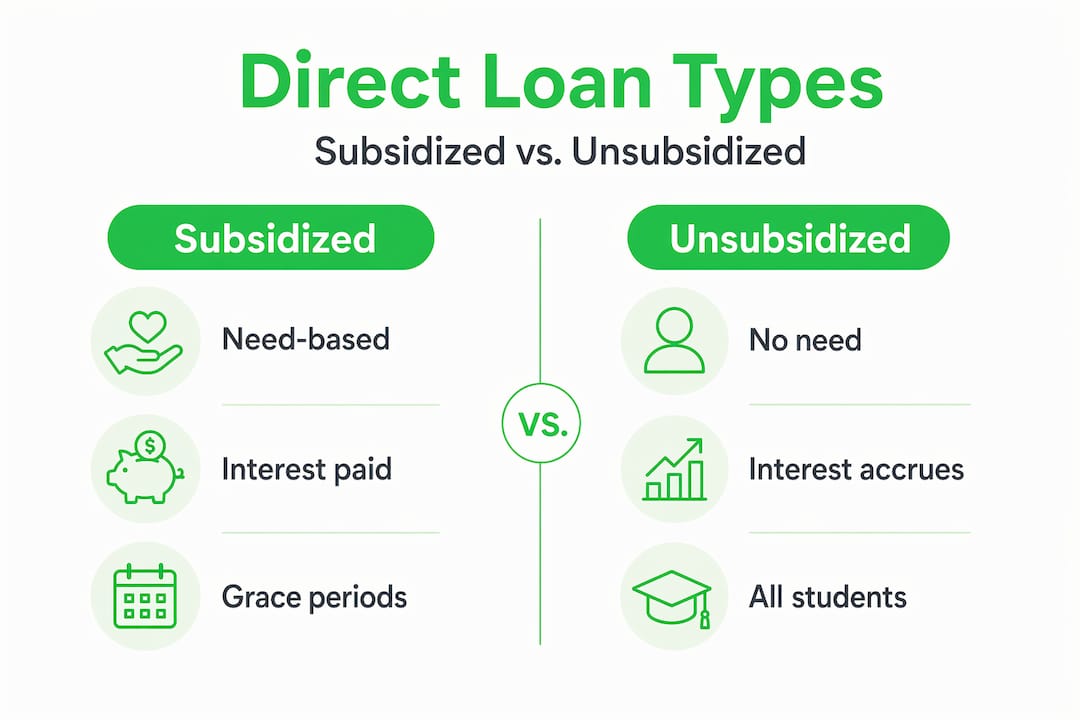
Subsidized vs. unsubsidized direct loans explained
This is where most borrowers get tripped up. The word “direct” tells you who the lender is. The words “subsidized” and “unsubsidized” tell you who pays the interest while you’re in school. That distinction has a direct impact on how much you owe by graduation.
Feature | Direct Subsidized Loan | Direct Unsubsidized Loan |
Financial need required | Yes | No |
Interest during school | Government pays it | Accrues and capitalizes |
Eligible students | Undergraduates only | Undergrad, graduate, professional |
Interest during grace period | Government pays it | Accrues and capitalizes |
Interest during deferment | Government pays it | Accrues and capitalizes |
Direct Subsidized Loans do not charge interest while you are enrolled at least half-time, during the six-month grace period after you leave school, and during any approved deferment period. The government essentially absorbs that cost for you. This is a real financial benefit that can save hundreds or even thousands of dollars depending on how long you’re in school.

Unsubsidized loans accrue interest from the moment the funds are disbursed. If you don’t pay that interest while you’re in school, it capitalizes. That means the unpaid interest gets added to your principal balance, and then you start paying interest on the larger amount. A $5,000 loan can quietly grow before repayment even begins.
Many borrowers don’t realize that the “direct loan” label is about the lender, not the borrower’s cost. Focusing on whether your loan is subsidized or unsubsidized is where your attention should really go. Understanding when interest subsidy applies, specifically during in-school, grace, and deferment periods, gives you a far clearer picture of your actual loan cost.
Pro Tip: If you have an unsubsidized loan and can afford to make small interest payments while you’re in school, do it. Even modest payments prevent capitalization and keep your balance from growing before you graduate.
Eligibility and how enrollment affects your loans
Meeting the general federal aid eligibility requirements is your starting point, but your enrollment status plays an ongoing role throughout your time in school. Many borrowers don’t realize that what happens after you receive your loan can be just as important as qualifying for it in the first place.
Here are the core requirements you need to meet to be eligible for a Direct Loan:
Enrollment at least half-time at a school participating in the Direct Loan Program
U.S. citizenship or eligible noncitizen status
Valid Social Security number
Satisfactory academic progress as defined by your school
No existing default on a federal student loan
Completion of the Free Application for Federal Student Aid (FAFSA)
Your enrollment status is not a one-time checkbox. It is something that can shift during your academic career, and changes in enrollment status directly affect whether your subsidized loans stay interest-free. If you drop below half-time, your subsidized loans lose their interest protection, and accrual begins. That can happen in ways you might not expect, such as switching to a lighter course load mid-semester or taking a leave of absence.
Your school is responsible for reporting your enrollment changes to your loan servicer, but that process can take time. Consulting your school or servicer promptly when your plans change gives you a chance to understand what it means for your loans before interest starts adding up.
Pro Tip: Don’t wait for your servicer to notify you of an enrollment change. If you know your schedule is shifting, call your servicer directly and ask how it affects your loan interest status.
Practical implications for borrowers
Understanding the type of direct loan you have is not just a technicality. It shapes your borrowing decisions, your repayment costs, and your eligibility for certain programs down the road. Here are the most practical things to keep in mind.
Prioritize subsidized loans first. When your financial aid package includes both subsidized and unsubsidized loans, borrow the subsidized amount before accepting unsubsidized funds. The interest-free period during school has real value.
Understand your annual and lifetime borrowing limits. Subsidized and unsubsidized loans each carry limits that vary by year in school and dependency status. Knowing your caps helps you plan ahead and avoid shortfalls later.
Watch what happens to unpaid interest. Borrowers who don’t pay interest on unsubsidized loans during school can face a noticeably higher balance when repayment begins. Even understanding this risk, and deciding to let interest accrue, is better than being surprised by it.
Know your loan type before choosing a repayment plan. When you’re ready to manage repayment, the specific type of direct loan you hold affects what plans are available to you. Identifying your exact loan type is especially important when comparing income-driven repayment options or forgiveness programs, since generic use of the term “Direct Loan” can obscure critical qualification differences.
Be aware of PLUS and Consolidation loans. The Direct Loan program also includes PLUS loans for parents and Direct Consolidation Loans. If you are a parent borrower or are thinking about consolidating, these loan types come with their own rules and repayment considerations separate from student subsidized and unsubsidized loans.
For a side-by-side look at how federal borrowing compares to private options, this breakdown of repayment options is worth reading before you decide how much to borrow.
My take on what borrowers most often miss
I’ve worked with many borrowers who came in confused about why their loan balance was higher than expected. Almost every time, the explanation came down to one thing: they had an unsubsidized loan and didn’t realize interest was building while they were still in class.
The subsidized versus unsubsidized distinction is genuinely one of the most financially significant differences in the entire federal loan system, and yet it’s the one that gets the least attention during the enrollment process. Most students hear “federal loan” and assume it works the same no matter what. It doesn’t.
What I’ve learned is that borrowers who take ten minutes to understand exactly what type of loan they have before signing make noticeably better decisions. They borrow less unsubsidized debt, they sometimes make small interest payments in school, and they’re not blindsided during repayment. That’s not luck. That’s just being informed.
My honest recommendation is this: look at your loan documents before your next semester begins. Identify whether each loan is subsidized or unsubsidized. If you’re not sure where to find that information, your loan servicer can tell you in a single phone call. It’s one of the most low-effort, high-return things you can do for your financial health as a student.
— Ellis
How TitanPrep helps you stay on track
Federal student loan rules shift, and keeping up with the latest policy changes while managing your coursework is a real challenge. TitanPrep is a document preparation and support service that helps borrowers organize paperwork, track deadlines, and maintain records related to federal student loan programs. Whether you’re preparing for income-driven repayment or working through the requirements for Public Service Loan Forgiveness, having your documents in order matters.
Check out TitanPrep’s student loan updates page for current information on policy changes that could affect your federal direct loans. If you’re concerned about rising payments, the 2025 payment outlook explains what borrowers should watch for. For borrowers dealing with servicer issues, TitanPrep also offers guidance on Aidvantage complaints and how to document them properly. TitanPrep does not guarantee outcomes. Eligibility for any federal program is determined solely by the U.S. Department of Education or your loan servicer.
FAQ
What is a federal direct loan in simple terms?
A federal direct loan is money lent to you directly by the U.S. Department of Education through the William D. Ford Federal Direct Loan Program. It is not from a private bank, and it comes with fixed interest rates and access to federal repayment protections.
What is the difference between subsidized and unsubsidized direct loans?
Subsidized loans are for undergraduate students with financial need, and the government pays the interest while you’re enrolled at least half-time. Unsubsidized loans are available to more students but accrue interest during all periods, including while you’re still in school.
How do I get a federal direct loan?
You apply by completing the FAFSA each year, which determines your eligibility and how much you can borrow. Your school then packages your financial aid offer, including any direct loans you qualify for.
Does my enrollment status affect my federal direct loan?
Yes. Dropping below half-time enrollment can cause your subsidized loans to begin accruing interest, ending the government’s interest subsidy. Contact your school or loan servicer right away if your enrollment status changes.
Can federal direct loans be used for loan forgiveness programs?
Yes, Direct Loans are generally eligible for programs like Public Service Loan Forgiveness and income-driven repayment forgiveness. Knowing your exact loan type matters because not all federal loans qualify, and being precise when applying can affect your outcome.
Recommended
Comments