
What Is a Discharge Application for Student Loans?
- TitanPrep Official

- Jul 21
- 9 min read

A discharge application is a formal request to cancel federal student loan debt when a borrower meets specific qualifying conditions, such as school closure or total and permanent disability. This process applies to Direct Loans, Federal Family Education Loans (FFEL), and Perkins Loans. Understanding what is a discharge application, which program fits your situation, and how to complete it correctly gives you the best chance at real relief. Missing a step or submitting the wrong documentation can delay your case by months.
What types of discharge applications exist for federal student loans?
Federal student loan discharge programs each target a different qualifying circumstance. The U.S. Department of Education recognizes several distinct categories, and each one carries its own eligibility rules and documentation requirements.
Closed school discharge cancels your loan debt if your school shut down while you were enrolled or shortly after you withdrew. This program covers Direct, FFEL, and Perkins Loans. A closed school discharge applies automatically in some cases, but applying independently rather than waiting for automatic notification can shorten time to relief by several months.

Total and Permanent Disability (TPD) discharge cancels loans for borrowers who cannot work due to a severe, lasting disability. Borrowers qualify through one of three evidence paths: a Social Security Administration (SSA) award letter, a VA disability rating decision showing 100% disability, or a physician certification from a licensed doctor. Processing times for TPD discharge usually range 2–6 months depending on how complete your documents are.
Unpaid refund discharge applies when a school failed to return loan funds it owed to the Department of Education after a borrower withdrew. Borrower defense to repayment covers situations where a school misled borrowers or violated state law in connection with the loan or education provided.
The table below summarizes the main discharge types, their core eligibility criteria, and the documentation typically required.
Discharge type | Core eligibility | Typical documentation |
Closed school | School closed while enrolled or within 180 days of withdrawal | Enrollment records, closure notice, loan account details |
Total and permanent disability | Unable to work due to severe, lasting disability | SSA award letter, VA rating decision, or physician certification |
Unpaid refund | School failed to return owed funds after withdrawal | Withdrawal records, payment history, school refund policy |
Borrower defense | School used deception or illegal conduct related to your loan | Enrollment agreements, marketing materials, evidence of misrepresentation |
Understanding which category fits your situation is the first step. Applying under the wrong program wastes time and delays relief.
How do you determine eligibility and verify your federal student loans?
Eligibility verification starts at StudentAid.gov. That site shows every federal loan tied to your Social Security number, including the loan type, servicer, and current balance. Private loans do not qualify for any federal discharge program, which is a common point of confusion for borrowers.
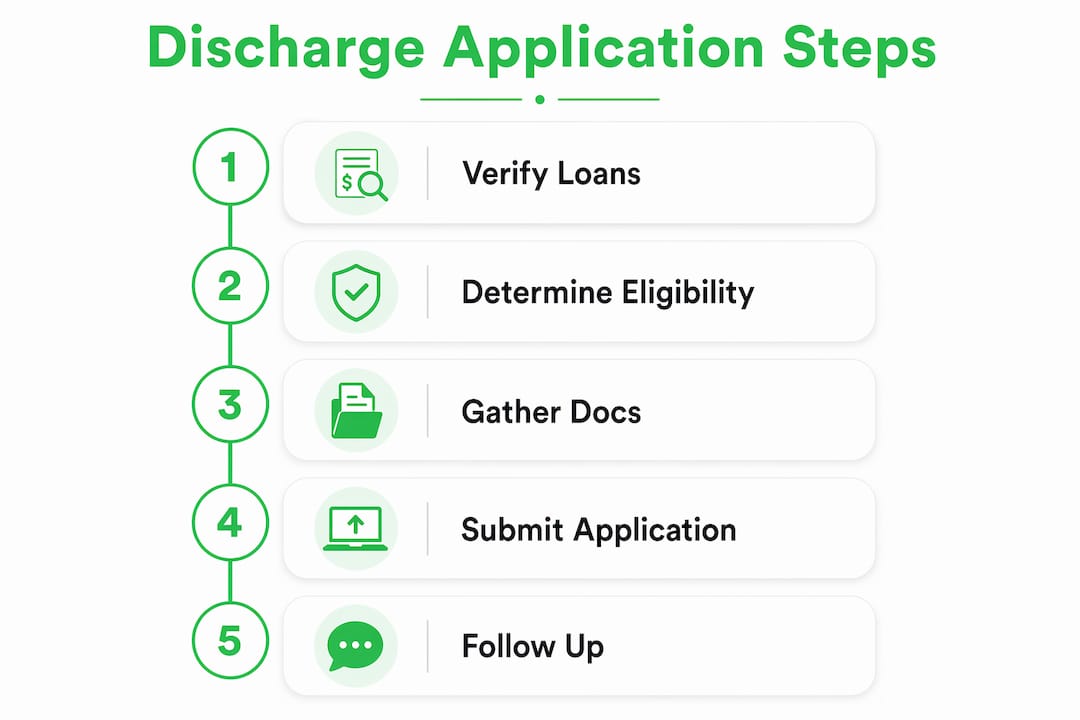
Financial aid experts confirm that verifying your federal loan type early saves time and prevents applying for relief programs that do not cover private loans. If your loans appear as “private” in your records, federal discharge is not an option, and you would need to contact your private lender directly about their own hardship policies.
Once you confirm your loans are federal, check the specific eligibility criteria for the discharge type you are pursuing:
Closed school discharge: Your school must appear on the Department of Education’s closed school list, and your withdrawal date must fall within the qualifying window.
TPD discharge: You must provide documentation from the SSA, VA, or a licensed physician confirming your disability status.
Unpaid refund discharge: Your school must have received loan funds on your behalf and failed to return them after you withdrew.
Borrower defense: You must show that the school’s conduct directly harmed you and was connected to your enrollment or loan.
A common mistake borrowers make at this stage is assuming that any school-related problem qualifies for discharge. Not every school closure or tuition dispute meets the Department’s standards. Read the eligibility criteria for your specific program carefully before you gather documents.
Pro Tip: Log into StudentAid.gov and download your complete loan history before you do anything else. This one document tells you your loan types, servicers, and balances, and it saves you from chasing information later.
How do you complete and submit a discharge application?
The discharge application process follows a clear sequence. Skipping steps or submitting incomplete paperwork is the fastest way to delay your case.
Identify the correct application form. Each discharge type has its own form. The TPD application is available through the Social Security Administration and the Department of Education. The closed school discharge form is available through your loan servicer or directly from the Department. Download the current version of the form, since outdated versions are rejected.
Gather all required documentation before you start filling out the form. For closed school discharge, this means enrollment agreements, transcripts, and any school closure notices. For TPD discharge, this means your SSA award letter, VA rating decision, or a completed physician certification form. Supplying comprehensive supporting documents, including enrollment contracts, transcripts, closure notices, and payment records, can significantly speed up processing by preventing follow-up requests.
Complete every section of the form. Leave nothing blank. If a field does not apply to you, write “N/A” rather than skipping it. Incomplete forms are returned, which adds weeks to your timeline.
Choose your submission method. Online submission through your servicer’s portal is faster and creates an automatic record of your submission date. Paper submissions by certified mail also work, but keep the tracking number and a copy of everything you send.
Make certified copies of your entire submission package before you send it. Keeping certified copies of all submission materials protects you if documents are lost by servicers or the Department of Education. Store both digital and physical copies in a safe location.
Submit and record the date. Write down the exact date you submitted your application and the name of the servicer or office that received it. This information matters if you need to follow up later.
Follow up proactively. After submission, follow up with your servicer 30–60 days later if you have received no status update. Proactive communication prevents your file from stalling in an administrative backlog.
Pro Tip: Create a dedicated folder, physical or digital, for every document related to your discharge application. Label each file with the date and document type. If your servicer ever claims they did not receive something, you have dated proof ready.
What happens after you submit a discharge application?
Submission is not the end of the process. Many borrowers mistakenly think submitting the form concludes their work. Active communication with the servicer is required to provide additional information and avoid denials or delays.
After you submit, your servicer reviews the application and forwards it to the Department of Education for a final decision. During this period, your loans may be placed in a forbearance status, which means payments are paused but interest may still accrue depending on your loan type. Typical processing times range from a few weeks to several months.
Possible outcomes after review include:
Approval: Your loan balance is canceled, and you receive written confirmation. After approval, check your credit report to confirm the discharged debt is reported correctly. Errors in credit reporting after discharge are common and worth disputing promptly.
Request for more information: The Department may contact you for additional documents. Respond quickly. Delays in your response extend the overall timeline.
Denial: You receive a written explanation of why your application was rejected. A denial is not necessarily final.
If your discharge request is denied, you have the right to appeal. The denial letter will explain the appeals process and the deadline for submitting a response. You can also contact your servicer to ask what specific documentation would have strengthened your case. Understanding the reason for denial is the most useful step you can take before deciding whether to reapply or appeal.
Tips and common pitfalls to avoid when applying
Strong applications share a few consistent qualities. Weak ones share the same mistakes.
Submit complete documentation from the start. Incomplete documentation is the most common reason for delays. Servicers approve applications faster when supporting records are clear and complete.
Understand the cooperation clause. Borrowers applying for closed school discharge must agree to cooperate with Department of Education enforcement actions against the closed school. This clause is standard and non-negotiable. Refusing to sign it disqualifies your application.
Keep every copy. Certified copies of your full submission package protect you against document loss. Having dated, organized digital or physical copies is critical proof of timely submission.
Follow up on schedule. If you receive no status update within 30–60 days, contact your servicer. Regular follow-up is a critical but often overlooked step that keeps applications from stalling in administrative backlogs.
Avoid common errors when disputing debt. Borrowers who misunderstand the discharge process sometimes dispute unauthorized debt through the wrong channel, which delays resolution.
Pro Tip: Set a calendar reminder for 30 days after your submission date. If you have not heard anything by then, call your servicer and ask for a status update. Write down the name of the representative you spoke with and the date of the call.
Key Takeaways
A federal student loan discharge application cancels eligible debt only when borrowers meet specific program criteria, submit complete documentation, and follow up consistently throughout the review process.
Point | Details |
Verify your loan type first | Confirm loans are federal at StudentAid.gov before applying, since private loans do not qualify. |
Match the right discharge program | Each discharge type has distinct eligibility criteria; applying under the wrong program wastes time. |
Submit complete documentation | Incomplete paperwork is the leading cause of delays; include all supporting evidence upfront. |
Keep certified copies | Retain dated copies of every document you submit to protect against servicer document loss. |
Follow up at 30–60 days | Proactive contact with your servicer prevents your application from stalling in a backlog. |
What I have learned from watching borrowers navigate discharge applications
The single biggest mistake I see borrowers make is treating submission as the finish line. They fill out the form, send it in, and then wait in silence for months. When nothing happens, they assume the process is moving along. It usually is not. Files sit in queues. Servicers send requests for additional information to outdated email addresses. Deadlines pass. The borrower finds out their application was closed due to non-response.
The borrowers who succeed treat the application as an ongoing conversation, not a one-time event. They call their servicer. They document every interaction. They respond to information requests within days, not weeks. That level of engagement is not optional. It is the actual work of getting a discharge approved.
The other pattern I notice is that borrowers underestimate how much documentation matters. Submitting the bare minimum form with no supporting evidence is technically allowed. It also dramatically increases the chance of a delay or denial. Servicers are processing high volumes of applications. A complete, well-organized file with clear evidence gets resolved faster than a thin file that requires multiple follow-up requests.
Stay informed about policy changes too. Discharge programs have evolved significantly in recent years, and eligibility rules can shift. Checking for student loan updates regularly keeps you from missing changes that affect your case.
— Ellis
How Titanprep supports borrowers through the discharge process
Titanprep is a document preparation and support service that helps borrowers organize, prepare, and submit paperwork for federal student loan programs, including certain discharge options such as total and permanent disability and school closure. Titanprep is not affiliated with the U.S. Department of Education or any government agency, and it does not guarantee specific outcomes. Eligibility for any federal program is determined solely by the Department or your loan servicer.
If you want clear guidance on your discharge options and help staying organized through the process, Titanprep’s loan forgiveness guide is a practical starting point. You can also check the latest student loan updates to stay current on program changes that may affect your eligibility.
FAQ
What is a discharge application for federal student loans?
A discharge application is a formal request to cancel federal student loan debt based on a qualifying circumstance, such as school closure, total and permanent disability, or borrower defense. The U.S. Department of Education reviews the application and makes the final eligibility determination.
Do private loans qualify for federal discharge programs?
Private loans do not qualify for any federal discharge program. Only Direct Loans, FFEL loans, and Perkins Loans are eligible, which is why verifying your loan type at StudentAid.gov before applying is a necessary first step.
How long does a discharge application take to process?
Processing times vary by discharge type and document completeness. TPD discharge applications typically take 2–6 months. Incomplete documentation extends that timeline, so submitting a full, organized package from the start reduces delays.
What should I do if my discharge application is denied?
Read the denial letter carefully to understand the specific reason. You have the right to appeal, and the letter will explain the deadline and process. Contacting your servicer to ask what documentation would have strengthened your case is also a useful next step before reapplying.
How do I follow up on a discharge application I already submitted?
Contact your loan servicer directly if you have not received a status update within 30–60 days of submission. Document the date of your call and the name of the representative you spoke with. Proactive follow-up is the most effective way to prevent your file from stalling.
Recommended
Comments