
What Happens If You Miss IDR Recertification
- TitanPrep Official

- Jul 21
- 8 min read

Missing your IDR recertification deadline means your monthly student loan payment reverts to the 10-year Standard Repayment Plan amount, often 2 to 4 times higher than what you currently pay. Income-Driven Repayment (IDR) is the formal term for plans like IBR, PAYE, and ICR that cap your payments based on income and family size. What happens if you miss IDR recertification catches many borrowers off guard because the payment jump can happen overnight. The good news: you can recertify at any time to return to income-driven payments. Acting quickly limits the financial damage.
What happens if you miss your IDR recertification deadline?
Missing your recertification date triggers an automatic payment reset. Your loan servicer moves your account to the standard repayment amount, calculated on your original loan balance when you first entered the IDR plan. That figure can push a $150 monthly payment up to $500 or a $50 payment up to $200 overnight.
One detail surprises most borrowers: the standard amount is based on the balance at IDR entry, not your current balance. That means even if you have paid down your principal, the reset payment can still feel shockingly high.

The consequences also vary by plan type. Here is a side-by-side look:
Plan | Payment After Missed Deadline | Interest Capitalization? |
IBR (Income-Based Repayment) | Reverts to standard 10-year amount | Yes, unpaid interest capitalizes |
PAYE (Pay As You Earn) | Reverts to standard 10-year amount | No capitalization |
ICR (Income-Contingent Repayment) | Reverts to standard 10-year amount | No capitalization |
The IBR capitalization rule is the most costly consequence. When unpaid interest capitalizes, it gets added to your principal. You then pay interest on a larger balance going forward, which compounds your total debt over time.
There is also a family size trap worth knowing. If you do not update your family size during recertification, servicers default to one, even if you have dependents. That default inflates your calculated payment unnecessarily. A borrower with three dependents could end up paying far more than their income actually requires.
Pro Tip: You can submit a new IDR application at any time to return to income-driven payments. Processing typically takes several weeks, so the higher payment stays in effect until your servicer completes the review. Submit as soon as you realize you missed the deadline.
How does missed recertification affect loan forgiveness?
The IDR recertification consequences extend beyond your monthly bill. They touch your forgiveness timeline too, and the effects depend on which forgiveness program you are pursuing.
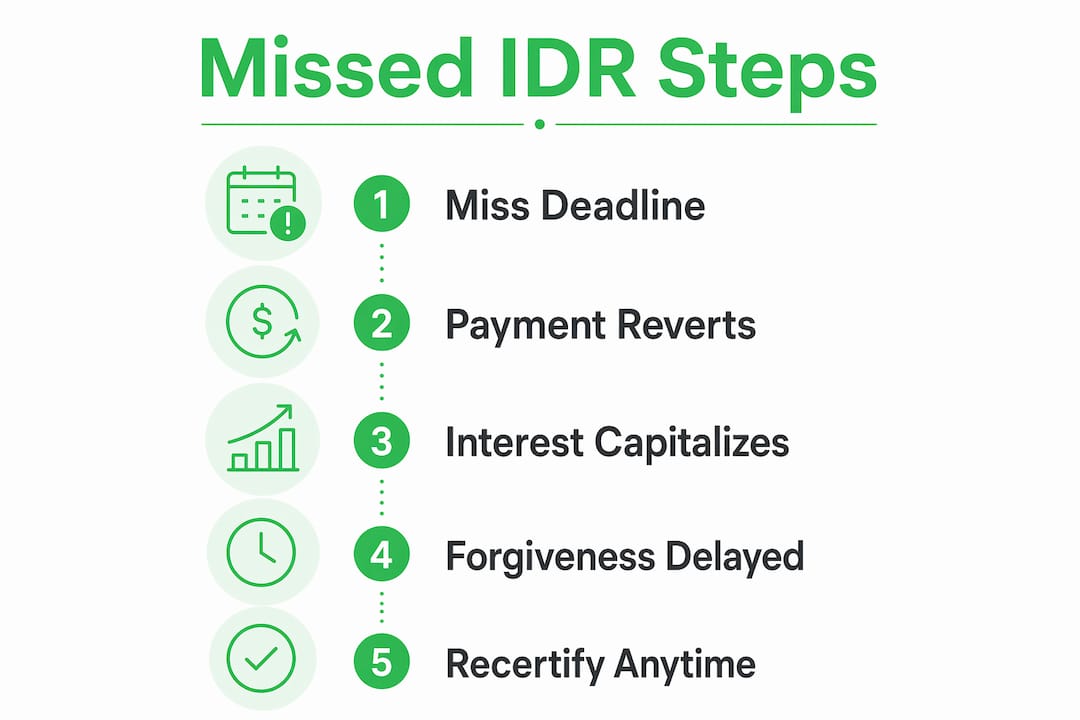
For Public Service Loan Forgiveness (PSLF), the months you spend on the higher standard payment generally count toward forgiveness as long as you continue making qualifying payments. That sounds reassuring, but the higher payment amount reduces the financial benefit of forgiveness. PSLF forgives the remaining balance after 120 qualifying payments. If your payments are inflated during the gap, you pay more out of pocket before reaching that finish line.
For the standard 20 or 25-year IDR forgiveness track, the same logic applies. Months count, but you are paying more per month than necessary. Over a year of missed recertification, that difference can add up to thousands of dollars.
Months on higher standard payments count toward PSLF if payments qualify under program rules.
Direct Consolidation Loans may lose PSLF credit during months on non-qualifying payment plans, so confirm your plan status with your servicer.
Missed recertification can delay your forgiveness timeline if you enter forbearance, since forbearance months do not count toward forgiveness.
Maintaining detailed payment records is critical to verify that each month is counted correctly.
Recertifying promptly restores your lower payment and protects your forgiveness progress.
Recent policy changes have added complexity to this picture. The Titanprep resource on new forgiveness guidance covers how updated Department of Education rules affect IDR and PSLF timelines in 2026. Staying current on those changes matters as much as meeting your recertification deadline.
The core takeaway here is simple: missed recertification does not erase your forgiveness progress, but it does make the path more expensive. Every month at the inflated payment is money you could have kept in your pocket.
What should you do if you missed your IDR recertification?
Knowing what to do if IDR recertification is missed reduces the financial hit significantly. Speed matters more than anything else here. Follow these steps in order:
Contact your loan servicer immediately. Call or log into your servicer’s portal and ask about your current payment status. Confirm whether your account has already reverted to the standard plan and ask what documentation they need to process a new IDR application.
Submit your income and family size documentation right away. You will need recent tax returns or pay stubs and an accurate family size count. Do not underestimate your family size. Submitting correct information the first time avoids a second round of corrections and delays.
Request temporary forbearance if the higher payment is unaffordable. Your servicer can place your account in forbearance while your new application is processed. This pauses payments, but remember: forbearance does not count toward PSLF or IDR forgiveness. Use it only if you genuinely cannot make the higher payment.
Save your confirmation number. Online submissions generate a confirmation number. Keep it. If your servicer later claims they never received your application, that number is your proof. For paper submissions, use tracked postal delivery. Proof of submission is your defense against wrongful payment increases.
Set calendar reminders for your new recertification anniversary date. Once your application is processed, your servicer will assign a new annual deadline. Mark it in your calendar at least 90 days out so you have time to gather documents without rushing.
Consider early recertification if your income drops. You do not have to wait for your anniversary date. If your income falls significantly, recertifying early locks in a lower payment sooner.
Pro Tip: If you are enrolled in an IBR plan, recertify as fast as possible after a missed deadline. IBR is the only common IDR plan where unpaid interest capitalizes onto your principal. Every month of delay on IBR costs you more than it would on PAYE or ICR.
For borrowers who want to return to income-driven terms, Titanprep’s guide on signing up for IBR walks through the application process step by step.
Why timing your IDR recertification strategically matters
Most borrowers treat recertification as a mandatory chore. The smarter approach is to treat it as a financial planning tool. Timing your recertification relative to income changes can save you thousands over the life of your loan.
Here is how to think about it:
If your income dropped recently, recertify early. You do not have to wait for your anniversary date. Submitting now locks in a lower payment based on your reduced income, and those savings start immediately.
If your income increased recently, wait until your deadline to recertify. Recertifying early when income is higher raises your payment sooner than necessary. Delay it legally to keep your current lower payment as long as possible.
If your income is stable, recertify on schedule and use the process to confirm your family size is accurate. Even a stable income with an updated family size can lower your payment.
If you are pursuing PSLF, every month at a lower payment means more forgiven at the end. Strategic timing directly increases your forgiveness amount.
If you are unsure whether early recertification applies to your plan, call your servicer and ask specifically whether your plan allows early recertification without penalty.
A common misconception is that recertification must happen exactly on the anniversary date or not at all. That is not true. You can recertify early, and in many income situations, doing so is the financially smarter move. The IDR recertification process is more flexible than most borrowers realize.
Key takeaways
Missing your IDR recertification deadline causes an immediate payment increase to the standard 10-year amount, but recertifying quickly limits the damage and protects your forgiveness timeline.
Point | Details |
Payment spike is immediate | Payments revert to the standard 10-year amount, often 2 to 4 times higher, the moment you miss your deadline. |
IBR carries extra risk | Only IBR capitalizes unpaid interest after a missed deadline, growing your principal and long-term debt. |
Forgiveness progress is mostly protected | Months on higher payments still count toward PSLF if qualifying, but forbearance months do not. |
Submit proof of recertification | Save confirmation numbers or use tracked mail to protect against servicer errors. |
Timing is a financial tool | Recertify early when income drops, wait until the deadline when income rises, to control your payment amount. |
The underrated cost of waiting even one month
I have worked with enough borrowers to say this plainly: the most expensive mistake is not missing the deadline. It is waiting a few more weeks after you realize you missed it. That hesitation is where the real damage happens, especially on IBR plans where interest capitalizes every month you delay.
The second thing I see borrowers get wrong is assuming the servicer will fix it automatically or send a clear warning. Servicers send notices, but those notices get buried in email or mailed to old addresses. The responsibility to track your recertification anniversary date sits entirely with you, not your servicer.
What I find most underused is the strategic timing angle. Borrowers who understand that early recertification is optional gain a real financial advantage. If your income dropped this year, recertifying now instead of waiting six months could save you hundreds of dollars in payments you never needed to make.
The IDR recertification process is not complicated once you understand the rules. What makes it hard is the anxiety around it, the fear that missing a deadline means permanent damage. It does not. You can recertify at any time. The sooner you act, the less it costs you. Check out Titanprep’s breakdown of IDR recertification details if you want a deeper look at how the rules apply to your specific plan.
— Ellis
How Titanprep helps you stay on top of recertification
Missed deadlines and confusing servicer communications are exactly the problems Titanprep is built to help you manage. Titanprep assists borrowers with organizing and submitting IDR recertification paperwork, tracking annual deadlines, and maintaining records of all submissions and servicer communications. If you are dealing with a payment spike after a missed deadline or trying to figure out your next steps, Titanprep’s team can help you get your documents in order and submitted correctly. Visit the student loan updates page for the latest guidance on IDR recertification rules, forgiveness timelines, and policy changes affecting borrowers in 2026. Titanprep is not affiliated with the Department of Education, and eligibility for any federal program is determined by your servicer.
FAQ
What happens immediately after you miss an IDR recertification deadline?
Your monthly payment reverts to the 10-year Standard Repayment Plan amount, which is often 2 to 4 times higher than your income-driven payment. This change takes effect automatically once the deadline passes.
Can you still recertify after missing the IDR deadline?
Yes. You can submit a new IDR application at any time after missing the deadline. Processing takes several weeks, so the higher payment stays in effect until your servicer completes the review.
Does missing IDR recertification hurt your PSLF progress?
Months spent on the higher standard payment generally still count toward PSLF if you continue making qualifying payments. However, months in forbearance do not count, so avoid forbearance unless the higher payment is truly unaffordable.
Does missing recertification cause interest capitalization on all IDR plans?
No. Interest capitalization after a missed deadline applies only to IBR plans. PAYE and ICR plans do not capitalize unpaid interest in the same situation, making IBR the highest-risk plan for delayed recertification.
How do you protect yourself if your servicer claims they never received your recertification?
Save the confirmation number from any online submission immediately. For paper submissions, use tracked postal delivery. That documentation is your proof of timely filing if a dispute arises.
Recommended
Comments