
The Role of Loan Counseling for Student Borrowers


Loan counseling is defined as a required educational process that prepares student borrowers to understand their loan terms, repayment obligations, and legal rights before and after borrowing. Federal law mandates this process for all federal student loan recipients. The role of loan counseling goes beyond paperwork. It gives you the knowledge to avoid default, choose the right repayment plan, and protect your credit. Whether you are taking out your first loan or preparing to graduate, understanding how this process works puts you in a stronger position from day one.
What is the role of loan counseling in federal student borrowing?
Federal loan counseling comes in two forms: entrance counseling and exit counseling. Both are required by law, and both serve a specific purpose at different points in your borrowing timeline.
Entrance counseling is required before your first loan disbursement. It typically takes 20–30 minutes to complete online. The session covers your loan terms, interest rates, repayment responsibilities, and borrower rights. Skipping it blocks your loan funds entirely.

Exit counseling is triggered when you graduate, withdraw, or drop below half-time enrollment. This applies even if you are transferring to another school or plan to re-enroll soon. Like entrance counseling, it takes about 20–30 minutes online and focuses on repayment readiness.
Here is what both sessions typically cover:
Your total loan balance and interest rates
Available repayment plans, including Income-Driven Repayment (IDR) options
Your loan servicer’s contact information
Grace periods and when repayment begins
Consequences of default and how to avoid them
Your rights as a borrower, including deferment and forbearance options
Pro Tip: Complete entrance counseling as soon as your school notifies you. Waiting until the last minute can delay your disbursement and create cash-flow problems that affect tuition deadlines.
Exit counseling is completed through StudentAid.gov using your FSA ID. The session gives you a clear picture of your total debt and repayment plan options. Your school’s financial aid office can confirm the exact steps required on your end.
How does loan counseling help borrowers manage repayment and avoid default?
Loan counseling guidance does not just check a box. It directly reduces your risk of missing payments, falling into delinquency, or defaulting on your loans.
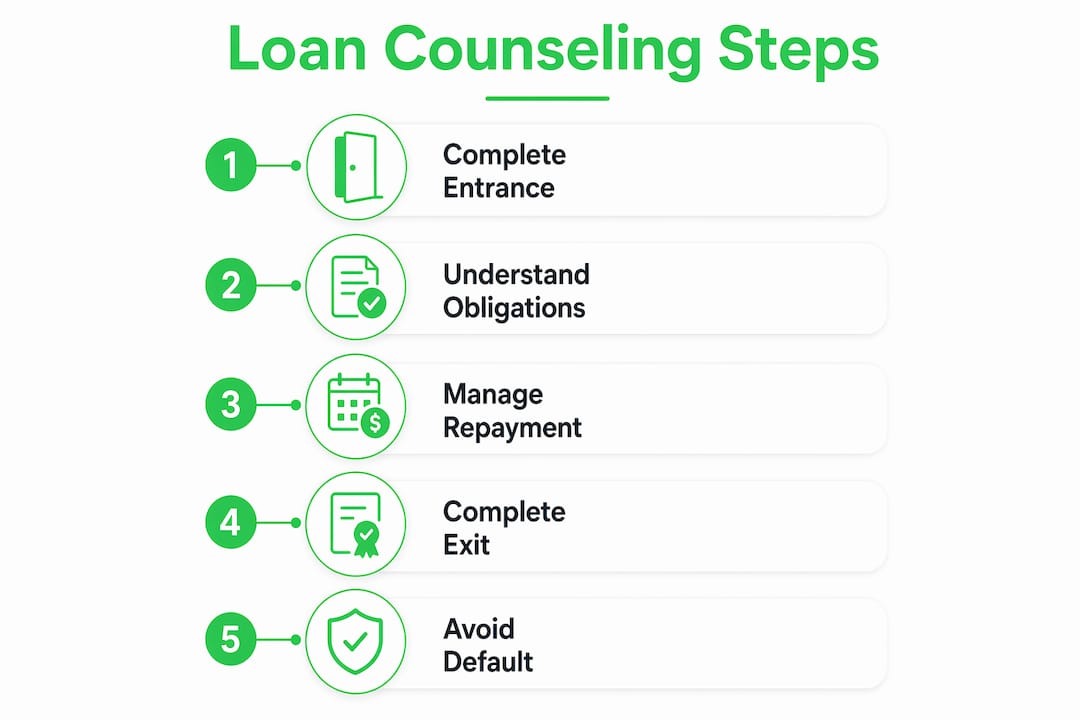
Exit counseling functions as a repayment-preparation checkpoint. It helps you understand your rights, obligations, and the timeline for when payments begin. That clarity matters because many borrowers are surprised to learn their grace period ends sooner than expected.
One of the most common and costly mistakes borrowers make is assuming that completing exit counseling automatically enrolls them in a repayment plan. It does not. Exit counseling reviews your options, but you must separately contact your loan servicer to actually enroll. Missing that step can leave you in an unplanned repayment status.
Here are the steps to take immediately after completing exit counseling:
Log in to StudentAid.gov to confirm your loan servicer’s name and contact details.
Contact your servicer directly to choose and enroll in a repayment plan.
Set up automatic payments if possible. Many servicers offer a small interest rate reduction for autopay.
Mark your grace period end date on your calendar so you are not caught off guard.
Review your budget to confirm your monthly payment fits your income.
Missing counseling requirements can also cause administrative blocks on your loan disbursement, leading to late tuition fees or delayed access to funds. The financial impact of skipping a 30-minute session can be significant.
Pro Tip: After exit counseling, request a written confirmation from your loan servicer that your repayment plan is active. Keep that record in a safe place alongside your counseling completion certificate.
The importance of loan counseling becomes clearest when borrowers skip the follow-up steps. Counseling gives you the map. You still have to drive.
What is nonprofit credit counseling and how does it differ from federal loan counseling?
Federal loan counseling and nonprofit credit counseling serve different purposes. Federal counseling is mandatory and specific to your student loans. Nonprofit credit counseling is optional, broader in scope, and designed for borrowers managing more complex financial situations.
Nonprofit credit counseling provides personalized financial guidance that includes budgeting, credit report review, and debt management planning. Certified counselors offer this advice confidentially and without selling financial products. The National Foundation for Credit Counseling (NFCC) is one of the most recognized organizations offering these services.
Here is a direct comparison of the two types of counseling:
Feature | Federal loan counseling | Nonprofit credit counseling |
Required? | Yes, by federal law | No, voluntary |
Scope | Student loans only | All debts, budgeting, credit |
Format | Online, self-guided | One-on-one with a counselor |
Cost | Free | Free or low-cost |
Provider | NFCC-affiliated agencies | |
Outcome | Loan disbursement or repayment readiness | Personalized debt management plan |
Nonprofit credit counselors may also help you enroll in a debt management program. These programs negotiate with creditors to reduce interest rates and fees. You still repay the full principal balance, but the monthly payment becomes more manageable.
Borrowers who benefit most from nonprofit credit counseling typically carry multiple debts alongside their student loans. If you are managing credit card balances, medical bills, or personal loans at the same time, a certified counselor can help you build a plan that addresses all of it together. Objective, personalized advice from a counselor without a conflict of interest is one of the strongest benefits this type of service offers.
How can borrowers maximize the benefits of loan counseling services in 2026?
The benefits of loan counseling only materialize when you act on what you learn. Completing the sessions is the starting point, not the finish line.
These are the most effective ways to get full value from your counseling experience:
Complete entrance counseling early. Do not wait until your school’s deadline. Completing it ahead of schedule prevents disbursement delays and gives you time to ask questions.
Review your total loan balance during exit counseling. Many borrowers are surprised by how much they owe when they add up all their loans. Knowing the full number helps you choose the right repayment plan.
Enroll in a repayment plan immediately after exit counseling. Counseling does not enroll you automatically. Contact your servicer within a week of completing the session.
Use counseling insights to compare repayment plans. Income-Driven Repayment plans like SAVE, PAYE, and IBR cap your monthly payment based on income. Standard repayment pays off your loan faster but requires higher monthly payments.
Seek nonprofit credit counseling if you carry other debts. If student loans are just one part of a larger debt picture, an NFCC-affiliated counselor can help you build a budget that covers everything.
Track enrollment status changes. If you drop below half-time enrollment for any reason, exit counseling becomes mandatory right away. Missing this trigger can create compliance issues with your school and servicer.
Common mistakes to avoid:
Assuming counseling automatically starts your repayment plan
Ignoring your loan servicer’s contact information provided during counseling
Waiting until the grace period ends to choose a repayment plan
Skipping nonprofit credit counseling when managing multiple types of debt
Pro Tip: If you are unsure which repayment plan fits your income, use the Loan Simulator tool on StudentAid.gov. It shows estimated monthly payments across all available federal repayment plans based on your actual loan data.
Staying organized after counseling is just as important as completing it. Keep records of your counseling completion, your servicer’s contact details, and any repayment plan enrollment confirmations in one place.
Key Takeaways
Loan counseling is the foundation of responsible student loan management. Completing both entrance and exit counseling, then acting on the information, is the most direct path to avoiding default and staying financially stable.
Point | Details |
Entrance counseling is required | Complete it before your first disbursement to avoid blocked funds and tuition delays. |
Exit counseling does not enroll you | You must contact your loan servicer separately to activate a repayment plan. |
Nonprofit credit counseling fills gaps | NFCC-affiliated counselors provide free or low-cost help for borrowers managing multiple debts. |
Timing triggers matter | Dropping below half-time enrollment requires exit counseling immediately, not just at graduation. |
Act on counseling insights promptly | Enroll in a repayment plan within days of completing exit counseling to avoid default risk. |
What I have learned about loan counseling after years of watching borrowers struggle
Most borrowers treat loan counseling as a formality. They click through the slides, hit submit, and move on. That is the single biggest mistake I see, and it costs people real money.
Exit counseling, in particular, is one of the most underused tools in the federal student loan system. It lays out your repayment options, your total balance, and your servicer’s contact information in one place. Borrowers who actually read through it and take notes walk away with a clear plan. Those who rush through it often end up in the wrong repayment plan or miss their grace period entirely.
The gap between federal loan counseling and nonprofit credit counseling is also widely misunderstood. Federal counseling covers your student loans. It does not help you figure out how your student loan payment fits alongside your car payment, rent, and credit card bills. That is where an NFCC-affiliated counselor adds real value. The advice is free or nearly free, and it is completely objective.
My honest view is that borrowers who engage seriously with both types of counseling tend to navigate repayment with far less stress. They know what they owe, when payments start, and what to do if their income changes. That knowledge does not eliminate the debt, but it removes the fear of the unknown. For a step-by-step exit counseling walkthrough, Titanprep has a clear guide that walks you through exactly what to expect.
— Ellis
How Titanprep supports borrowers through the repayment process
Loan counseling gives you the foundation. Titanprep helps you build on it. Titanprep is a document preparation and support service that assists borrowers with organizing and submitting paperwork for federal programs like Income-Driven Repayment, Public Service Loan Forgiveness, and borrower discharge options. The service tracks deadlines, stores records securely, and helps you stay compliant with program requirements through its client portal. Check the latest federal student loan updates to stay current on program changes that may affect your repayment plan. If you are dealing with servicer issues or need help with a forgiveness application, Titanprep’s resources are built to keep you organized and on track. Titanprep does not guarantee outcomes. Eligibility is determined by the U.S. Department of Education or your loan servicer.
FAQ
What is the purpose of federal loan entrance counseling?
Federal entrance counseling educates first-time borrowers on loan terms, interest rates, repayment obligations, and borrower rights before any funds are disbursed. Completing it is required by law and typically takes 20–30 minutes online.
Does exit counseling automatically enroll me in a repayment plan?
No. Exit counseling reviews your options but does not enroll you in any plan. You must contact your loan servicer directly to select and activate a repayment plan.
When is exit counseling required?
Exit counseling is required when you graduate, withdraw from school, or drop below half-time enrollment. This applies even if you plan to re-enroll or transfer to another institution.
How is nonprofit credit counseling different from federal loan counseling?
Federal loan counseling is mandatory and covers student loans only. Nonprofit credit counseling, offered through organizations like the NFCC, is voluntary and provides personalized budgeting and debt management support across all types of debt.
Can nonprofit credit counseling help reduce what I owe?
Nonprofit credit counselors can enroll you in a debt management program that negotiates lower interest rates and fees with creditors. You still repay the full principal balance, but monthly payments become more manageable.
Recommended
Comments