
The Role of FAFSA in Repayment: 2026 Borrower Guide
- TitanPrep Official

- Jul 21
- 8 min read

FAFSA is defined as the Free Application for Federal Student Aid, the mandatory form the U.S. Department of Education uses to determine your eligibility for federal financial aid. The role of FAFSA in repayment is widely misunderstood. FAFSA does not create a loan or a repayment obligation. It opens the door to aid programs, some of which require repayment and some of which do not. Understanding this distinction is the first step to managing your federal student debt with confidence. As of 2026, approximately 13 million borrowers receive federal student aid annually, with total outstanding federal student loan balances reaching $1.6 trillion. That scale makes clarity about FAFSA’s actual function more important than ever.
How does FAFSA affect your federal student loan repayment options?
FAFSA data is processed into a number called the Student Aid Index, or SAI. The SAI is an index, not a dollar amount of aid. It measures your financial need and tells colleges and the federal government how much aid you may qualify for.
Your school uses the SAI to build your financial aid package. That package may include Direct Subsidized Loans, Direct Unsubsidized Loans, Pell Grants, work-study, or a combination. You choose which parts of that package to accept. Accepting a loan is a separate decision from filing FAFSA.
Your repayment options depend entirely on which loans you accept, not on FAFSA itself. FAFSA determines eligibility. Your loan choices determine your repayment path. Here is what FAFSA directly influences:
Loan type eligibility: Direct Subsidized Loans require demonstrated financial need, which FAFSA data establishes. Unsubsidized Loans are available regardless of need, but still require FAFSA.
Aid package composition: Schools use your SAI to decide how much grant aid versus loan aid to offer. A lower SAI typically means more grant aid and less loan exposure.
Program access: Federal programs like Public Service Loan Forgiveness (PSLF) and Income-Driven Repayment (IDR) are only available on federal loans, which require FAFSA to access in the first place.
Ongoing eligibility: You must file FAFSA each year to maintain access to federal aid. Missing a filing year can interrupt your loan access and program participation.
Pro Tip: Filing FAFSA early each year, as soon as the form opens in october, gives you the best chance at need-based aid before school funds run out.
What types of federal aid does FAFSA unlock, and which require repayment?
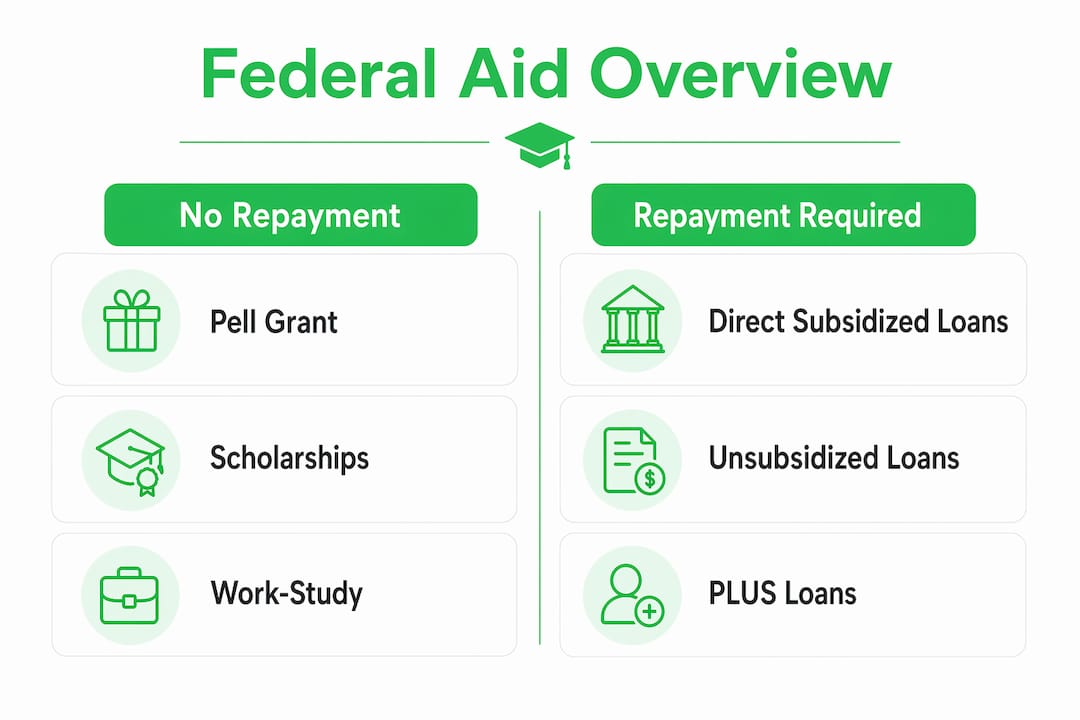
Not all aid from FAFSA comes with a repayment obligation. Understanding the difference protects you from borrowing more than you need.

Aid Type | Repayment Required? | Key Detail |
Pell Grant | No | Need-based; does not need to be repaid |
Federal Work-Study | No | Earned income, not debt |
Direct Subsidized Loan | Yes | Government pays interest while you are in school |
Direct Unsubsidized Loan | Yes | Interest accrues immediately after disbursement |
Parent PLUS Loan | Yes | Parent borrower is responsible, not the student |
Grad PLUS Loan | Yes | For graduate students; credit check required |
Federal grants like the Pell Grant and scholarships do not require repayment. Work-study funds are wages you earn through a part-time job. Neither creates debt. Federal Direct Loans are different. They require repayment with interest, and the interest terms vary by loan type.
Direct Subsidized Loans are the most favorable option for undergraduates with financial need. The government covers interest while you are enrolled at least half-time. Direct Unsubsidized Loans start accruing interest the moment funds are disbursed. That difference compounds significantly over a four-year degree.
Pro Tip: Accept subsidized loans before unsubsidized ones whenever possible. The interest savings over a standard repayment period can be substantial.
What are the 2026 federal student loan repayment plan changes?
Starting july 1, 2026, borrowers who take out new federal loans face a significantly narrowed set of repayment choices. This is one of the most consequential shifts in federal student loan policy in years, and FAFSA remains the gateway to the loans affected by it.
The two available plans for new loans after july 1, 2026 are:
Repayment Assistance Plan (RAP): Payments are calculated at 1%–10% of your adjusted gross income minus $50 per dependent. Forgiveness is available after 30 years of qualifying payments. Borrowers with lower income and higher balances benefit most from this plan.
Tiered Standard Plan: A fixed repayment schedule with payments that increase in tiers over time. Borrowers with smaller balances and stable income may find this plan more predictable and cost-effective.
According to expert analysis by Mark Kantrowitz, borrowers with lower income and higher balances benefit more from income-driven plans like RAP, while those with smaller balances may benefit from the Tiered Standard Plan. That guidance matters because choosing the wrong plan at the start of repayment can cost you thousands of dollars over time.
Borrowers with loans originated before july 1, 2026 retain access to older repayment plans, including existing IDR options. New borrowers do not. This makes the timing of your FAFSA filing and loan acceptance decisions more consequential than in previous years.
Loan default also directly affects your FAFSA eligibility. Default blocks all federal aid, including Pell Grants, until you resolve it. Staying current on your loans protects your ability to file FAFSA and access future aid. You can review your repayment plan options to understand which path fits your financial situation before you commit.
Common misconceptions about FAFSA and student loan repayment
Many borrowers carry assumptions about FAFSA that lead to real financial problems. Clearing these up early saves you from unexpected debt.
Misconception: FAFSA is a loan application. FAFSA is a financial aid eligibility form. Submitting it does not commit you to any loan or repayment obligation.
Misconception: Loans are automatic after FAFSA. Loan disbursement requires additional steps. You must complete Entrance Counseling and sign a Master Promissory Note (MPN) before any federal loan funds reach your school.
Misconception: Your loan servicer and FAFSA are connected. FAFSA’s role ends at eligibility determination. Once loans are disbursed, your loan servicer manages repayment. The servicer handles billing, payment processing, and plan changes. FAFSA has no further involvement.
Misconception: Repayment plans are assigned automatically. Borrowers must actively choose a repayment plan. If you do not select one, your servicer places you on a default plan that may not suit your income or goals.
Misconception: Filing FAFSA every year is optional. FAFSA must be filed annually to maintain federal aid eligibility. Skipping a year can interrupt your access to grants, loans, and program participation.
Pro Tip: Review your aid offer letter carefully before accepting any loans. You can accept grants and work-study while declining all or part of your loan offer.
How can borrowers manage FAFSA-linked federal loans effectively?
Managing federal student loans well starts before repayment begins. These steps keep you in control of your debt and your options.
Log into your FSA account regularly. Your Federal Student Aid account at studentaid.gov shows all your federal loans, balances, servicer information, and repayment history. Checking it at least once per semester keeps you informed.
Cross-check repayment calculators. The Federal Student Aid Loan Simulator may not reflect the most recent 2026 plan changes. Use independent calculators and updated resources to verify your projected payments before committing to a plan.
Choose your repayment plan proactively. Do not wait for your servicer to assign one. Compare RAP and the Tiered Standard Plan based on your income, balance, and long-term financial goals. You can also learn how to change your repayment plan if your situation changes.
Budget around your loan payments. Treating your loan payment like a fixed monthly bill, similar to rent, prevents missed payments. Resources on budgeting for repayment can help you build a plan that works.
Avoid default at all costs. Default removes your access to FAFSA-based aid entirely. If you are struggling, contact your servicer immediately to discuss deferment, forbearance, or plan changes before you miss a payment.
Staying organized and proactive is the single most effective way to manage federal student debt. The rules are complex, but the actions required of you are straightforward.
Key takeaways
FAFSA determines your eligibility for federal student aid but does not create any loan or repayment obligation on its own. Your repayment path is shaped entirely by the loans you accept, the plans you choose, and how consistently you stay current on payments.
Point | Details |
FAFSA is not a loan | Filing FAFSA creates no debt; only accepting a loan triggers repayment obligations. |
SAI drives your aid package | Your Student Aid Index determines financial need and shapes the loans and grants your school offers. |
2026 narrows plan choices | New loans after july 1, 2026 are limited to RAP or the Tiered Standard Plan. |
Default blocks future aid | Defaulting on any federal loan removes your FAFSA eligibility until the default is resolved. |
Active choices are required | You must complete Entrance Counseling, sign an MPN, and select a repayment plan yourself. |
What borrowers often get wrong about FAFSA’s real power
Most of the anxiety I see around FAFSA comes from a single misunderstanding: borrowers treat it as the source of their debt. They fill out the form, see a loan offer, and assume the debt is already theirs. That assumption leads to passive decision-making, and passive decision-making in federal student loans is expensive.
FAFSA is a key, not a lock. It opens access to federal programs that can genuinely reduce your repayment burden, including PSLF, IDR, and grant aid that never needs to be repaid. The borrowers who use it well are the ones who understand they still hold the decision-making power after they submit the form.
The 2026 repayment changes make this even more pressing. Borrowers who take out new loans without understanding the RAP and Tiered Standard Plan options are walking into a 30-year commitment without reading the terms. That is avoidable. The information is available. The tools exist. What is missing for most borrowers is the habit of checking before committing.
My honest advice: treat every FAFSA filing as the start of an annual financial review, not a bureaucratic checkbox. Look at what you owe, what you have accepted, and what your repayment plan will cost you over time. The federal government’s role in your loans does not end at disbursement, and neither should your attention to it.
— Ellis
How Titanprep helps you stay on top of your repayment
Federal student loan repayment involves more paperwork, deadlines, and plan decisions than most borrowers expect. Titanprep is a document preparation and support service that helps you organize and submit the paperwork for programs like IDR, PSLF, and borrower discharge options. Titanprep is not affiliated with the U.S. Department of Education or any loan servicer. The service tracks deadlines, stores your documents securely, and helps you maintain records of all submissions and servicer communications. If you are preparing for the 2026 plan changes or want to understand your current options, start with Titanprep’s student loan updates guide and explore the federal loan forgiveness programs available to borrowers like you.
FAQ
Does filing FAFSA mean I have to repay student loans?
No. Filing FAFSA does not create any repayment obligation. You only owe money if you accept a federal loan, complete Entrance Counseling, and sign a Master Promissory Note.
How does FAFSA affect my repayment plan options?
FAFSA determines which federal loans you are eligible for. The loans you accept then determine which repayment plans you can access, including RAP and the Tiered Standard Plan for loans originated after july 1, 2026.
Can I lose FAFSA eligibility if I default on student loans?
Yes. Loan default blocks all federal aid, including Pell Grants, until you resolve the default through rehabilitation or consolidation.
What is the Student Aid Index and why does it matter for repayment?
The SAI is a number calculated from your FAFSA data that measures your financial need. It shapes your aid package, including how much loan aid versus grant aid your school offers, which directly affects how much you need to borrow and repay.
What repayment plans are available for new federal loans in 2026?
Borrowers who take out new federal loans after july 1, 2026 can only access the Repayment Assistance Plan (RAP) or the Tiered Standard Plan. Older repayment options are not available for these new loans.
Recommended
Comments