
Tax Implications of Loan Forgiveness: Your 2026 Guide
- TitanPrep Official

- Jul 21
- 8 min read

The tax implications of loan forgiveness are defined as the federal and state income tax obligations that arise when a lender cancels your debt. Starting january 1, 2026, the IRS treats most forgiven student loan balances as ordinary income, which means a tax bill arrives alongside your debt relief. The forgiven amount gets added to your gross income for the year, potentially pushing you into a higher bracket and reducing eligibility for certain deductions. Not every forgiveness program works the same way, and knowing the difference between taxable and tax-free discharge is the first step toward managing what you owe.
What are the tax implications of loan forgiveness by program type?
The IRS does not treat all forgiveness equally. The program that cancels your debt determines whether you owe federal income tax, and the difference can be significant.

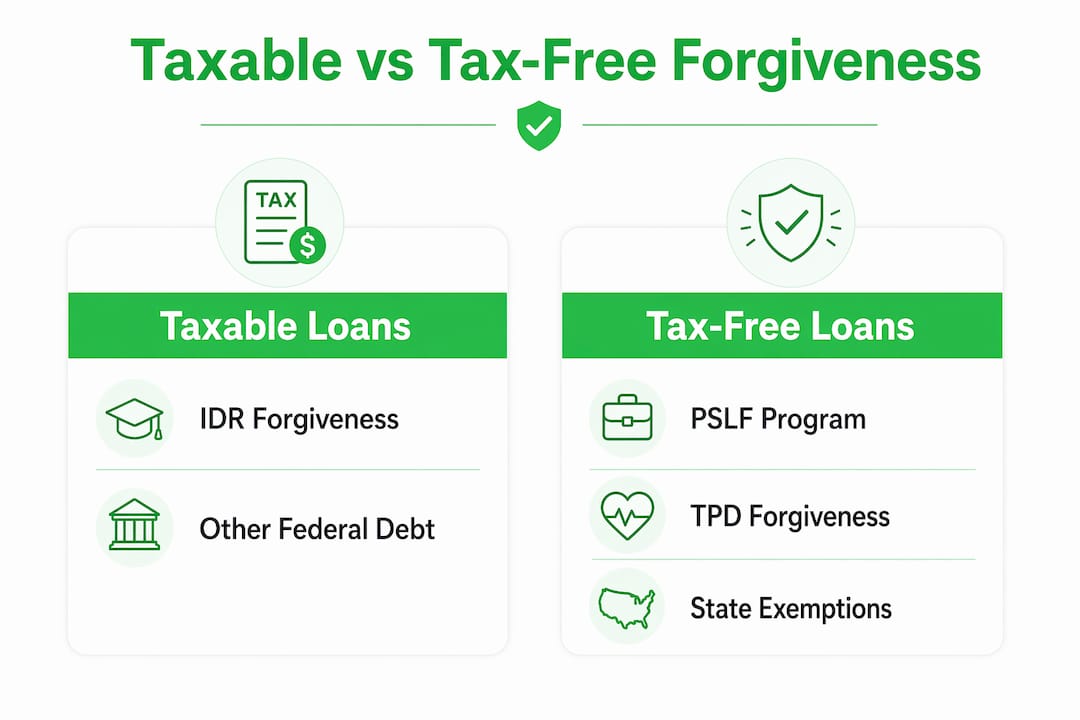
Programs that are federally taxable in 2026
IDR forgiveness is taxable starting january 1, 2026. Income-Driven Repayment plans include Income-Based Repayment, Pay As You Earn, and Saving on a Valuable Education. Borrowers who reach the end of their repayment term under any of these plans will receive a Form 1099-C from their loan servicer. That form reports the canceled amount as income, and the IRS expects you to include it on your tax return.
Programs that remain federally tax-free
Several forgiveness types carry no federal tax obligation:
Public Service Loan Forgiveness (PSLF): PSLF forgiveness is federally exempt and does not trigger Form 1099-C. Qualifying borrowers in government or nonprofit roles keep the full benefit. You can review eligibility details in Titanprep’s guide to PSLF and teacher forgiveness.
Total and Permanent Disability (TPD) discharge: Federally tax-free for borrowers who qualify based on a documented disability.
Death discharge: Loans discharged due to a borrower’s death are not taxable to the estate or co-borrowers.
Closed school discharge: Generally tax-free at the federal level, though state treatment varies.
Borrower defense to repayment: Federal tax treatment depends on the specific discharge approval; consult a tax professional for your situation.
Pro Tip: State tax rules do not automatically follow federal exemptions. Even if your forgiveness is federally tax-free, your state may still tax it. Check your state revenue authority’s guidance before assuming you owe nothing.
The distinction between taxable and tax-free programs matters most when you are planning your budget for the year your forgiveness is processed. Borrowers who qualify for DOE forgiveness programs should confirm their program type before assuming any tax outcome.
How do you calculate and report the tax on forgiven loans?
Forgiven student debt is classified as cancellation of debt income, or COD income, under IRS rules. The IRS requires you to report forgiven debt as income on Form 1040 in the tax year the cancellation occurs.
Here is how to work through the calculation and reporting process:
Receive Form 1099-C. Your loan servicer sends this form after your debt is canceled. Box 2 shows the forgiven amount. Keep it with your tax documents.
Add the forgiven amount to your gross income. The canceled balance is treated as ordinary income. If you earned $45,000 in wages and $57,000 was forgiven, your gross income for the year becomes $102,000.
Determine your tax bracket impact. An average IDR borrower with $57,000 forgiven and a 22% federal tax rate could owe more than $12,000 in federal tax on that forgiveness alone. That number does not include state taxes.
Check for secondary effects. Forgiveness-triggered income can eliminate access to the student loan interest deduction and phase out other income-based tax credits. The tax cost extends beyond the simple bracket calculation.
File Form 982 if the insolvency exclusion applies. The IRS insolvency exclusion lets you reduce or eliminate taxable COD income if your total liabilities exceeded your total assets at the moment of cancellation. You document assets and liabilities on Form 982 and attach it to your Form 1040.
Scenario | Forgiven Amount | Tax Bracket | Estimated Federal Tax |
IDR borrower, standard income | $57,000 | 22% | $12,540 |
Insolvent borrower (liabilities exceed assets) | $57,000 | 22% | $0 (excluded via Form 982) |
PSLF recipient | $57,000 | Any | $0 (federally exempt) |
Pro Tip: Timing matters. Borrowers whose forgiveness eligibility date falls before 2026 generally do not owe federal tax, even if the discharge processes in 2026. Confirm your eligibility date in writing with your servicer.
What strategies reduce the tax burden from loan forgiveness?
A large tax bill from loan forgiveness is manageable with the right preparation. The goal is to avoid a surprise when you file.
Adjust your tax withholding now. If you know forgiveness is coming, increase your federal withholding through your employer’s W-4 form. Spreading the tax cost across pay periods is easier than writing a single check in april.
Make estimated quarterly payments. Self-employed borrowers or those with variable income can pay estimated taxes to the IRS each quarter. This prevents underpayment penalties when the forgiven amount hits your return.
Set aside a dedicated savings reserve. Proactive tax planning reduces the month-to-month burden in your filing year. A separate savings account earmarked for your tax bill keeps the funds available and out of your regular spending.
Apply for an IRS installment agreement. Borrowers with total tax liability of $50,000 or less can request a short-term plan (180 days or less) or a monthly payment arrangement directly with the IRS. Borrowers above $50,000 face a more complex application process and may need professional help to negotiate terms.
Claim the insolvency exclusion if you qualify. If your debts exceeded your assets at the time of cancellation, file IRS Form 982 to exclude some or all of the forgiven amount from income. Document every asset and liability carefully.
Work with a tax professional. A CPA or enrolled agent familiar with COD income can identify exclusions you might miss and help you file accurately. For year-end planning strategies, resources like year-end tax planning tips provide a useful framework for organizing your finances before the filing deadline.
Pro Tip: Watch for legislative changes. No current legislation as of mid-2026 restores the federal tax exemption for IDR forgiveness, but Congress has revisited this issue before. Stay informed through Titanprep’s student loan updates page.
How do state taxes on forgiven loans differ from federal rules?
State tax treatment of forgiven student loans follows its own rules, and those rules do not automatically mirror federal law. State tax treatment can differ significantly from federal treatment, sometimes taxing forgiveness that the IRS exempts entirely.
The clearest example is Mississippi. PSLF forgiveness is federally tax-free, but Mississippi taxes it as state income. A borrower in Mississippi who receives $57,000 in PSLF forgiveness owes nothing to the IRS but still faces a state tax bill. That gap catches many borrowers off guard.
Key points to check for your state:
Does your state conform to federal COD income rules? Some states automatically adopt federal tax law changes; others do not. Conformity status determines whether your state taxes IDR forgiveness the same way the IRS does.
Does your state exempt PSLF or disability discharges? Federal exemptions do not bind state governments. Confirm your state’s position directly with your state department of revenue.
What is your state income tax rate? Even a modest state rate applied to a large forgiven balance creates a real dollar obligation. Factor this into your total tax estimate.
States have wide discretion over their own tax codes, and guidance changes. Consult your state tax authority or a local tax specialist to confirm your current treatment before your forgiveness is processed.
Key Takeaways
Most federal student loan forgiveness starting in 2026 is taxable as ordinary income, but programs like PSLF and TPD discharge remain federally exempt, making program type the single most important factor in your tax outcome.
Point | Details |
IDR forgiveness is taxable in 2026 | Forgiven IDR balances count as ordinary income and trigger IRS Form 1099-C starting january 1, 2026. |
PSLF and TPD discharge stay tax-free | These programs carry no federal income tax obligation and do not generate a Form 1099-C. |
Insolvency exclusion can eliminate the bill | File IRS Form 982 if your liabilities exceeded assets at cancellation to reduce or remove taxable income. |
State taxes may apply even when federal taxes do not | States like Mississippi tax PSLF forgiveness despite the federal exemption. Always verify your state’s rules. |
Proactive planning limits the tax shock | Adjusting withholding, making estimated payments, and saving ahead reduces the burden at filing time. |
The tax bill does not erase the benefit
I have worked with enough borrowers to say this clearly: the fear of a tax bill stops people from pursuing forgiveness they have already earned. That is a costly mistake.
Even with a $12,000 federal tax bill on $57,000 of forgiven debt, you are still $45,000 ahead of where you would have been repaying the full balance. The math favors forgiveness in almost every realistic scenario. The tax is real, but it is a fraction of the debt you no longer carry.
What I have seen go wrong is not the tax itself. It is the surprise. Borrowers who did not know the forgiveness was taxable get a Form 1099-C in February and have no savings set aside. That is the problem worth solving, and it is entirely preventable.
My honest advice: treat the tax as a known cost of the program, not a penalty. Build it into your plan the year before your forgiveness date. Watch for legislative changes, because Congress has adjusted these rules before and may do so again. And do not let uncertainty about state taxes paralyze you. Get a clear answer from your state revenue authority and move forward with accurate information.
Loan forgiveness, even taxable forgiveness, is one of the most significant financial relief tools available to federal borrowers. Use it.
— Ellis
How Titanprep supports borrowers through the forgiveness process
Titanprep helps federal student loan borrowers stay organized through every stage of the forgiveness process, from initial application to final discharge. The service assists with preparing and submitting paperwork for IDR plans, PSLF, and eligible discharge programs, and tracks deadlines so nothing falls through the cracks. Understanding the tax side of forgiveness is part of staying fully prepared, and Titanprep’s resources are built to support that. You can review how Titanprep works to see how document preparation and deadline tracking fit into your overall plan. Titanprep is not affiliated with the U.S. Department of Education, and eligibility for any federal program is determined solely by the Department or your loan servicer.
FAQ
Are forgiven student loans taxable in 2026?
Most forgiven student loans are taxable as ordinary income starting january 1, 2026. IDR forgiveness triggers a federal tax bill, while PSLF and disability discharges remain federally exempt.
What IRS form reports canceled student loan debt?
Your loan servicer issues IRS Form 1099-C after canceling your debt. You report the forgiven amount as income on Form 1040 for the year the cancellation occurs.
Can I avoid taxes on forgiven loans if I am insolvent?
Yes. The IRS insolvency exclusion lets you exclude forgiven debt from taxable income if your total liabilities exceeded your total assets at the time of cancellation. File IRS Form 982 with your return to claim this exclusion.
Does my state tax forgiven student loans?
State treatment varies widely. Some states tax forgiveness that is federally exempt, including PSLF forgiveness in Mississippi. Confirm your state’s rules with your state department of revenue before your forgiveness is processed.
What if I cannot pay the full tax bill at once?
Borrowers with total tax liability of $50,000 or less can apply for an IRS installment agreement, either a short-term plan of 180 days or less or a monthly payment arrangement. Balances above $50,000 require a more detailed application process.
Recommended
Comments