
Student Loans Went Back to Standard Payment in 2026


The Standard Repayment Plan is the fixed 10-year federal repayment structure that millions of borrowers are now returning to as student loans went back to standard payment following the end of the SAVE plan. This shift is not gradual. Starting July 1, 2026, the U.S. Department of Education began notifying SAVE plan enrollees that their income-driven protections are ending, and the clock is ticking. If you are among the borrowers affected, understanding what standard repayment means for your monthly budget, your options, and your timeline is the most important financial task you have right now.
How does the standard repayment plan work compared to income-driven plans?
The Standard Repayment Plan amortizes your loan balance over 120 months with equal fixed monthly payments, meaning your payment amount never changes and your loan is fully paid off in 10 years. For consolidation loans, the term can extend up to 30 years, but the same fixed-payment logic applies.
The math is straightforward but the impact is real. A $35,000 loan at 5.5% interest costs roughly $380 per month under Standard Repayment, compared to under $200 per month under SAVE for a borrower earning $45,000 annually. That gap represents a significant budget shift for most recent graduates.

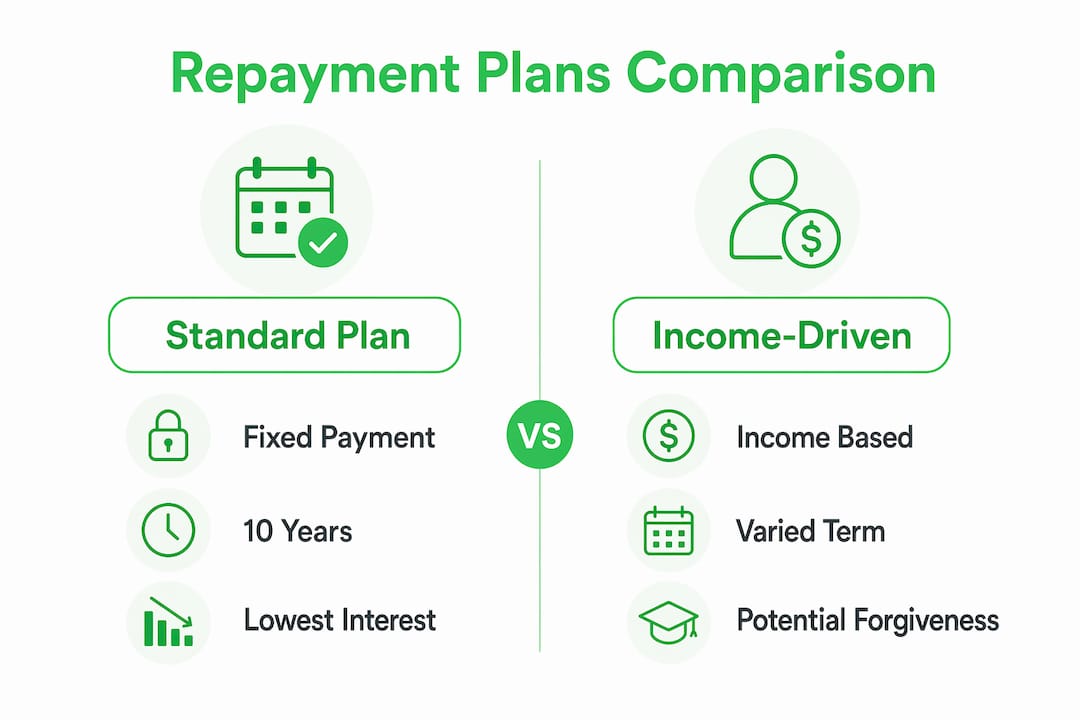
The trade-off is total interest paid. The Standard Repayment Plan pays the least total interest of any federal repayment option because you pay off the principal faster. Income-Driven Repayment plans like SAVE, PAYE, and IBR lower your monthly payment by extending your term, sometimes to 20 or 25 years, which means you pay more interest over time.
Here is a side-by-side comparison of the key differences:
Feature | Standard Repayment | Income-Driven Plans (SAVE, IBR, PAYE) |
Monthly payment | Fixed, based on loan balance | Based on income and family size |
Repayment term | 10 years (up to 30 for consolidation) | 20 to 25 years |
Total interest paid | Lowest among federal plans | Higher due to extended term |
Forgiveness eligibility | None | Yes, after 20 or 25 years |
Payment flexibility | None | Adjusts with income changes |
Pro Tip: Enrolling in autopay under the Standard Repayment Plan reduces your interest rate by 0.25%, which lowers your monthly payment slightly and reduces total interest paid over the life of the loan. It is a small but consistent saving that requires no extra effort.
What is the 2026 transition timeline for SAVE plan borrowers?
The transition process follows a specific schedule that every SAVE plan borrower needs to understand. Here is how it unfolds:
July 1, 2026: Federal loan servicers begin sending notices to SAVE plan borrowers. Each borrower receives a personal notification, not a general announcement.
90-day decision window: From the date your notice is sent, you have 90 days to select a new repayment plan. This window is individual, not universal.
September to October 2026: Borrowers who do not choose a plan are automatically enrolled in Standard or Tiered Standard by their servicer.
After auto-enrollment: Your new fixed payment begins. Changing plans after this point is possible but requires additional paperwork and processing time.
One detail that many borrowers miss: not all deadlines are the same. Because notices go out on a rolling basis, some borrowers have until October 2026 to act. That staggered timeline means you should not assume your deadline matches your classmate’s or your coworker’s. Check your servicer account directly.
Pro Tip: Do not wait for your notice to arrive before researching your options. Review the available student loan repayment plans now so you are ready to act the moment your 90-day window opens.
How will returning to standard payments affect your budget?
The financial impact of this transition is the part that catches most borrowers off guard. Monthly bills can double when moving from SAVE to Standard Repayment, and for borrowers who have been on income-driven plans for years, the adjustment is significant.
Standard payments are fixed and can represent 10 to 15 percent or more of gross income for some borrowers. That percentage matters because it directly competes with rent, groceries, transportation, and other non-negotiable expenses. Many borrowers underestimate this impact until the first higher bill arrives.
Here are the key budget areas to evaluate before your transition date:
Housing costs: A higher loan payment reduces the income available for rent or mortgage. If your debt-to-income ratio was already tight, managing your debt load becomes more complex when standard payments resume.
Emergency savings: Fixed payments leave less room for unexpected expenses. Building a buffer before your transition date reduces financial risk.
Discretionary spending: Subscriptions, dining, and entertainment budgets are the first areas most borrowers adjust to absorb higher loan payments.
Deferment and forbearance: These options still exist under Standard Repayment but are not automatic. You must apply and qualify, and interest continues to accrue during most forbearance periods.
“Many borrowers underestimate the financial impact of the plan change until receiving higher monthly bills.” — The Financial Wire
Using a debt payoff calculator before your transition date helps you visualize exactly how long repayment will take and how much total interest you will pay under different scenarios. That clarity makes budget planning much more concrete.
What repayment alternatives can reduce your payment increase?
The end of SAVE does not mean your only option is the Standard Repayment Plan. The 2026 overhaul introduced new plans and preserved some legacy options depending on your borrowing history.
Plan | Who qualifies | Key feature |
Repayment Assistance Plan (RAP) | All federal borrowers | Payments from 1% to 10% of income |
Tiered Standard Plan | All federal borrowers | Fixed payments, tiered by loan balance |
IBR (legacy) | Borrowers with no new loans after July 1, 2026 | Income-based, 20 to 25 year term |
Standard Repayment | All federal borrowers | Fixed, 10-year term |
Extended Repayment | Borrowers with $30,000+ in loans, no new loans post-July 2026 | Fixed or graduated, up to 25 years |
The Repayment Assistance Plan is the most significant new option for borrowers who need income-based flexibility. RAP caps payments between 1% and 10% of earnings and protects against runaway interest accumulation, meaning your balance does not grow uncontrollably even when payments are low.
The Tiered Standard Plan is a fixed-payment option structured in tiers based on your loan balance. It is available to all federal borrowers and provides a middle ground between the full Standard payment and income-driven options.
Legacy plans, including IBR, Extended, and Graduated Repayment, remain available to borrowers who do not take new federal loans after July 1, 2026. This is a critical detail. Taking out even one new federal loan after that date triggers a mandatory shift to RAP or Tiered Standard for all your loans, including existing ones. Parent PLUS loan borrowers face an even more restricted set of choices, with only the Tiered Standard Plan available for new borrowing after mid-2026.
Pro Tip: If you are considering graduate school or any additional federal borrowing, understand that new loans after July 2026 eliminate your access to IBR and PAYE for all your loans. That decision has long-term repayment consequences worth calculating before you apply.
How can you take control before automatic enrollment happens?
Acting before your servicer makes the decision for you is the single most effective step you can take right now. Early action avoids default and gives you control over which plan fits your financial situation rather than accepting whatever the auto-enrollment process assigns.
Follow these steps to stay ahead of the transition:
Log into your servicer account today. Confirm your current plan, loan balance, and interest rate. This is your baseline.
Calculate your payment under each option. Use the Federal Student Aid loan simulator at studentaid.gov to compare Standard, RAP, and Tiered Standard payments side by side.
Review your budget honestly. Determine the maximum monthly payment you can absorb without compromising rent, utilities, or savings.
Select your plan before your notice arrives. You do not have to wait for the 90-day window to open. Contact your servicer directly to request a plan change at any time.
Document everything. Keep records of your plan selection, confirmation numbers, and any communications with your servicer. Disputes are easier to resolve when you have written proof.
Learning how to change your repayment plan before the deadline removes the pressure of acting under a tight timeline. If your current income makes standard payments unaffordable, exploring income-driven repayment options now gives you time to gather documents and submit a complete application.
Key takeaways
The most important action any SAVE plan borrower can take in 2026 is selecting a new repayment plan before the 90-day auto-enrollment window closes, because waiting means the government chooses for you.
Point | Details |
Standard plan mechanics | Fixed payments over 10 years result in the lowest total interest but the highest monthly cost. |
2026 transition timeline | Notices begin July 1, 2026; auto-enrollment into Standard or Tiered Standard follows after 90 days. |
Payment shock is real | Monthly payments can double moving from SAVE to Standard, representing 10 to 15 percent of gross income. |
New alternatives exist | RAP offers income-based payments from 1% to 10% of earnings for borrowers who need flexibility. |
New loans change everything | Borrowing any new federal loan after July 1, 2026 eliminates access to IBR and PAYE for all your loans. |
What this transition really means for borrowers
The return to standard student loan payments is not just a policy change. It is a financial reality check for millions of borrowers who built their budgets around lower income-driven payments. I have seen how quickly payment shock can derail otherwise solid financial plans, and the 2026 transition is one of the most significant shifts in federal student loan policy in years.
What concerns me most is the gap between when notices go out and when borrowers actually read them. A 90-day window sounds generous until you factor in the time needed to compare plans, run the numbers, and submit paperwork correctly. Borrowers who treat this as urgent, not eventual, are the ones who end up with a plan that actually fits their life.
The good news is that the new repayment structure does include real alternatives. RAP is a meaningful option for borrowers with variable or lower incomes. The Tiered Standard Plan gives structure without the full weight of the 10-year fixed payment. The tools exist. The question is whether you use them before the deadline or after.
My honest advice: do not let the complexity of this transition become an excuse for inaction. Read the latest student loan updates, know your numbers, and make a deliberate choice. The borrowers who come out of this transition in the best shape are the ones who treated July 2026 as a deadline, not a suggestion.
— Ellis
How TitanPrep helps you manage the repayment transition
Staying organized during a major repayment transition is harder than it sounds. TitanPrep helps federal student loan borrowers prepare and submit the paperwork needed to apply for Income-Driven Repayment plans, including RAP, and tracks deadlines so nothing falls through the cracks. Through the TitanPrep client portal, you can upload documents, monitor your file status, and maintain records of every submission and servicer communication. If you are unsure which plan fits your situation or want support staying on track through the 2026 changes, see how TitanPrep works and take the first step toward a repayment plan that actually fits your budget. TitanPrep is not affiliated with the U.S. Department of Education.
FAQ
What does it mean that student loans went back to standard payment?
It means the SAVE plan is ending and borrowers are being transitioned to the Standard Repayment Plan, which requires fixed monthly payments over 10 years. Borrowers who do not select a new plan within their 90-day window will be automatically enrolled in Standard or Tiered Standard by their servicer.
When does the 2026 student loan transition take effect?
Servicer notices begin going out on July 1, 2026, with each borrower receiving an individual 90-day window to choose a new plan. Auto-enrollment is expected between September and October 2026 for borrowers who do not act.
Can I avoid the Standard Repayment Plan if payments are too high?
Yes. The Repayment Assistance Plan (RAP) and the Tiered Standard Plan are both available as alternatives. Legacy plans like IBR remain accessible for borrowers who do not take new federal loans after July 1, 2026.
What happens if I miss my 90-day deadline?
Your servicer will automatically place you in the Standard or Tiered Standard Repayment Plan. You can still request a plan change after enrollment, but the process takes additional time and your higher payment may begin before the switch is processed.
Does borrowing new federal loans after July 2026 affect my existing repayment plan?
Yes. Taking out any new federal loan after July 1, 2026 eliminates your eligibility for IBR and PAYE across all your loans, including existing ones, and restricts you to RAP or Tiered Standard going forward.
Recommended
Comments