
Student Loan Tax Impact: What Borrowers Need to Know


The student loan interest deduction is defined as an above-the-line tax deduction that lets eligible borrowers reduce their taxable income by up to $2,500 per year in interest paid on qualifying federal or private student loans. Understanding student loan tax impact goes beyond this single deduction. Starting in 2026, most loan forgiveness under Income-Driven Repayment plans is taxable income again, meaning a forgiven balance can trigger a tax bill that catches borrowers off guard. Knowing which forms to track, which programs stay tax-free, and how to plan ahead puts you in a much stronger position at tax time.
How does the student loan interest deduction work?
The student loan interest deduction reduces your taxable income by up to $2,500 per year based on interest you actually paid. This deduction is an adjustment to income, not an itemized deduction. That means you can claim it even if you take the standard deduction, which benefits the majority of filers.
Your eligibility depends on your Modified Adjusted Gross Income, or MAGI. The IRS phases out the deduction for single filers with a MAGI above $85,000 and eliminates it completely at $100,000. Married borrowers filing jointly get double those thresholds. If your income falls within the phase-out range, you still receive a partial deduction.

To qualify, your loan must have been taken out solely to pay for qualified education expenses. You must also be legally obligated to repay the loan, meaning a parent who pays off a loan in their child’s name cannot claim the deduction unless they are also the borrower.
Here is a quick summary of eligibility requirements:
The loan must be a qualified student loan used for higher education expenses.
You cannot be claimed as a dependent on someone else’s return.
Your MAGI must fall below the phase-out ceiling for your filing status.
You must have paid interest during the tax year, not just accrued it.
Pro Tip: If you have multiple loans with different servicers, add up the interest from all your Form 1098-E statements before entering a number on your return. Missing even one form understates your deduction.
Your loan servicer sends Form 1098-E when you pay $600 or more in interest during the year. This form shows the exact amount of interest you paid and is the document you use to claim the deduction. Keep every 1098-E you receive, since multiple servicers may each send a separate form that you must combine for your filing.
What are the tax implications of student loan forgiveness starting in 2026?
The American Rescue Plan Act temporarily excluded most student loan forgiveness from federal income tax through the end of 2025. That exclusion has expired. Starting in 2026, most IDR forgiveness is treated as ordinary taxable income again.
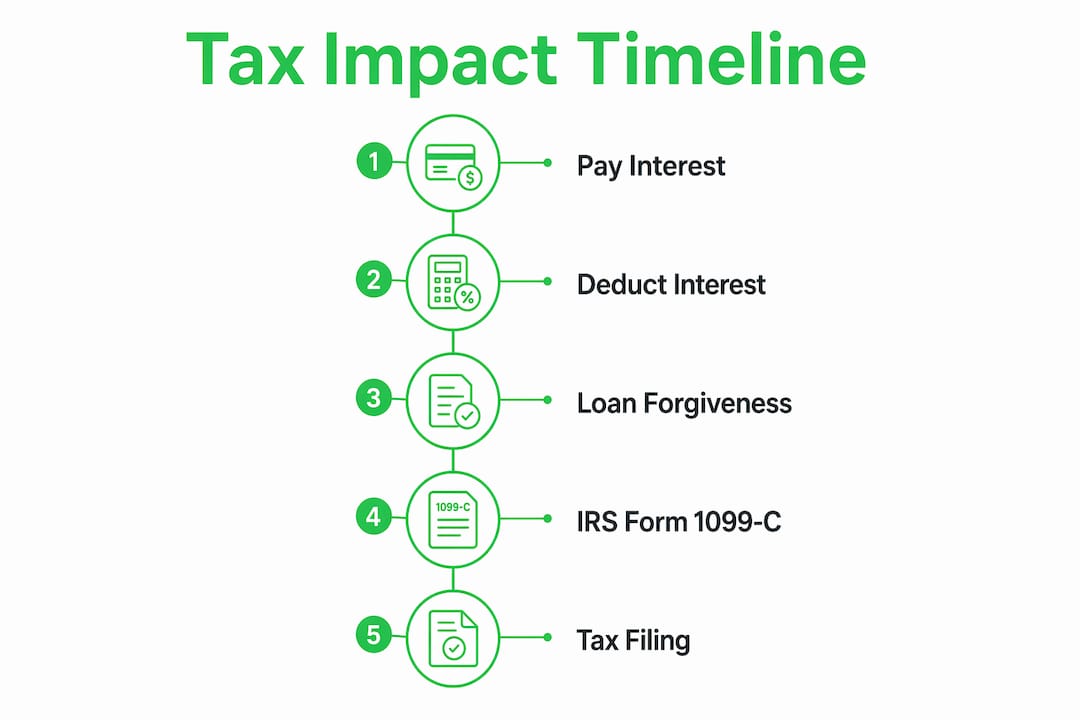
The financial impact can be significant. If $57,000 of your loan balance is forgiven and you are in the 22% tax bracket, your federal tax bill from that forgiveness alone could exceed $12,000. That figure does not include state taxes, which vary by state and can add thousands more.
Not all forgiveness programs carry this tax liability. The following programs remain tax-free after 2025:
Public Service Loan Forgiveness (PSLF): Forgiveness after 120 qualifying payments in public service is still excluded from federal income tax.
Teacher Loan Forgiveness: Forgiveness for qualifying teachers remains tax-free at the federal level.
Total and Permanent Disability Discharge: Borrowers who qualify due to disability continue to receive tax-free discharge.
Death Discharge: Loan discharge due to the borrower’s death is not taxable income.
The tax consequences of forgiveness can also push you into a higher tax bracket for that year. A higher bracket reduces your eligibility for income-sensitive credits like the Earned Income Tax Credit or the Child Tax Credit. This is the ripple effect that most borrowers do not anticipate.
When debt is cancelled, your servicer or the Department of Education issues Form 1099-C. You must report this amount as income on your federal return. Failing to report it triggers IRS notices and potential penalties. You can review the 2026 forgiveness program updates to understand which programs apply to your situation.
How can borrowers plan for potential tax liabilities from forgiveness?
Proactive planning is the most effective way to avoid a surprise tax bill. Borrowers who know forgiveness is coming have time to prepare. Those who do not plan often face a bill they cannot pay in a single lump sum.
Follow these steps to stay ahead of the liability:
Estimate your forgiven amount. Contact your loan servicer and ask for a projected payoff balance at your expected forgiveness date. This gives you a working number to plan around.
Adjust your tax withholding. If you are a W-2 employee, submit an updated Form W-4 to increase withholding in the year forgiveness occurs. This spreads the tax payment across the year instead of creating a lump-sum bill in april.
Make estimated tax payments. Self-employed borrowers or those with variable income should use IRS Form 1040-ES to make quarterly payments in the year of forgiveness.
Build a dedicated savings fund. Set aside a portion of your income each month in the years leading up to forgiveness. Treat it like a tax escrow account.
Consult a tax professional early. A CPA or enrolled agent familiar with student loan tax rules can model your specific scenario and recommend the right strategy. Forgiveness tax planning is complex enough that professional guidance pays for itself.
One option many borrowers overlook is the insolvency exclusion. If your total liabilities exceed your total assets at the moment of forgiveness, you may qualify to exclude some or all of the forgiven amount from income using IRS Form 982. This requires detailed financial documentation, but it can dramatically reduce your tax burden.
Pro Tip: Even borrowers who end up owing taxes after IDR forgiveness often come out ahead financially compared to continuing to make full payments. Run the numbers with a tax advisor before assuming forgiveness is a bad deal.
What tax documents do you need to track?
Two forms matter most for borrowers: Form 1098-E and Form 1099-C. Knowing what each one reports and when to expect it prevents filing errors and missed deductions.
Form 1098-E is the interest statement. Your loan servicer sends it by january 31 each year if you paid $600 or more in interest. The form shows the total interest paid during the prior tax year. If you have loans with more than one servicer, each servicer sends its own 1098-E. You add all of them together to calculate your total deductible interest.
Form 1099-C is the cancellation of debt statement. The IRS requires lenders and servicers to issue this form when they cancel $600 or more in debt. You must report the amount shown on Form 1099-C as income unless an exclusion applies, such as insolvency or a tax-free forgiveness program.
Document | What it reports | When you receive it | Action required |
Form 1098-E | Interest paid on student loans | By january 31 | Claim deduction on Schedule 1 |
Form 1099-C | Cancelled or forgiven debt amount | After forgiveness event | Report as income or apply exclusion |
If a form does not arrive and you believe you qualify, contact your servicer directly. Servicers are required to provide these forms. If the amount shown is incorrect, request a corrected form before filing. Keep copies of all correspondence in case the IRS asks for documentation later.
Key Takeaways
The student loan interest deduction reduces taxable income by up to $2,500 without itemizing, while most IDR forgiveness becomes taxable income starting in 2026, requiring borrowers to plan ahead with the right documents and strategies.
Point | Details |
Interest deduction limit | Eligible borrowers deduct up to $2,500 annually; income phase-outs begin at $85,000 MAGI for single filers. |
2026 forgiveness tax change | Most IDR forgiveness is taxable again; a $57,000 forgiven balance can trigger a $12,000+ federal tax bill. |
Tax-free programs | PSLF, Teacher Loan Forgiveness, and disability discharge remain exempt from federal income tax. |
Key documents | Form 1098-E reports interest paid; Form 1099-C reports cancelled debt. Both must be filed correctly. |
Insolvency exclusion | IRS Form 982 can reduce or eliminate tax on forgiven debt if your liabilities exceed your assets at forgiveness. |
What I’ve learned watching borrowers face the 2026 tax shift
Most borrowers I talk to are surprised by two things. First, they did not know the interest deduction applies even when they take the standard deduction. Second, they assumed all loan forgiveness was tax-free because of what they read during the pandemic years.
The American Rescue Plan Act created a temporary window that ended after 2025. Many borrowers planned their finances around that window staying open permanently. It did not. The borrowers who are in the best position right now are the ones who started adjusting their withholding and building savings two or three years before their expected forgiveness date.
The insolvency exclusion is genuinely underused. A lot of borrowers who qualify for it never claim it because they do not know it exists or they assume the paperwork is too complicated. A qualified tax professional can walk you through IRS Form 982 in a single appointment. That one conversation could save you thousands of dollars.
My honest recommendation: do not wait until the year of forgiveness to think about taxes. The future of forgiveness programs is still evolving, and tax laws can shift again. Staying informed and planning early gives you options. Waiting gives you a bill.
— Ellis
How Titanprep can help you stay organized through it all
Managing the paperwork side of student loan programs is where many borrowers lose time and miss deadlines. Titanprep is a document preparation and support service that helps borrowers organize, submit, and track paperwork for federal programs including IDR, PSLF, and disability discharge. The service is not affiliated with the U.S. Department of Education. Titanprep does not guarantee forgiveness or specific outcomes. Eligibility is determined solely by the Department of Education or your loan servicer.
You can review how Titanprep works to understand the support available, or visit the student loan FAQ page for answers to common questions about forgiveness programs and tax considerations. Staying organized now makes the tax side of forgiveness much easier to manage later.
FAQ
Can I deduct student loan interest without itemizing?
Yes. The student loan interest deduction is an above-the-line adjustment to income, so you can claim it even when using the standard deduction.
Is PSLF forgiveness taxable in 2026?
No. Public Service Loan Forgiveness remains tax-free at the federal level. Only most IDR-based forgiveness became taxable again starting in 2026.
What is the student loan tax bomb?
The student loan tax bomb refers to the large tax bill borrowers face when a significant loan balance is forgiven under an IDR plan and counted as ordinary taxable income. A $57,000 forgiven balance at a 22% rate generates over $12,000 in federal taxes.
What should I do if I receive Form 1099-C?
Report the cancelled debt amount as income on your federal return, then determine whether an exclusion applies. If your liabilities exceeded your assets at the time of forgiveness, you may qualify for the insolvency exclusion using IRS Form 982.
How do I get my Form 1098-E if it never arrived?
Contact your loan servicer directly and request the form. Servicers are required to issue it if you paid $600 or more in interest. You can also log into your servicer’s online portal, where the form is typically available for download by january 31.
Recommended
Comments