
Student Loan Help vs Doing It Yourself in 2026


Student loan help versus doing it yourself defines whether you manage repayment applications and plan selections independently or pay someone to handle the paperwork for you. Most borrowers can handle the basics on their own using free federal tools, but 2026 brings a new set of repayment plans that raise the stakes for getting it wrong. Federal loan complaints reached 18,400 for the year ending June 2025, a 36% increase, which signals that more borrowers are struggling to stay on top of their obligations. Knowing when to go it alone and when to get support is the most practical decision you can make right now.
What does managing your student loans yourself actually involve?
Self-managing student loans means you use official government resources to research, select, and apply for repayment plans without paying a third party. The process is more structured than most borrowers expect, and StudentAid.gov resources give you everything you need to plan repayment, including when and how to pay, and how to contact your servicer if problems arise.
Here is what DIY student loan management typically looks like in practice:
Log in to StudentAid.gov to review your loan types, balances, and current servicer information.
Use the Loan Simulator tool on StudentAid.gov to compare monthly payments across all available repayment plans based on your income and family size.
Submit your repayment plan application directly through your servicer’s website or through StudentAid.gov, depending on the plan.
Recertify your income annually for Income-Driven Repayment (IDR) plans to keep your payment accurate and maintain eligibility.
Track your Public Service Loan Forgiveness (PSLF) progress using the PSLF Help Tool if you work for a qualifying employer.
The NFCC recommends that borrowers start with free online repayment guidance, which covers most scenarios in under 10 minutes, and only escalate to counseling when dealing with private loans or forgiveness applications. That is a useful benchmark. If your situation fits neatly into the federal system, you likely do not need to pay anyone.
Pro Tip: When you apply for an IDR plan, consent to IRS data sharing within the application. This pulls your income directly from your tax return and removes the need to upload documents manually, which speeds up processing considerably.
What professional help options exist for student loan borrowers?
Professional student loan assistance options range from free nonprofit counseling to paid document preparation services, and the quality gap between them is significant. Understanding what each type actually delivers helps you avoid overpaying or, worse, falling for a scam.
Here are the main categories of professional help available to you:
Nonprofit credit counseling: Organizations accredited by the NFCC offer free initial sessions to review your loan situation and recommend repayment strategies. Nonprofit credit counseling may charge monthly fees if you enroll in a Debt Management Plan, but the initial guidance is typically no cost. This is the most trustworthy category of paid help.
Financial literacy coaching: Services like Storehouse Firm provide structured education on debt and credit, helping borrowers understand their options before making decisions. This works well if you want to build knowledge rather than outsource a task.
Paid document preparation services: These companies charge fees to prepare and submit applications for IDR, PSLF, or discharge programs. The catch is that document prep services can cost up to $1,200 and often require the same work from you as applying directly.
Scam operations: These are not legitimate services. They promise guaranteed forgiveness, charge upfront fees, and often request your FSA ID credentials. Any company asking for your FSA ID login is a red flag without exception.
Professional help makes the most sense when you have multiple loan types including private loans, when you are applying for PSLF and need to track employer certifications over many years, or when you have missed payments and need to understand rehabilitation options. For straightforward federal repayment plan selection, the free tools are sufficient.
Pro Tip: Before paying any company for student loan help, search their name on the Consumer Financial Protection Bureau’s complaint database and your state attorney general’s website. Legitimate services have verifiable track records.
DIY vs. professional help: costs, risks, and real outcomes
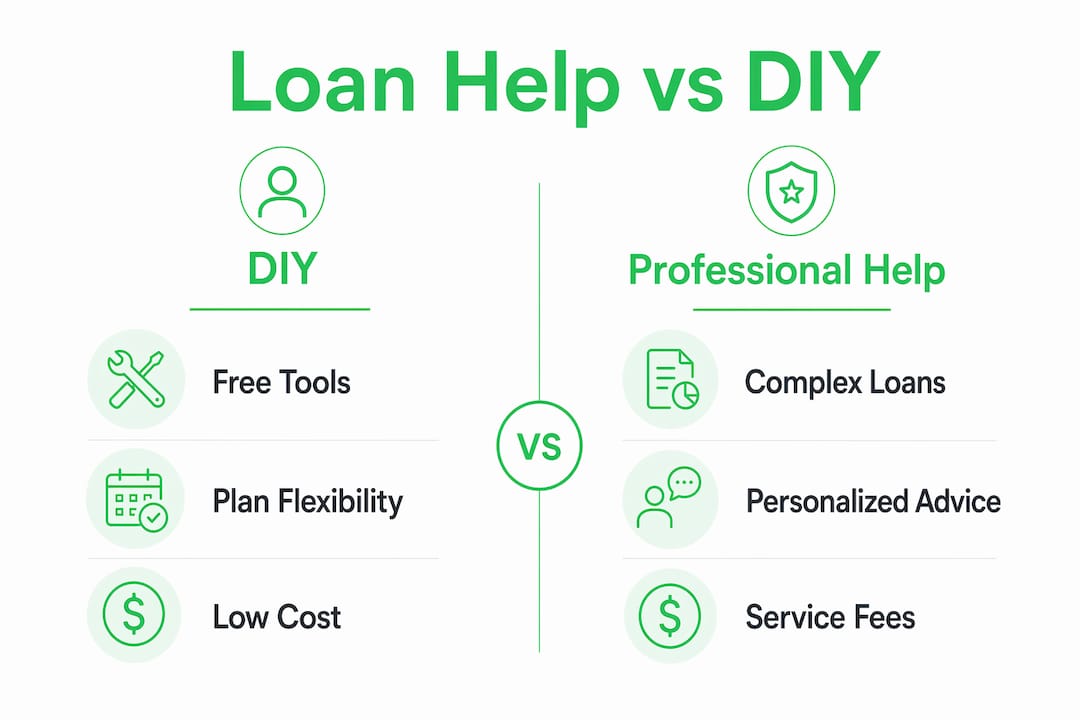
The most direct comparison between self-managing student loans and paying for help comes down to three factors: cost, risk, and the actual work involved.

Factor | DIY approach | Professional help |
Cost | Free through federal tools and servicers | $0 (nonprofit) to $1,200+ (paid services) |
Risk level | Low if using official channels | Moderate to high with unverified paid services |
Workload | Moderate; requires research and attention | Similar workload; you still provide documents |
Speed | Standard processing times | Faster with IRS data consent via official programs |
Accuracy | High if following federal instructions | Variable; depends on service quality |
The cost difference is the most striking point. Federal repayment plan applications through StudentAid.gov and your servicer cost nothing. Paying for forgiveness help often duplicates your own effort and carries real financial risk. A borrower who pays $800 to a document prep company and then provides all the same income documents themselves has not saved time. They have simply paid for a filing service that the government provides for free.
“Any company demanding FSA ID credentials to handle forgiveness or repayment applications is a red flag. Real support comes from official channels and nonprofit counseling.” — Hechinger Report
The risk profile of paid services is also uneven. Scams that request borrower passwords or verification codes are common and can result in identity theft or unauthorized account changes. DIY carries its own risk, mainly the risk of selecting the wrong plan or missing a deadline, but those errors are correctable through your servicer at no cost.
How do 2026 repayment changes affect the DIY vs. help decision?
Starting July 1, 2026, the federal repayment system changed in ways that make plan selection more consequential than it has been in years. Two main repayment options now exist for most federal borrowers: the Tiered Standard Plan and the Repayment Assistance Plan (RAP). Legacy plans, including older income-driven options, are being phased out by 2028.
Here is what each plan means for your decision:
Plan | Best for | Key feature |
Tiered Standard Plan | Borrowers with stable income | Fixed payments that decrease over time in tiers |
Repayment Assistance Plan (RAP) | Lower-income borrowers | Payments based on income, with a path to forgiveness |
The transition window is where borrowers face the greatest risk. Errors during plan enrollment can lead to default or missed forgiveness credit. IRS data consent within official applications speeds up income verification and reduces the chance of processing errors. This is a feature available to anyone applying directly through the federal system, not just those using paid services.
If you were enrolled in the SAVE plan, which was ruled unlawful, you need to actively select a new compliant plan before the 2028 deadline. Waiting is not a safe option. The repayment plan change process involves submitting a new application through your servicer, and the 2026 options require you to understand the difference between income-based and tiered payment structures before you choose.
For borrowers with straightforward federal loans, the DIY path through StudentAid.gov handles this transition well. For borrowers with complex situations, including multiple servicers, prior default history, or PSLF tracking needs, this is the moment when organized document support adds real value.
Key takeaways
Choosing between student loan help and doing it yourself comes down to your loan complexity, your comfort with federal tools, and your ability to stay organized through multi-year repayment programs.
Point | Details |
DIY is free and sufficient for most | Federal tools on StudentAid.gov cover plan selection, IDR applications, and PSLF tracking at no cost. |
Paid help rarely saves effort | Document prep services cost up to $1,200 and still require you to provide the same documents you would submit yourself. |
2026 plan changes raise the stakes | The shift to RAP and Tiered Standard Plan means selecting the wrong option now can affect forgiveness eligibility and payment amounts for years. |
Scam risk is real and specific | Any service requesting your FSA ID credentials is fraudulent. Legitimate help never requires your login. |
Nonprofit counseling is the safe middle ground | NFCC-accredited counselors offer free initial sessions and carry no scam risk, making them the best option when you want expert input without paying for document prep. |
What I’ve learned from watching borrowers navigate this choice
I have seen borrowers at both extremes. Some spend hundreds of dollars on services that file the same IDR application they could have submitted in 20 minutes on StudentAid.gov. Others avoid getting any help at all, miss their recertification deadline, and watch their payments spike because their servicer defaulted them to a standard plan.
The honest truth is that most federal loan situations do not require paid help. The federal system is designed for self-service, and the free tools are genuinely good. Where I see borrowers get into trouble is not in the application itself but in the follow-through. Recertifying income every year, tracking PSLF payment counts, and responding to servicer notices on time are the tasks that trip people up. That is where organized support, whether from a nonprofit counselor or a document preparation service like TitanPrep, adds real value. Not because the tasks are complicated, but because life gets in the way and deadlines get missed.
My advice is to start with the free tools. Use the Loan Simulator. Read the federal vs. private loan comparison before you assume your situation is more complex than it is. If you hit a wall, go to an NFCC-accredited counselor before paying anyone else. And if you decide you want document preparation support, choose a service that is transparent about what it does and does not guarantee outcomes it cannot control.
The 2026 repayment changes are real and they matter. But they are also navigable. You do not need to panic, and you do not need to pay someone $1,000 to file a form. You need accurate information and a plan.
— Ellis
How TitanPrep helps you stay organized through every step
TitanPrep is a document preparation and support service built for federal student loan borrowers who want to stay organized without overpaying for help. The service assists with preparing and submitting applications for IDR plans, PSLF, and certain discharge programs, and tracks deadlines so nothing falls through the cracks. TitanPrep does not guarantee forgiveness or specific outcomes. Eligibility is always determined by the U.S. Department of Education or your servicer.
If you are weighing your options right now, start with the federal forgiveness guide to understand which programs you may qualify for. You can also review how TitanPrep works to see whether document preparation support fits your situation. For quick answers on the 2026 plan changes, the student loan updates page covers the latest on RAP, Tiered Standard Plan, and what former SAVE enrollees need to do next.
FAQ
Is student loan help worth paying for?
Paid student loan help is rarely worth the cost for standard federal repayment plan applications, which are free through StudentAid.gov. It may add value for borrowers managing complex multi-loan situations, PSLF tracking over many years, or discharge applications that require organized documentation.
What are the risks of DIY student loan management?
The main risks of self-managing student loans are missing recertification deadlines for IDR plans and selecting the wrong repayment plan during transition periods like the 2026 shift to RAP and Tiered Standard Plan. Both errors are correctable but can temporarily increase your payment or affect forgiveness progress.
How do I know if a student loan help service is a scam?
Any service that requests your FSA ID username and password, guarantees loan forgiveness, or charges large upfront fees before doing any work is a scam. Legitimate services, including nonprofit counselors and document preparation companies, never need your federal login credentials.
What is the Repayment Assistance Plan (RAP)?
RAP is one of two main federal repayment options available starting July 1, 2026, designed for borrowers with lower incomes. Payments are based on income and the plan includes a path to forgiveness, making it a strong option for borrowers who previously used income-driven plans like SAVE or REPAYE.
Can I apply for IDR plans without professional help?
Yes. IDR plan applications are submitted directly through StudentAid.gov or your loan servicer at no cost. Consenting to IRS data sharing during the application speeds up income verification and reduces the paperwork you need to provide manually.
Recommended
Comments