
Student Loan Forbearance Guide: Know Your Options
- TitanPrep Official

- Jul 21
- 8 min read

Student loan forbearance is defined as a temporary pause or reduction of your federal loan payments during a period of financial hardship. Federal guidelines allow forbearance for up to 12 months at a time, with a cumulative maximum of three years for discretionary types. Interest accrues on all loan types during forbearance, which means your balance grows even when you are not making payments. This student loan forbearance guide walks you through every stage: types, eligibility, application steps, financial costs, and smarter alternatives so you can make a clear, confident decision.
What are the types of student loan forbearance?
Federal forbearance falls into three categories: mandatory, general (also called discretionary), and administrative. Each has different eligibility rules and approval processes.

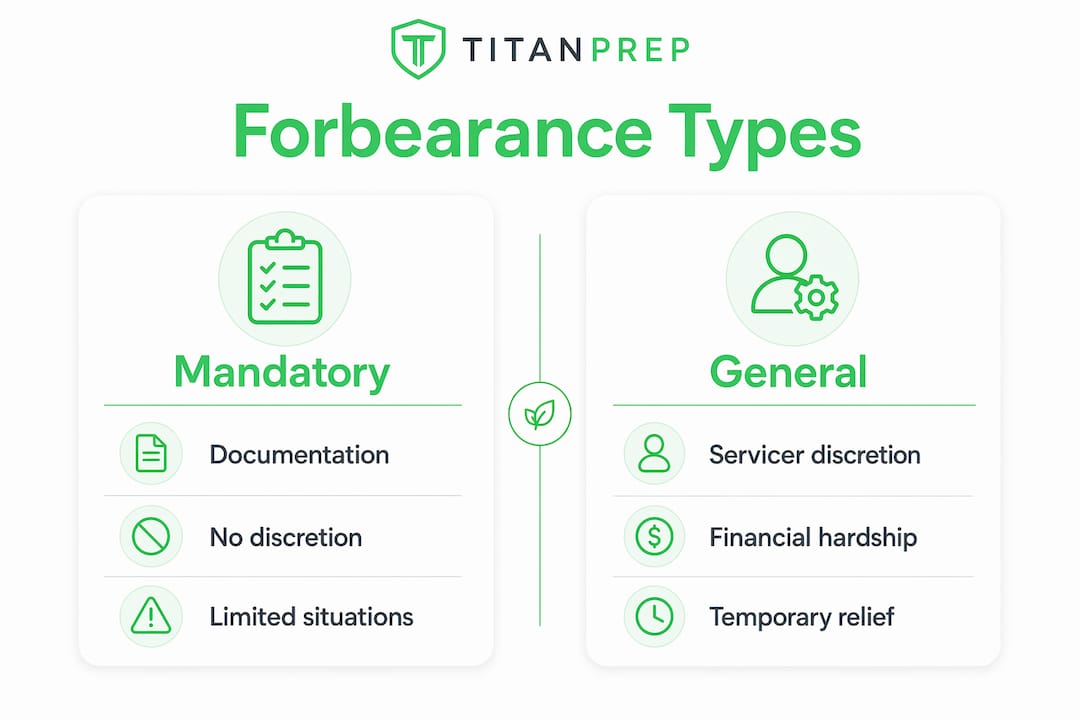
Mandatory forbearance
Mandatory forbearance is a legal right for borrowers who meet documented eligibility criteria. Your loan servicer must grant it once you provide proof. Common qualifying situations include:
Service in AmeriCorps or a national service program
A monthly student loan payment that exceeds 20% of your gross monthly income
Serving in a medical or dental internship or residency
Qualifying for the Department of Defense Student Loan Repayment Program
Serving as a member of the National Guard activated by a governor
Because servicers have no discretion here, your documentation must be accurate and complete. Missing a single required form can delay approval even when you clearly qualify.
General (discretionary) forbearance
General forbearance is granted at your servicer’s discretion based on financial hardship, illness, or other qualifying circumstances. Servicers review your situation and decide whether to approve. This type carries the three-year cumulative limit and requires renewal every 12 months.
Administrative forbearance
Administrative forbearance is applied automatically by the federal government or your servicer during specific events, such as a national emergency or a processing delay. You do not need to apply. The COVID-19 payment pause was the most widely known example of this type.
How to apply for student loan forbearance: step by step
Applying for forbearance is straightforward when you prepare correctly. Missing documentation is the most common reason for denial, so gather your paperwork before you contact your servicer.
Confirm your loan type. Log into StudentAid.gov to identify whether your loans are federal Direct Loans, FFEL Program loans, or Perkins Loans. Forbearance rules differ slightly by loan type.
Identify the correct forbearance type. Decide whether you qualify for mandatory or general forbearance based on your situation. This determines which form you need.
Gather your documents. For general forbearance, collect recent pay stubs, bank statements, a letter of financial hardship, and any medical documentation if applicable. For mandatory forbearance, gather proof of your qualifying status, such as an AmeriCorps enrollment letter or a military activation order.
Contact your loan servicer. Call or log into your servicer’s online portal. Request the correct forbearance application form. Servicers such as Aidvantage, MOHELA, and Nelnet each have their own portals, but the underlying federal forms are standardized.
Submit your application with all supporting documents. Do not send the form without attachments. Incomplete submissions are the primary cause of delays and denials.
Confirm receipt and approval in writing. Ask your servicer to confirm the start date, end date, and any conditions of your forbearance in writing. Save this confirmation.
Set a renewal reminder. General forbearance must be renewed every 12 months. Mark your calendar at least 30 days before expiration.
Pro Tip: Call your servicer rather than relying solely on the online portal when submitting for the first time. A phone call creates a verbal record and lets you confirm that your documents were received and are complete before the review begins.
What are the financial implications of student loan forbearance?
Forbearance costs more than most borrowers expect. Interest accrues on all loan types during forbearance, including subsidized loans, which is a critical difference from deferment. That accrued interest does not capitalize immediately after your forbearance period ends, but it does add to your principal balance if left unpaid.
The table below compares the key financial and eligibility differences between forbearance and deferment.
Feature | Forbearance | Deferment |
Interest on subsidized loans | Accrues | Government pays |
Interest on unsubsidized loans | Accrues | Accrues |
Counts toward PSLF | No | Depends on plan |
Counts toward IDR forgiveness | No | Depends on plan |
Servicer approval required | Yes (general type) | Yes |
Maximum duration | 3 years cumulative | Varies by type |
Time in forbearance does not count toward Public Service Loan Forgiveness or most Income-Driven Repayment forgiveness timelines. This is the most financially damaging aspect of long-term forbearance use for borrowers pursuing forgiveness. Every month in forbearance is a month that does not advance your forgiveness clock.
Accrued interest can significantly increase your total repayment if you rely on forbearance for extended periods. A borrower with $40,000 in loans at 6% interest accrues roughly $200 per month in interest during forbearance. Over 12 months, that adds $2,400 to the balance before a single payment resumes.
Pro Tip: If you can afford to pay even a small amount during forbearance, apply it directly to accruing interest. This prevents your balance from growing and reduces the total cost of the pause.
What are the best alternatives to student loan forbearance?
Forbearance is a short-term tool, not a long-term repayment strategy. Income-Driven Repayment plans often provide lower or even $0 monthly payments while keeping your forgiveness timeline active. IDR plans calculate your payment based on your income and family size, which means a sudden drop in income can reduce your required payment to nearly nothing without pausing your progress toward forgiveness.
Deferment is the better choice when you qualify, especially for subsidized loans. The federal government pays the interest on subsidized loans during deferment, which means your balance does not grow. Borrowers should exhaust deferment options first before turning to forbearance, particularly if they hold subsidized Direct Loans.
You can also use a loan repayment calculator to model what different repayment scenarios cost over time. Seeing the numbers side by side often makes the right choice obvious.
Forbearance is appropriate in these situations:
You face a sudden, short-term financial crisis with a clear resolution timeline
You do not qualify for deferment or an IDR plan
You need immediate relief while waiting for an IDR application to process
You are in a mandatory forbearance situation where it is your legal right
Forbearance is a last resort in these situations:
You are pursuing PSLF or IDR forgiveness and cannot afford to lose qualifying months
Your financial hardship is expected to last more than six months
You hold subsidized loans and qualify for deferment
Best practices for managing repayment during financial hardship:
Apply for an IDR plan before requesting forbearance whenever possible
Check your debt-to-income ratio to understand your mandatory forbearance eligibility
Review your repayment plan options annually, not just during a crisis
Keep copies of every document you submit to your servicer
Never assume forbearance renews automatically. It does not.
How to manage forbearance renewals and avoid common mistakes
Renewal management is where most borrowers lose control of their forbearance situation. Cumulative time limits catch borrowers off guard when they have used forbearance across multiple servicers or loan types over several years.
Follow these steps to stay on track with renewals:
Log your forbearance history. Record every forbearance period, including start date, end date, and the servicer involved. Keep this in a dedicated folder, physical or digital.
Calculate your remaining time. Subtract your total months used from the 36-month cumulative limit for general forbearance. Know exactly how much time you have left before you exhaust your options.
Submit your renewal at least 30 days early. Servicers need processing time. A late submission can result in a gap where payments are technically due, which may trigger delinquency.
Refresh your documentation. Servicers require updated proof of hardship at each renewal. Old pay stubs or outdated bank statements will not satisfy the requirement.
Confirm the renewal in writing. Repeat the same confirmation step you used for your original application. Do not assume approval because you were approved before.
Common mistakes that lead to denied renewals or unexpected costs include submitting incomplete paperwork, waiting until the last week of a forbearance period to request renewal, and failing to track cumulative time across multiple loan servicers.
Pro Tip: Create a simple spreadsheet with columns for servicer name, forbearance type, start date, end date, and months used. Update it every time you request or renew forbearance. This single habit prevents the most common and costly forbearance mistakes.
Key Takeaways
Forbearance is a federally regulated, time-limited tool that pauses payments but never stops interest from accruing, making it most effective as a short-term emergency measure rather than a repayment strategy.
Point | Details |
Interest always accrues | All loan types accumulate interest during forbearance, growing your total balance. |
Three-year cumulative limit | General forbearance has a 36-month lifetime cap; track your usage carefully. |
Forgiveness timeline pauses | Months in forbearance do not count toward PSLF or IDR forgiveness progress. |
IDR plans are often better | Income-Driven Repayment can lower payments to $0 while keeping forgiveness on track. |
Documentation drives approval | Missing paperwork is the top reason forbearance applications are denied or delayed. |
Why I think most borrowers reach for forbearance too quickly
After working with student loan borrowers for years, the pattern I see most often is this: someone hits a financial rough patch, calls their servicer in a panic, and requests forbearance because it is the first option offered. The servicer approves it in minutes. The borrower feels relief. And then 12 months later, their balance is higher than when they started.
Forbearance is not a bad tool. It is a misused one. The problem is that it feels like a solution when it is actually a delay. Every month of forbearance is a month of interest that compounds quietly in the background. For a borrower with $60,000 in loans, that is not a small number.
What I tell borrowers is this: before you request forbearance, spend 20 minutes on StudentAid.gov and check your IDR eligibility. If your income dropped, your IDR payment may have dropped too, possibly to $0. That $0 payment still counts toward forgiveness. Forbearance does not. The difference over 10 years of PSLF pursuit is enormous.
The borrowers who manage their loans best are the ones who treat forbearance like a fire extinguisher. You keep it available, you know how to use it, and you hope you never need it. When you do need it, you use it precisely and briefly, then return to a plan that moves you forward. Check your forgiveness eligibility before you default to forbearance. The answer may surprise you.
— Ellis
How Titanprep helps you stay organized through forbearance
Applying for forbearance, tracking renewal deadlines, and managing documentation across multiple servicers is a lot to handle on your own. Titanprep is a document preparation and support service that helps borrowers organize, submit, and maintain paperwork for federal student loan programs, including forbearance requests, IDR applications, and PSLF submissions. Titanprep is not affiliated with the U.S. Department of Education or any loan servicer. Through the Titanprep client portal, you can upload documents, track submission status, and stay ahead of critical deadlines. Learn how the process works on the Titanprep how it works page and take the first step toward staying organized.
FAQ
What is student loan forbearance?
Student loan forbearance is a temporary pause or reduction of your federal loan payments, granted for up to 12 months at a time with a maximum of three cumulative years for general forbearance.
Does forbearance hurt your credit?
Forbearance itself does not directly damage your credit score, but the growing loan balance from accrued interest can affect your debt-to-income ratio and future borrowing capacity.
How does forbearance differ from deferment?
The key difference is interest: the federal government pays interest on subsidized loans during deferment, but interest accrues on all loan types during forbearance, increasing your total balance.
Does time in forbearance count toward loan forgiveness?
No. Months spent in forbearance do not count toward Public Service Loan Forgiveness or Income-Driven Repayment forgiveness timelines, which is why IDR plans are often the better choice.
Can I switch from forbearance to an IDR plan?
Yes. You can request an IDR plan at any time through your loan servicer or StudentAid.gov. Switching stops the forbearance clock and restores your progress toward forgiveness.
Recommended
Comments