
Student Loan Default Resolution Process: 2026 Guide
- TitanPrep Official

- Jul 21
- 8 min read

The student loan default resolution process is the formal set of steps federal borrowers use to restore defaulted loans to good standing and regain access to repayment benefits. Three federally supported methods exist: loan rehabilitation, direct consolidation, and full repayment. Each path carries distinct credit consequences, eligibility requirements, and timelines. The U.S. Department of Education and its Default Resolution Group oversee these options for federal borrowers. Understanding which path fits your situation is the first step toward getting back on track.
What are the main options to resolve student loan default?
Federal borrowers have three structured paths to exit default. Each one restores your access to repayment plans and federal financial aid, but they differ significantly in how they affect your credit report and how long they take.
Loan rehabilitation
Rehabilitation is the only method that removes the default notation from your credit report. Rehabilitation requires 9 payments within a 10-month window, with each payment due within 20 days of your statement date. Missing that window resets the process. The trade-off: late payments recorded before the default still remain on your credit history.

As of june 2026, federal borrowers can rehabilitate a loan only once. New legislation allows two rehabilitations starting july 1, 2027. That change matters if you have previously rehabilitated and re-defaulted.
Direct consolidation
Direct consolidation lets you exit default faster. Consolidation allows exit from default by making 3 on-time payments or agreeing to an income-driven repayment plan. The catch: consolidation does not remove the default from your credit report. It stays visible to lenders even after your loan is back in good standing.
Full repayment
Paying the full balance clears the default immediately. This option works for borrowers who have access to a lump sum, such as an inheritance or settlement. For most borrowers carrying tens of thousands in debt, full repayment is not realistic. The two structured programs above are the practical routes.
Pro Tip: If your credit score recovery is the priority, choose rehabilitation over consolidation. Rehabilitation is the only option that wipes the default notation from your report.
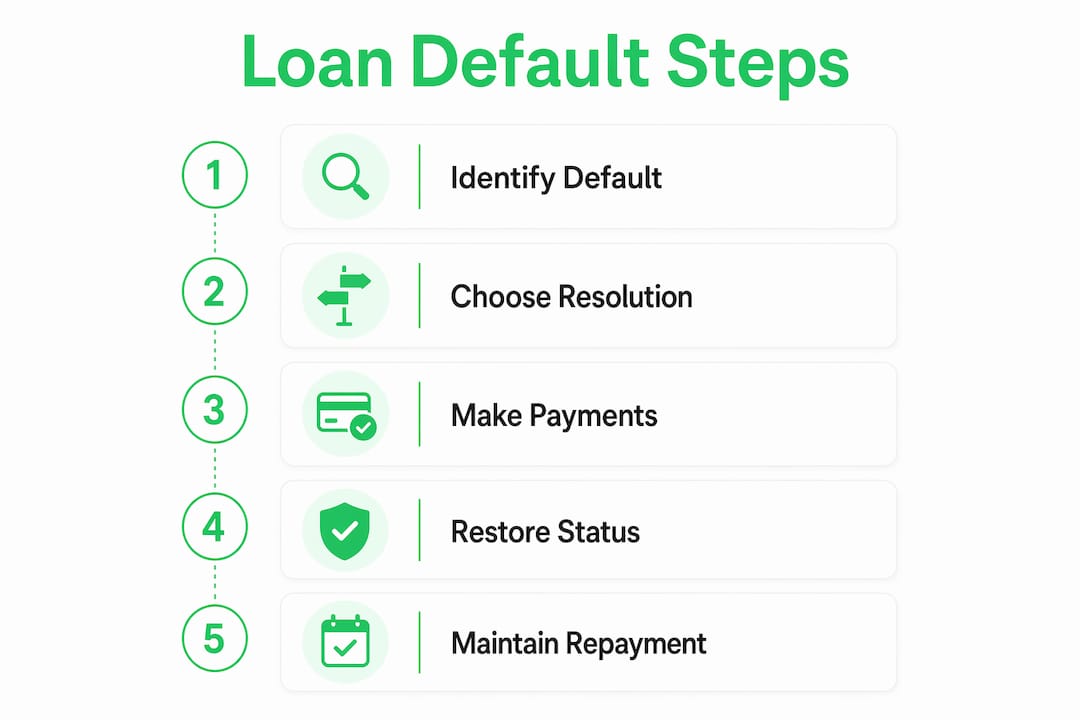
Here is a quick comparison of the three options:
Feature | Rehabilitation | Consolidation | Full repayment |
Removes default from credit report | Yes | No | Yes |
Time to complete | 9–10 months | Weeks | Immediate |
Requires income documentation | Yes | Yes | No |
Restores federal aid eligibility | Yes | Yes | Yes |
Available more than once | Once (twice from 2027) | Multiple times | Unlimited |
How to apply for and navigate the loan rehabilitation process
Rehabilitation has a clear sequence. Follow each step carefully, because missing a deadline can restart the clock.
Contact the Default Resolution Group. Call 1-800-621-3115 to initiate the process. This is the federal servicer that handles defaulted federal loans. Have your loan account number and income information ready before you call.
Submit your income documentation. Your monthly payment is calculated as a percentage of your discretionary income. Lower income means lower payments. The servicer will request pay stubs, tax returns, or a self-certification form if you are unemployed.
Set up your payment schedule. Once your payment amount is confirmed, you will receive a written agreement. Sign it and keep a copy. Payments must be made on time for 9 consecutive months within a 10-month window.
Make all 9 payments. Each payment must arrive within 20 days of your statement date. Autopay reduces the risk of a missed deadline. Do not assume a payment posted correctly. Confirm each one.
Confirm loan transfer. After completing rehabilitation, your loan moves to a standard servicer. Monitor your StudentAid.gov portal daily during this transition to catch any document requests before they cause delays.
Enroll in an affordable repayment plan. After rehabilitation, enroll in an income-driven plan immediately. Rehabilitation alone does not prevent re-default. Sustainable monthly payments do. Review your income-driven repayment options to find the plan that fits your budget.
Pro Tip: Keep a paper trail of every payment confirmation, every phone call, and every document you submit. Servicer errors happen, and your records are your defense.
One important note on private loans: private student loan defaults lack structured federal resolution programs. Private lenders follow their own contract policies, and settlement or loan modification may be the only options. If your loans are private, consult a legal professional before proceeding.
How to use direct consolidation to resolve default quickly
Direct consolidation is the faster exit from default. It suits borrowers who need to restore federal aid eligibility quickly or who cannot sustain a 9-month payment plan.
The application process runs through StudentAid.gov. Here is what to expect:
Gather your documents. You will need your FSA ID, loan account details, and income information for selecting a repayment plan.
Choose your repayment plan. You must agree to an income-driven repayment plan or make 3 consecutive on-time payments on the defaulted loan before consolidation is approved.
Submit and monitor. Processing takes weeks, and the servicer may request additional documents. Respond to every request within the stated deadline or the application stalls.
Understand interest capitalization. When your loan consolidates, any unpaid interest gets added to the principal balance. Your new loan balance will be higher than your original debt.
Check your credit report. The default notation stays on your report after consolidation. It does not disappear the way it does after rehabilitation.
One procedural issue catches many borrowers off guard: wage garnishment complicates consolidation eligibility. If a court order for wage garnishment is already in place, you must clear that order before consolidating. Contact the Default Resolution Group to understand your specific situation.
Borrowers with lower incomes and higher debt should also consider the Repayment Assistance Plan as a strong option in the current 2026 repayment landscape. It may offer lower monthly payments than older income-driven plans. Check recent student loan updates to stay current on which plans are available.
How to prevent student loan default before it happens
The best version of the student loan default resolution process is the one you never need. Acting before a missed payment becomes a default saves your credit, your wages, and your access to federal benefits.
Contacting your servicer quickly after a missed payment is the single most effective step. Servicers can offer deferment or forbearance to temporarily pause or reduce your payments. These options buy time without triggering default.
Key prevention steps every borrower should know:
Call your servicer at the first sign of trouble. The Default Resolution Group number is 1-800-621-3115. Do not wait for a collections notice.
Request deferment or forbearance. Both options pause payments legally. Forbearance accrues interest; deferment may not, depending on your loan type.
Act within 75 days of your first missed payment. Borrowers who resolve issues within 75 days of the initial default notice may avoid having the default reported to credit bureaus entirely.
Budget proactively. Poor debt-to-income planning drives most loan defaults. Track your income and required payments monthly. Build a small emergency fund to cover one or two payments if your income drops.
Review your repayment plan. If your current payment is unaffordable, switch to an income-driven plan before you miss a payment. Explore your repayment plan options to find a payment that fits your income.
Pro Tip: Set a calendar reminder 30 days before each payment due date. If your financial situation has changed, that gives you time to contact your servicer and request an adjustment before a missed payment appears on your record.
Ignoring delinquency leads to wage garnishment, tax refund offsets, and loss of federal financial aid eligibility. None of those outcomes are reversible quickly. Early action is always the lower-cost path. For context on how federal and private loan defaults differ in resolution options, the distinction matters significantly when choosing your next step.
You can also find current guidance on financial aid updates that may affect your eligibility and resolution options as federal policy continues to shift in 2026.
Key Takeaways
The most effective approach to resolving federal student loan default is choosing rehabilitation when credit recovery matters, or consolidation when speed is the priority, and then immediately enrolling in an income-driven repayment plan to prevent re-default.
Point | Details |
Rehabilitation clears your credit | It is the only method that removes the default notation from your credit report. |
Consolidation is faster but limited | Consolidation exits default in weeks but leaves the default visible on your credit history. |
Act within 75 days | Resolving a missed payment within 75 days may prevent the default from reaching credit bureaus. |
Rehabilitation limits are changing | One rehabilitation is allowed through june 2026; two will be permitted starting july 1, 2027. |
Post-resolution planning is critical | Enrolling in an income-driven plan after rehabilitation or consolidation prevents re-default. |
What I have learned from watching borrowers navigate default
The borrowers I see struggle most are not the ones with the highest balances. They are the ones who waited too long to act. Default does not happen overnight. There is a delinquency window, usually months long, where servicers can offer real help. Most borrowers do not call until a collections notice arrives. By then, options have narrowed.
The second mistake I see constantly: completing rehabilitation and then doing nothing. Rehabilitation is not a finish line. It is a reset. Without an affordable repayment plan in place the day your loan transfers to a new servicer, re-default is a real risk. Loan rehabilitation alone is not sufficient without sustainable budgeting and repayment planning. That sentence should be printed on every rehabilitation agreement.
One more thing borrowers overlook: the tax implications of forgiven debt. Tax law changes in 2026 mean discharged or forgiven loans outside of Public Service Loan Forgiveness may count as taxable income federally. If you are pursuing forgiveness as part of your post-default plan, talk to a tax professional before that forgiveness posts. The surprise tax bill can be significant.
The path out of default exists. It is structured, it is documented, and it works when you follow it consistently.
— Ellis
How Titanprep supports borrowers working through default resolution
Dealing with loan default involves a lot of paperwork, deadlines, and back-and-forth with servicers. Titanprep is a document preparation and support service that helps federal student loan borrowers stay organized through that process. Titanprep assists with preparing and submitting applications for Income-Driven Repayment plans, Public Service Loan Forgiveness, and certain discharge programs. The client portal lets you upload documents, track deadlines, and monitor your file status in one place. Titanprep is not affiliated with the U.S. Department of Education and does not guarantee outcomes. To understand exactly how Titanprep works and whether it fits your situation, visit the site. You can also review the federal forgiveness guide for post-default repayment options.
FAQ
What is the student loan default resolution process?
The student loan default resolution process is the set of federally supported steps a borrower takes to restore a defaulted federal loan to good standing. The three primary methods are loan rehabilitation, direct consolidation, and full repayment.
How long does loan rehabilitation take?
Rehabilitation requires 9 on-time payments completed within a 10-month window. The process typically takes 9–10 months from the date you sign your rehabilitation agreement.
Does consolidation remove default from my credit report?
No. Direct consolidation does not remove the default notation from your credit report. Only loan rehabilitation removes the default record, though prior late payments remain visible.
Can I rehabilitate my student loan more than once?
As of june 2026, federal borrowers may rehabilitate a loan only once. Starting july 1, 2027, new legislation permits two rehabilitations per loan.
What happens if I ignore student loan delinquency?
Ignoring delinquency leads to default, which triggers wage garnishment, tax refund offsets, and loss of federal financial aid eligibility. Borrowers who act within 75 days of the initial default notice may avoid having the default reported to credit bureaus at all.
Recommended
Comments