
The Role of Bankruptcy in Student Loans: 2026 Guide
- TitanPrep Official

- Jul 21
- 9 min read

Can bankruptcy actually discharge your student loans?
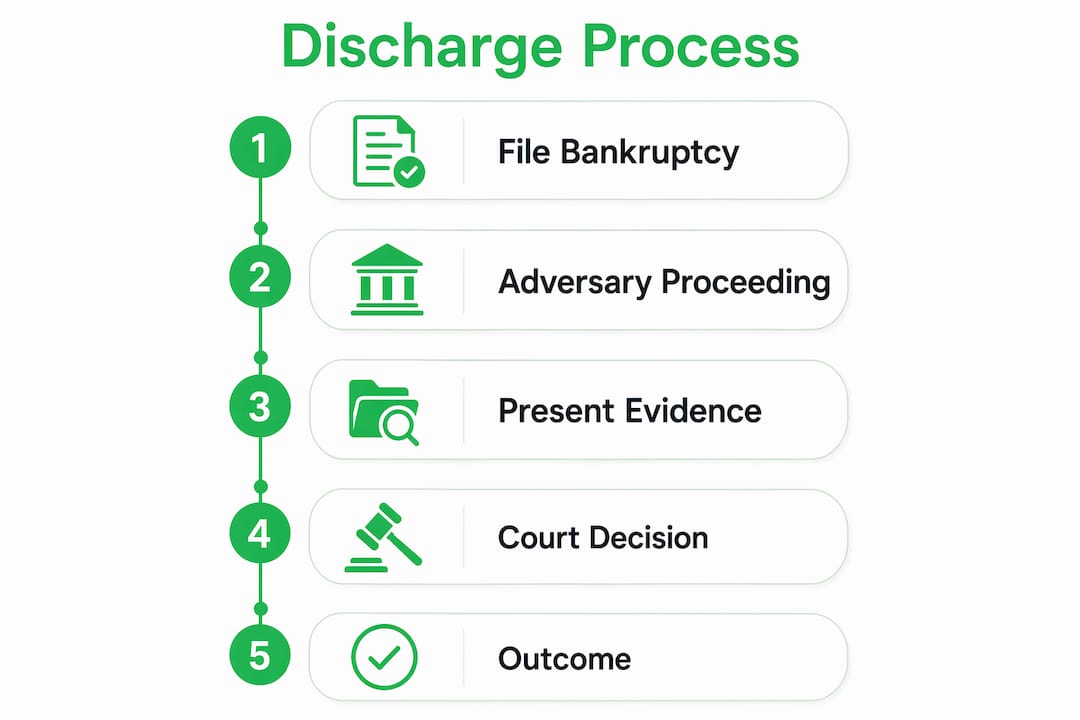
Yes, bankruptcy can discharge student loans, but it requires more than a standard filing. You must prove “undue hardship” through a separate legal action called an adversary proceeding. Both federal and private student loans are potentially dischargeable, though the process differs between them. Recent policy reforms from the Department of Justice and the Department of Education have made this path more accessible than most borrowers realize.
Here is what you need to know upfront:
Student loans are not automatically wiped out when you file bankruptcy.
You must file a separate adversary proceeding and meet the undue hardship standard.
The Brunner test is the legal framework most courts use to evaluate your case.
Policy updates have streamlined the federal process significantly.
Bankruptcy stays on your credit report for several years, so it is typically a last resort.
How do you qualify for student loan discharge in bankruptcy?
Qualifying for discharge starts with filing a bankruptcy petition under either Chapter 7 or Chapter 13. That alone does not touch your student loans. You must then file a separate adversary proceeding, which is essentially a lawsuit within your bankruptcy case, asking the court to rule that repaying your loans would cause undue hardship.
To succeed, you generally need to satisfy all three prongs of the Brunner test:
Present inability to pay: Your current income and expenses leave no room to maintain even a minimal standard of living while repaying the loans.
Persistent hardship: Your financial situation is unlikely to improve for a significant portion of the repayment period, often due to disability, chronic illness, age, or limited employment prospects.
Good faith effort: You have genuinely tried to repay, whether by making payments, applying for income-driven repayment, or seeking deferment.
Courts look at concrete evidence: pay stubs, tax returns, medical records, and documentation of job searches. Conditions like permanent disability, extended unemployment, or a fixed income with limited prospects tend to carry the most weight.
Pro Tip: Before filing, gather at least two years of tax returns, recent pay stubs, a detailed monthly budget, and any medical or disability documentation. Courts want specifics, not general claims of hardship.

How do courts decide if your hardship qualifies?
The Brunner test governs most courts, but its application varies. Here is how each prong typically plays out in practice:
Prong 1: Minimal standard of living. The court compares your income against your reasonable monthly expenses. If you cannot cover basic needs like housing, food, and medical care after loan payments, this prong is met.
Prong 2: Persistence of hardship. This is the hardest prong to satisfy. Courts look for “additional circumstances” beyond ordinary financial difficulty, such as a permanent medical condition or an age that limits future earning potential.
Prong 3: Good faith repayment effort. Courts check whether you explored income-driven repayment plans, applied for deferment, or made any payments at all before filing.
Some jurisdictions, notably the Eighth Circuit, reject Brunner entirely and apply a “totality of circumstances” test instead, weighing all relevant factors together rather than requiring each prong to be met independently.
The Department of Justice introduced a standardized attestation form for federal loan cases. This 15-page document collects detailed financial and personal information, allowing DOJ attorneys to assess cases more consistently. When the cost of litigation exceeds the likely recovery, the DOJ now recommends discharge rather than fighting the case in court.
Factor | What courts examine |
Income and expenses | Monthly cash flow vs. basic living costs |
Disability or illness | Medical records, prognosis, work limitations |
Employment history | Job search efforts, education level, marketability |
Repayment history | Prior payments, IDR enrollment, deferment requests |
Loan type | Federal vs. private, qualified vs. non-qualified |
What happens after the court rules on your discharge?
The outcome of your adversary proceeding determines everything that follows. Two very different paths open depending on the court’s decision.
If discharge is granted: Your student loan debt is eliminated, either fully or partially. Collection calls stop immediately under the automatic stay, and once discharge is finalized, lenders cannot legally pursue repayment. A partial discharge may reduce your balance to an amount the court deems manageable given your circumstances.
If discharge is denied: Your loans survive the bankruptcy intact. You will still owe the full balance, and interest that accrued during the proceeding gets added on top. Your credit takes a hit regardless of the outcome.
Pro Tip: Even if full discharge is denied, a Chapter 13 repayment plan can give you 3–5 years of structured, lower payments while protecting assets like your home. That breathing room can be worth pursuing on its own.
Bankruptcy triggers an automatic stay on collections the moment you file, but it does not stop interest from accruing. Chapter 7 cases typically resolve in 3–6 months. Chapter 13 involves a 3–5 year repayment plan, which can offer temporary relief even when full discharge is not on the table.
Bankruptcy drops your credit score significantly and remains on your credit report for multiple years. That long-term impact is a major reason most financial counselors treat it as a last resort rather than a first move.
How does discharge differ for federal vs. private student loans?
Federal and private student loans follow the same undue hardship standard on paper, but the practical experience is quite different.
Federal student loans:
The DOJ and Department of Education jointly streamlined the process in November 2022 and updated it through March 2026.
Borrowers submit a standardized attestation form, reducing the burden of litigation.
DOJ attorneys are now directed to recommend discharge when litigation costs outweigh potential recoveries.
Most DOJ-supported cases result in full or partial discharge before going to trial.
Private student loans:
No standardized attestation process exists; borrowers face a higher evidentiary burden.
Lenders often resist discharge aggressively, even when the borrower clearly qualifies.
Some private loans are not qualified education loans under the Bankruptcy Code and can be discharged like ordinary unsecured debt, without proving undue hardship at all.
Feature | Federal loans | Private loans |
Undue hardship required | Yes | Yes (for qualified loans) |
Attestation form available | Yes (DOJ/DOE process) | No |
Discharge without hardship proof | No | Yes, if loan is non-qualified |
Lender resistance | Lower post-2022 | Often high |
Non-qualified private loans include loans that exceeded the cost of attendance, loans for unaccredited schools, and loans taken out when the borrower was enrolled less than half-time. If your private loan falls into one of these categories, you may be able to dispute the debt without filing an adversary proceeding at all.
Why do so few borrowers even try to discharge their loans?
The biggest barrier is a myth. Most borrowers believe student loans simply cannot be discharged in bankruptcy, so they never ask. The Consumer Financial Protection Bureau has stated plainly that this belief is false, yet it persists widely.
“For too long, a myth has persisted that student loans are not dischargeable in bankruptcy. The myth is not true because, in fact, student loans can be discharged in bankruptcy.” — Consumer Financial Protection Bureau
Professor Jason Iuliano’s research, published in the American Bankruptcy Law Journal, found that only 1 in 500 bankruptcy filers even attempts student loan discharge. He calls this the “Student Loan Bankruptcy Gap,” a situation where thousands of eligible borrowers leave relief on the table simply because they do not know it exists.
Bankruptcy attorneys share some of the responsibility. Many discourage clients from pursuing discharge because adversary proceedings are complex and expensive, creating a cycle where low attempt rates reinforce the myth that discharge is impossible.
Pro Tip: If an attorney tells you student loans “can’t” be discharged without reviewing your specific situation, get a second opinion from someone who specializes in student loan bankruptcy cases.
How do you prepare a strong adversary proceeding?
Preparation is what separates successful discharge attempts from failed ones. Courts respond to documentation, not just hardship claims.
Compile your financial picture completely. Two years of tax returns, recent pay stubs, bank statements, and a written monthly budget are the foundation of your case.
Document your medical or disability status. If a health condition limits your ability to work, get a written statement from your treating physician that addresses your prognosis and work capacity.
Show your repayment history. Records of payments made, income-driven repayment applications, and deferment or forbearance requests demonstrate good faith to the court.
For federal loans, complete the DOJ attestation form carefully. Every section matters. Incomplete or inconsistent answers can undermine an otherwise strong case.
Work with an attorney experienced in adversary proceedings. General bankruptcy attorneys may not know the current DOJ/DOE guidelines. A specialist understands what evidence moves the needle.
Research your jurisdiction’s standard. If you are in the Eighth Circuit, your case will be evaluated under the totality of circumstances test, not Brunner. That changes how you frame your argument.
You can also review student loan discharge examples to understand how courts have ruled in cases similar to yours.
What do the success rate numbers actually show?
Recent data shows the success rate for student loan discharge attempts has increased significantly, driven primarily by the DOJ/DOE policy reforms and the standardized attestation process.
That figure deserves context. The 87% rate applies to borrowers who actually filed an adversary proceeding, a group that remains tiny relative to the total number of eligible filers. The underlying problem, as Iuliano’s research shows, is that most eligible borrowers never attempt discharge at all. If you do file, your odds are better than they have ever been.
What are your alternatives if bankruptcy is not the right move?
Bankruptcy is not the only path when student loan payments become unmanageable. Several federal programs can reduce your monthly obligation without the credit consequences.
Income-driven repayment plans cap your monthly payment at a percentage of your discretionary income and forgive remaining balances after 20–25 years of qualifying payments. Public Service Loan Forgiveness eliminates federal loan balances after 10 years of payments in a qualifying government or nonprofit job. Deferment and forbearance can pause payments temporarily during financial hardship without triggering the credit damage that bankruptcy causes.
For borrowers still in school or weighing future debt, exploring ways to pay for college without loans can prevent the problem from growing. Mark Kantrowitz, a widely cited student loan expert, consistently notes that income-driven repayment remains preferable to bankruptcy for most borrowers because it preserves credit and offers a structured path to eventual forgiveness.
Private loan borrowers have fewer federal options, but negotiating directly with lenders for modified payment terms or settlement is worth attempting before pursuing bankruptcy. You can find repayment assistance options that may fit your situation better than a bankruptcy filing.
How have recent legal and policy changes shifted the landscape?
The November 2022 DOJ/DOE guidance was the most significant change to student loan bankruptcy practice in decades. Before that guidance, federal attorneys routinely opposed discharge regardless of the borrower’s circumstances, making adversary proceedings costly and unpredictable. The new policy directs DOJ attorneys to evaluate each case on its merits and to recommend discharge when the evidence supports it.
The updated process, current through March 2026, includes the standardized attestation form, clearer criteria for DOJ recommendations, and a directive to settle rather than litigate when litigation costs exceed likely recoveries. Courts have responded positively, and the 87% success rate reflects that shift.
On the legislative side, Congress has not yet passed a law explicitly making student loans freely dischargeable, though proposals have circulated. Until that changes, the undue hardship standard remains the only statutory path. What has changed is how aggressively the government defends against discharge, and that shift alone has transformed outcomes for borrowers who pursue the process. Stay current on student loan policy updates as this area continues to evolve.
Key Takeaways
Discharging student loans in bankruptcy is genuinely possible in 2026, but only for borrowers who file an adversary proceeding and meet the undue hardship standard under the Brunner test or a totality of circumstances approach.
Point | Details |
Discharge requires extra steps | You must file an adversary proceeding in addition to your bankruptcy petition. |
Brunner test is the main standard | Courts evaluate inability to pay, persistent hardship, and good faith repayment efforts. |
Success rate reached 87% | Post-2022 DOJ/DOE reforms drove this rise among borrowers who actually filed for discharge. |
Most eligible borrowers never try | Only about 1 in 500 bankruptcy filers attempts student loan discharge, according to major studies. |
Credit impact is serious | Bankruptcy drops your score significantly and remains on your credit report for multiple years. |
FAQ
Does bankruptcy do anything for student loans?
Yes. Filing bankruptcy triggers an automatic stay on collections, and if you file a separate adversary proceeding and prove undue hardship, a court can discharge your student loans fully or partially.
What is the success rate of bankruptcy for student loans?
A study of 2022–2023 cases found an 87% success rate for borrowers who actually attempted discharge, largely due to updated DOJ/DOE policies that streamlined the process.
How do you get student loans discharged in bankruptcy?
File a bankruptcy petition, then file a separate adversary proceeding asking the court to rule that repayment causes undue hardship. You will need to satisfy the Brunner test and provide detailed financial documentation.
Can you discharge private student loans in bankruptcy?
Private loans that qualify as “qualified education loans” require the same undue hardship proof as federal loans. However, private loans that do not meet that definition, such as loans exceeding cost of attendance or loans for unaccredited schools, may be dischargeable without that standard.
Recommended
Comments