
PSLF Qualifying Payments Tracker: 2026 Guide
- TitanPrep Official

- Jul 21
- 7 min read

The PSLF qualifying payments tracker is the official system federal student loan borrowers use to monitor progress toward the 120 payments required for Public Service Loan Forgiveness. You access it through StudentAid.gov, which serves as the authoritative source for your certified payment count. MOHELA, the designated PSLF loan servicer, also displays payment data, but its records frequently lag behind the official count. Understanding how these two platforms interact, and knowing the difference between “eligible” and “qualifying” payments, is the most important thing you can do before you reach payment 119.
What is the PSLF qualifying payments tracker?
The PSLF qualifying payments tracker, formally called the PSLF payment count tool, lives inside your StudentAid.gov account under the “My Aid” section. StudentAid.gov is the authoritative source for your certified payment count, making it more reliable than any servicer portal. MOHELA processes your payments and maintains its own records, but those figures can fall weeks or months behind what StudentAid.gov shows.
Here is what the tracker displays:
Qualifying payments: Payments that are fully certified and officially count toward forgiveness
Eligible payments: Payments that meet loan and repayment plan criteria but are still awaiting employer certification
Employment periods: The certified employment windows tied to each payment block
Loan-level detail: Payment counts broken down by individual loan, not just a single total
The tracker updates after you submit an Employment Certification Form (ECF), also called the PSLF Form. Each approved ECF converts eligible payments into qualifying payments for the covered employment period. Without a submitted and approved ECF, your payments sit in “eligible” status indefinitely and do not count toward forgiveness.
Check your payment count every 6–12 months, or immediately after any change in employer or repayment plan. Waiting longer creates gaps that are harder to resolve.

Pro Tip: Log into StudentAid.gov directly rather than relying on MOHELA’s portal for your official count. Servicer data can lag, and discrepancies between the two platforms are common during system updates.
What counts as a qualifying PSLF payment?
A qualifying payment meets four specific conditions at the same time. PSLF requires 120 on-time monthly payments for the full amount due under a qualifying repayment plan while you work full-time for a qualifying employer. Missing any one of these conditions means that month does not count.
The four requirements are:
On time: Payment received within 15 days of the due date
Full amount: Payment equals or exceeds the amount shown on your billing statement
Qualifying repayment plan: Income-Driven Repayment plans (IBR, PAYE, SAVE, ICR) and the Standard 10-Year Plan qualify; graduated and extended plans do not
Qualifying employer: A U.S. government agency, 501©(3) nonprofit, or other qualifying public service organization; you must work at least 30 hours per week
Eligible vs. qualifying: a critical distinction
Many borrowers confuse these two statuses, and the confusion costs them time. The table below clarifies the difference:
Status | What It Means | What You Need to Do |
Eligible | Payment meets loan and plan criteria; employer not yet certified | Submit an Employment Certification Form (ECF) |
Qualifying | Payment is fully certified and counts toward 120 | No action needed; count is locked in |
Not Eligible | Payment does not meet plan or loan requirements | Review repayment plan and loan type |
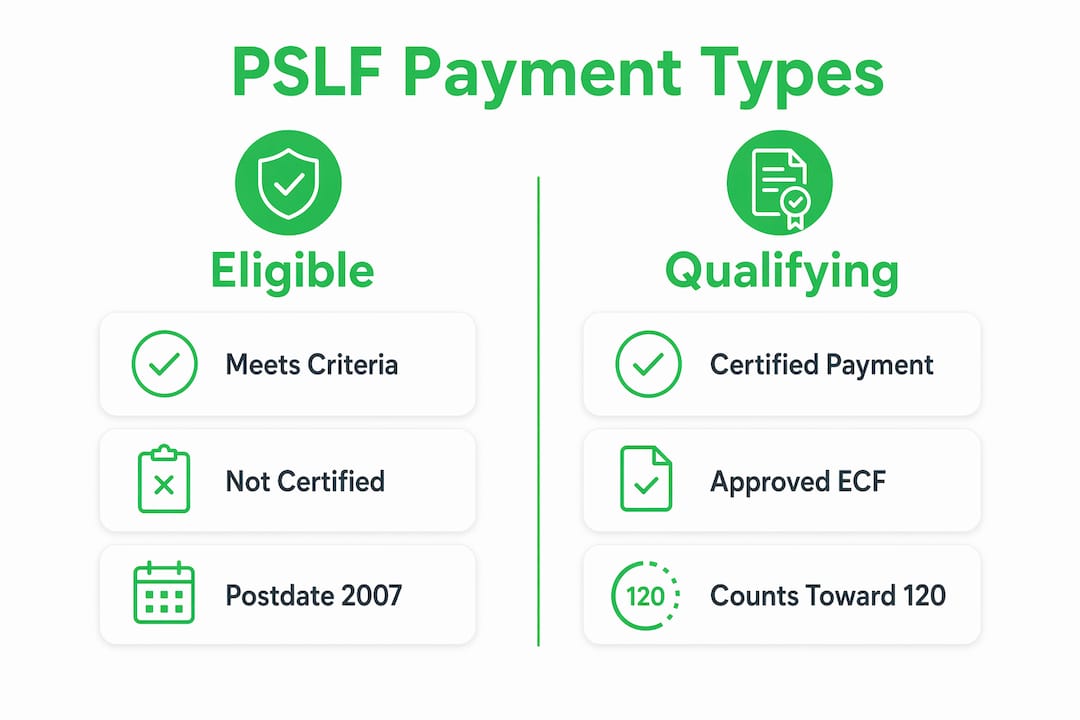
Eligible payments do not count until you submit and receive approval for an ECF covering that employment period. This is the single most common reason borrowers discover their count is lower than expected. A payment made in good faith under the right plan still sits uncounted if your employer has never been certified for that period.
Payments must also postdate October 1, 2007, the date the PSLF program opened. Any payment made before that date does not qualify, regardless of all other criteria.
How do you fix a wrong payment count?
Discovering a discrepancy in your payment count is stressful, but it is fixable. The process requires documentation and patience, not panic.
Follow these steps to investigate and resolve a wrong count:
Log into StudentAid.gov and download your full payment history. Compare it against your own bank or servicer records month by month.
Check your ECF approval history. Confirm that every employment period you have worked is covered by an approved certification. Gaps in certification create gaps in your count.
Contact MOHELA in writing. Submit a written dispute with specific payment dates and amounts you believe are missing or miscounted.
Request a manual count review if MOHELA cannot resolve the issue. A manual review request typically receives a response within 30 days when submitted with supporting documentation.
Escalate to the FSA Ombudsman if the servicer dispute does not resolve the issue. The Federal Student Aid Ombudsman Group handles unresolved servicer complaints.
What documentation you need
Gather these records before submitting any dispute:
Document | Purpose |
Bank statements or payment confirmations | Prove on-time, full payments |
Employer verification letters | Confirm qualifying employment periods |
Prior ECF approval notices | Show certified employment windows |
Loan servicer payment history | Cross-reference against StudentAid.gov data |
Maintaining a personal payment audit spreadsheet is the most effective way to catch errors before they pile up. Your spreadsheet should log the payment date, amount, loan type, employer, and whether an ECF covers that period. Borrowers who build this habit early find discrepancies within weeks rather than years.
Pro Tip: Submit your ECF annually or whenever you change employers. This converts eligible payments to qualifying payments on a regular schedule and prevents a backlog of uncertified months from building up over years.
What happens after you hit 120 qualifying payments?
Reaching 120 qualifying payments is a milestone, but it does not trigger automatic forgiveness. You must take one more deliberate step.
Here is what to expect after your count reaches 120:
Submit the PSLF Application for Forgiveness. This is a separate form from the ECF. The forgiveness application cannot be processed until exactly 120 qualifying payments are verified by the Department of Education.
Continue making payments during review. Do not stop paying until you receive written confirmation that forgiveness has been approved. Stopping early can create new complications.
Monitor your tracker during processing. Payment counts on StudentAid.gov and MOHELA may lag due to system updates and legal challenges, so a stalled count does not always mean something is wrong.
Expect a processing timeline of several months. The Department of Education reviews your full payment and employment history before approving forgiveness. Incomplete certifications or missing ECFs for any period will delay approval.
Watch for a forgiveness notification by mail and email. Once approved, your loan servicer will notify you and zero out your remaining balance.
The PSLF forgiveness application is a distinct, final process. Submitting ECFs throughout your repayment period speeds up verification, but it does not replace the formal application. Borrowers who skip this step after reaching 120 payments experience unnecessary delays of months.
You can also review PSLF updates and automatic forgiveness procedures to understand how recent policy changes may affect your timeline.
Key takeaways
Tracking your PSLF qualifying payments accurately on StudentAid.gov, certifying employment annually, and maintaining your own payment records are the three actions that determine whether you reach forgiveness on schedule or face costly delays.
Point | Details |
Use StudentAid.gov as your primary source | It is more reliable than MOHELA for official qualifying payment counts. |
Eligible payments do not count yet | Submit an ECF to convert eligible payments into qualifying payments. |
Submit ECFs annually | Annual certification prevents a backlog of uncertified months from building. |
Keep a personal audit spreadsheet | Cross-referencing your own records catches errors before they compound. |
Forgiveness requires a separate application | Reaching 120 payments does not trigger forgiveness automatically. |
What i have learned from watching borrowers use the tracker
The most consistent mistake I see is treating the PSLF tracker as a passive scoreboard rather than an active management tool. Borrowers check it once, feel reassured by the number they see, and then wait another two years before looking again. By then, uncertified employment periods have piled up, and what should have been a straightforward count is now a dispute process.
The second mistake is trusting MOHELA’s portal over StudentAid.gov. Servicer data lags. That is not an opinion. It is a documented pattern that has caused real borrowers to believe their count was lower than it actually was, and in some cases, to make repayment decisions based on inaccurate numbers.
My honest recommendation: build a simple spreadsheet the day you start PSLF. Log every payment, every employer, and every ECF submission. It takes ten minutes a month. When you eventually hit a discrepancy, and many borrowers do, you will have a clean record that makes the dispute process straightforward rather than overwhelming.
The PSLF eligibility and compliance guide from Titanprep is worth reading alongside this article if you want a fuller picture of the program requirements. And if you are navigating issues with MOHELA specifically, you are not alone. There are clear steps to take, and getting organized early makes every step easier.
— Ellis
How Titanprep can support your PSLF progress
Staying organized across 10 years of payments, employer changes, and ECF submissions is a real administrative challenge. Titanprep is a document preparation and support service that helps federal student loan borrowers organize, submit, and track paperwork related to PSLF and other forgiveness programs. Through the Titanprep client portal, you can upload documents, monitor your file status, and stay ahead of deadlines. Titanprep is not affiliated with the Department of Education and does not guarantee forgiveness outcomes. For the latest program updates and policy changes that affect your qualifying payment count, visit the student loan updates page. You can also explore the federal forgiveness guide to understand all your options in one place.
FAQ
What is the PSLF qualifying payments tracker?
The PSLF qualifying payments tracker is a tool on StudentAid.gov that shows your certified payment count toward the 120 payments required for Public Service Loan Forgiveness. It updates after each approved Employment Certification Form.
How often should i check my PSLF payment count?
Check your count every 6–12 months, or immediately after changing employers or repayment plans. Regular checks help you catch discrepancies before they become difficult to resolve.
What is the difference between eligible and qualifying payments?
Eligible payments meet loan and repayment plan criteria but have not yet been certified through an approved ECF. Qualifying payments are fully certified and officially count toward your 120-payment total.
Can my PSLF payment count decrease?
Yes. System updates, legal challenges, or corrections to employment certification can cause your count to change. If your count drops unexpectedly, request a manual review with supporting documentation.
Do i need to apply for forgiveness after reaching 120 payments?
Yes. Forgiveness is not automatic. You must submit a separate PSLF Application for Forgiveness, and the Department of Education must verify all 120 qualifying payments before your balance is discharged.
Recommended
Comments