
Income-Driven Repayment Process: Your 2026 Guide
- TitanPrep Official

- Jul 21
- 8 min read

Income-driven repayment (IDR) is defined as a federal program that adjusts your monthly student loan payment based on your income and family size. The income-driven repayment process exists to make federal loan payments affordable, especially when your balance far exceeds what a standard 10-year plan allows. As of early 2026, 11.8 million borrowers (27% of all federal student loan holders) are enrolled in IDR plans. That number reflects how many borrowers rely on this program to stay out of default and keep payments manageable. The U.S. Department of Education administers these plans through Federal Student Aid, and recent legislation, including the One Big Beautiful Bill (OBBB) Act, has reshaped the options available to you.
What IDR plans are available and who qualifies
The federal government currently offers four IDR plans: Income-Based Repayment (IBR), Pay As You Earn (PAYE), Income-Contingent Repayment (ICR), and the new Repayment Assistance Plan (RAP). Each plan caps your payment at a percentage of your discretionary income and offers loan forgiveness after a set repayment period.
The OBBB Act made significant changes to which plans remain available. RAP replaces older IDR plans for loans disbursed after july 1, 2026, and becomes the sole IDR option by july 1, 2028. RAP sets payments at 1–10% of your income and offers forgiveness after 30 years. If you already have loans, you may still enroll in IBR, PAYE, or ICR, but those plans are being phased out.
Here is a quick breakdown of current eligibility:
IBR: Available for Direct Loans and most Federal Family Education Loans (FFEL). The partial financial hardship requirement has been removed for new IBR enrollments after july 1, 2026, making it easier to qualify.
PAYE: Available only for Direct Loans first disbursed after October 1, 2007. Requires demonstrated partial financial hardship.
ICR: Available for Direct Loans, including Parent PLUS loans after consolidation.
RAP: Available for loans disbursed after july 1, 2026. Payments scale from 1–10% of income with a 30-year forgiveness timeline.
One critical deadline: Parent PLUS loans are not eligible for RAP and must be consolidated and enrolled in ICR before july 1, 2028 to preserve IDR access. Acting before july 1, 2026 maximizes your qualifying payment count toward forgiveness.
Pro Tip: If you hold Parent PLUS loans, consolidate them into a Direct Consolidation Loan and enroll in ICR now. Waiting past the deadline could cost you years of qualifying payments toward forgiveness.
No income ceiling exists for IDR enrollment. However, high income causes payments to revert to the standard 10-year plan amount, effectively capping what you owe each month.
How to apply for an income-driven repayment plan
Applying for IDR is straightforward when you know what to gather. The entire process runs through StudentAid.gov or directly through your loan servicer. You can apply for IDR online and typically receive a decision within 2–4 weeks.
Follow these steps to apply:
Log in to StudentAid.gov using your FSA ID. This is the official Federal Student Aid portal where you manage all federal loan activity.
Select your IDR plan. Review the available plans based on your loan type and disbursement date. If you are unsure which plan fits best, use the Loan Simulator tool on StudentAid.gov to compare estimated payments.
Verify your income. You can authorize the IRS Data Retrieval Tool (DRT) to pull your most recent tax return data directly into the application. This speeds processing and reduces errors.
Certify your family size. Report everyone in your household who you financially support, including dependents. Family size directly affects your discretionary income calculation and your monthly payment.
Submit and confirm. After submitting, your servicer will process the application and notify you of your new payment amount. Keep a copy of your submission for your records.
Continue making payments. Do not stop paying while your application is pending. Your servicer may place you in a temporary forbearance, but confirm this in writing to avoid missed payment counts.
Common errors include underreporting family size, submitting outdated income documents, and failing to confirm receipt with your servicer. Each mistake can delay processing or result in a higher payment than you qualify for.
Pro Tip: Authorize IRS data access during your application. It eliminates the need to upload tax documents manually and cuts processing time significantly.

For a broader look at your repayment options before you apply, reviewing student loan repayment plans can help you confirm IDR is the right fit for your situation.
How to recertify your income and family size each year
Recertification is not optional. Federal rules require you to recertify income and family size every 12 months to stay on your IDR plan. Missing this deadline has real consequences.
If you miss recertification, your payment reverts to the standard 10-year repayment amount. That can mean a payment jump of hundreds of dollars per month. Missed recertification also triggers interest capitalization, meaning unpaid interest gets added to your principal balance and you start paying interest on a larger amount.
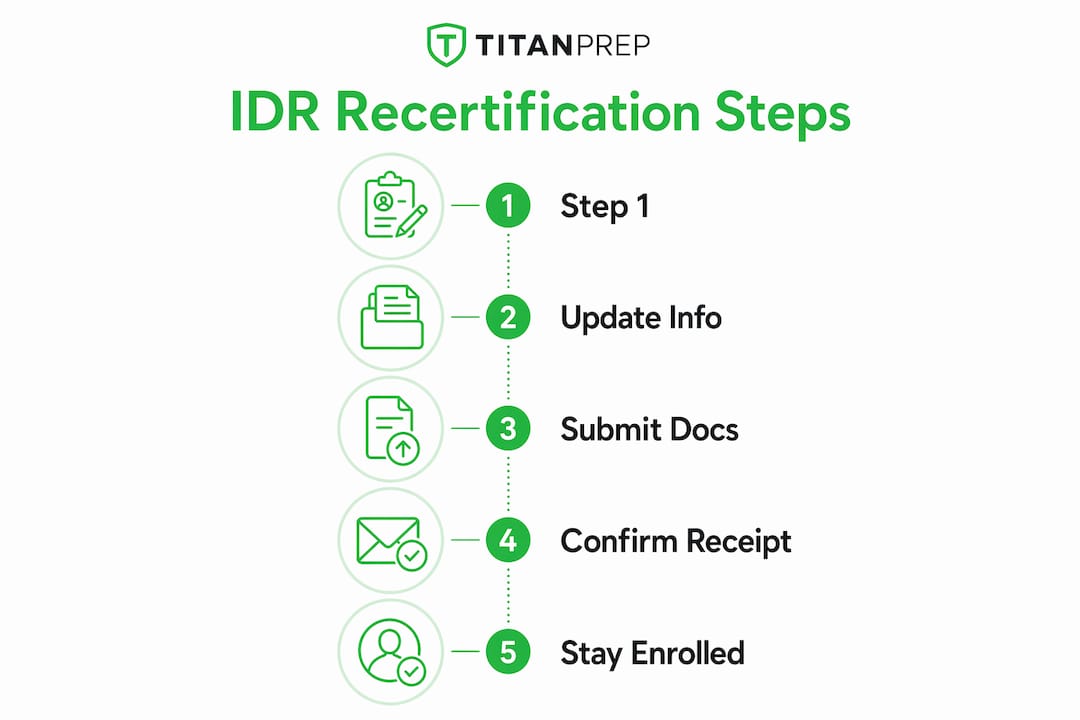
Here is how to stay on track:
Know your deadline. Your servicer sends a notice 60–90 days before your recertification due date. Do not rely solely on that notice. Set your own calendar reminder 90 days in advance.
Recertify online. Log in to StudentAid.gov and complete the annual recertification form. Use the IRS DRT again to pull current income data automatically.
Recertify early if your income drops. You do not have to wait for your annual deadline. If you lose a job or your income drops significantly, you can recertify immediately to lower your payment right away.
Update your family size. If you had a child, got married, or took on a dependent, update your family size at recertification. A larger family size lowers your discretionary income and reduces your payment.
Confirm processing with your servicer. After submitting, follow up to confirm your servicer received and processed the recertification. Servicer errors happen, and catching them early protects your payment count.
Automatic recertification is available through some servicers. If your servicer offers it, enroll. It removes the risk of forgetting the deadline entirely.
Common pitfalls and how to manage your IDR plan effectively
IDR plans offer real relief, but they come with long-term costs that borrowers often underestimate. Understanding these risks upfront helps you make better decisions over time.
Interest capitalization is the most significant hidden cost. A $30,000 balance can grow to $45,000 over time if your monthly payment does not cover accruing interest. That growth compounds, meaning your forgiveness amount grows too, and so does your potential tax bill.
Payment increases as income grows catch many borrowers off guard. IDR payments increase with income and revert to the standard 10-year amount once your calculated payment exceeds that cap. A mid-career salary increase can push you out of reduced-payment territory faster than expected.
Tax consequences of forgiveness are now a real concern. IDR forgiveness after december 2025 is treated as taxable income at the federal level. The tax exemption that applied through the end of 2025 has expired. Public Service Loan Forgiveness (PSLF) remains tax-free, but standard IDR forgiveness does not. Plan for this tax liability well before your forgiveness date.
Borrowers who reach IDR forgiveness after 20 or 25 years may owe a large tax bill in the year their loans are forgiven. Setting aside funds annually for that future liability is far less painful than facing a surprise tax debt all at once.
Additional risks to watch:
Forbearance gaps: Time spent in general forbearance does not count toward IDR forgiveness. Use income-driven repayment plans instead of forbearance whenever possible.
Plan transitions: Switching between IDR plans can reset your forgiveness clock in some cases. Understand the rules before you change your repayment plan.
Consolidation timing: Consolidating loans restarts your payment count toward forgiveness. Only consolidate when it is strategically necessary, such as for Parent PLUS loan eligibility.
For borrowers weighing whether IDR is worth the long-term cost, the IBR signup process and the broader context of PSLF servicing changes are both worth reviewing before you commit.
Key Takeaways
The income-driven repayment process requires annual recertification, careful plan selection, and proactive tax planning to deliver its full benefit without costly surprises.
Point | Details |
IDR enrollment is widespread | 11.8 million borrowers (27%) use IDR plans, confirming it is a mainstream repayment strategy. |
RAP replaces older plans | Loans disbursed after july 1, 2026 qualify only for RAP; older plans phase out by july 1, 2028. |
Recertify every 12 months | Missing recertification reverts your payment to the standard 10-year amount and triggers interest capitalization. |
Forgiveness is now taxable | IDR forgiveness after december 2025 counts as taxable income; PSLF forgiveness remains tax-free. |
Parent PLUS loans need action | Consolidate and enroll in ICR before july 1, 2028 to preserve IDR eligibility for Parent PLUS loans. |
What I have learned about IDR after years of watching borrowers navigate it
IDR plans are genuinely useful. For borrowers with high balances relative to their income, enrolling is often the right call. But the program rewards borrowers who treat it actively, not passively.
The biggest mistake I see is treating IDR as a “set it and forget it” solution. Borrowers enroll, feel relief from the lower payment, and then miss recertification or ignore a growing balance. By the time they check in, interest capitalization has added thousands to what they owe.
The second mistake is ignoring the tax math. A borrower who reaches forgiveness after 25 years with a $60,000 remaining balance could owe $15,000 or more in federal taxes that year. That is not a reason to avoid IDR. It is a reason to plan for it now, not later.
The legislative changes in 2026 add urgency. The IDR plan landscape is shifting significantly with RAP replacing older plans, and borrowers who do not act before key deadlines will lose options they cannot recover. Staying current on these changes is not optional. It is the difference between a manageable repayment path and one that costs you far more than it should.
My honest advice: enroll if you qualify, recertify on time every year, and build a plan for the tax bill at the end. The program works best for borrowers who stay engaged with it.
— Ellis
How Titanprep can help you stay on track with IDR
Managing the income-driven repayment process means keeping up with paperwork, deadlines, and program changes that shift regularly. Titanprep is a document preparation and support service that helps borrowers organize and submit applications for IDR, PSLF, and other federal student loan programs. Titanprep is not affiliated with the U.S. Department of Education or any loan servicer, but it does help you stay organized so nothing falls through the cracks. From tracking recertification deadlines to maintaining records of your submissions, Titanprep’s client portal gives you a clear view of where your file stands. Visit how Titanprep works to see how the service supports borrowers at every stage of the repayment process.
FAQ
What is income-driven repayment?
Income-driven repayment is a federal program that sets your monthly student loan payment as a percentage of your discretionary income and family size. Payments are recalculated annually and remaining balances may be forgiven after 20–25 years, or 30 years under RAP.
Who qualifies for an IDR plan?
Most borrowers with Direct Loans qualify for at least one IDR plan. Parent PLUS loans require consolidation into a Direct Consolidation Loan before becoming eligible for ICR, and must be enrolled before july 1, 2028.
How do I recertify my income-driven repayment plan?
Log in to StudentAid.gov annually before your recertification deadline and submit updated income and family size information. Using the IRS Data Retrieval Tool speeds the process and reduces the chance of errors.
Is IDR loan forgiveness taxable?
Federal IDR forgiveness after december 2025 is treated as taxable income. PSLF forgiveness is the only forgiveness type that remains tax-free at the federal level.
What happens if I miss my IDR recertification deadline?
Your payment reverts to the standard 10-year repayment amount, which is typically much higher. Missed recertification also triggers interest capitalization, adding unpaid interest to your principal balance.
Recommended
Comments