
How to Stay Compliant with Student Loan Programs


Staying compliant with student loan programs means meeting all federal requirements for payments, documentation, income recertification, and plan eligibility on an ongoing basis. Fail to meet these requirements and you risk default, wage garnishment, and lasting damage to your credit. The good news is that resources like StudentAid.gov, your loan servicer, and document support services like TitanPrep exist specifically to help you stay on track. This guide covers how to stay compliant with student loan programs in 2026, including the new repayment plan changes, how to avoid default, and the best practices for managing your loans long-term.
What are the main federal repayment plans and their compliance requirements?
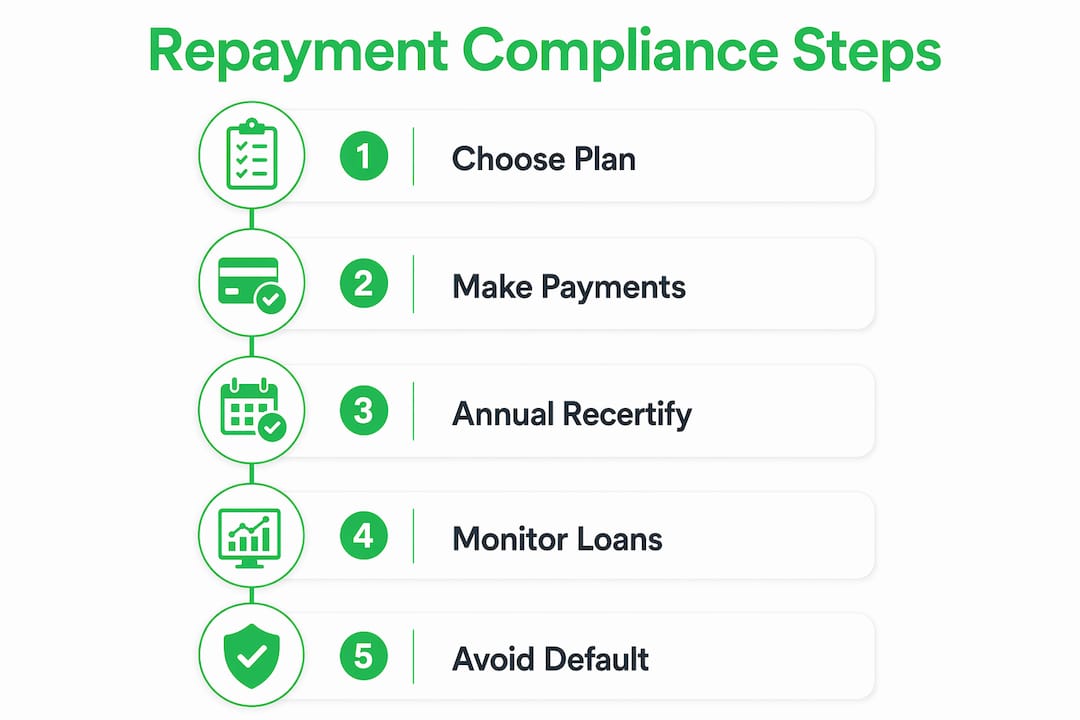
Federal student loan repayment compliance starts with choosing the right plan and meeting its specific requirements every year. The U.S. Department of Education offers several plan types, each with distinct rules for staying eligible.
The Standard Repayment Plan sets fixed monthly payments over 10 years. It requires no annual recertification, which makes it straightforward to maintain. Income-Driven Repayment (IDR) plans, including Income-Based Repayment (IBR) and Pay As You Earn (PAYE), calculate your payment as a percentage of your discretionary income. These plans require you to recertify income annually to keep your payment amount accurate and your eligibility intact. Missing recertification can result in increased monthly payments or loss of plan benefits.

2026 brings significant changes to the repayment plan landscape. The new Repayment Assistance Plan (RAP) and Tiered Standard Plan are replacing older IDR options. Legacy plans PAYE and ICR are set to sunset in 2028, and borrowers who do not proactively switch plans risk being automatically enrolled in less favorable options. Proactive plan selection is not optional. It is a compliance requirement that directly affects your payment amount and forgiveness progress.
Repayment Plan | Annual Recertification Required | Forgiveness Timeline |
Standard Repayment | No | None (10-year payoff) |
Income-Based Repayment (IBR) | Yes | 20 or 25 years |
Pay As You Earn (PAYE) | Yes | 20 years (sunsetting 2028) |
Repayment Assistance Plan (RAP) | Yes | Varies |
Tiered Standard Plan | No | None |
Pro Tip: Set a calendar reminder 90 days before your IDR recertification deadline. Servicers send notices, but processing delays can cost you your current payment amount if you wait too long.
If you hold Parent PLUS loans, the deadline pressure is even greater. Consolidating Parent PLUS loans before June 30, 2026, preserves access to income-driven repayment and forgiveness programs. Missing that date removes those options permanently for those loans.
How to avoid loan default and the consequences of non-compliance
Federal student loans enter default after 270 days past due. After 360 days without resolution, the Department of Education can begin wage garnishment or Treasury offsets. These are not empty threats. They happen automatically once the timeline triggers.
Default does not just hurt your credit score. It removes your access to deferment, forbearance, and income-driven repayment options. You lose eligibility for future federal financial aid. Your entire loan balance becomes due immediately. The financial consequences compound quickly, which is why acting before day 271 is the single most important compliance action you can take.
If you have already missed payments, three options exist to cure default:
Loan rehabilitation: Make nine voluntary, reasonable, and affordable payments within 10 consecutive months. This removes the default notation from your credit report.
Loan consolidation: Consolidate your defaulted loans into a Direct Consolidation Loan and agree to repay under an IDR plan. This is faster than rehabilitation but does not remove the default from your credit history.
Repayment in full: Pay the entire outstanding balance. This is rarely practical but does resolve the default immediately.
“The best time to contact your loan servicer is the moment you realize you cannot make a payment. Waiting until you are already behind removes options and accelerates consequences.”
Watch for official communications from your servicer and from the Department of Education. Notices about missed payments, delinquency status, and default warnings arrive by mail and email. Ignoring them does not pause the timeline. Responding quickly preserves your benefits and keeps collections from starting.
Best practices for managing and monitoring your loans
Knowing your loan status at all times is the foundation of good student loan management. Two portals give you direct access to your federal loan data: StudentAid.gov shows your loan balances, servicer information, and repayment history. MyEdDebt.ed.gov tracks collections activity if your loans have entered default. Log into both at least once per quarter.
Here are the core practices that keep borrowers compliant over the long term:
Set up autopay. Most servicers offer a 0.25% interest rate reduction for autopay enrollment. More importantly, autopay eliminates the risk of a missed payment due to a forgotten due date.
Update your contact information immediately whenever you change your address, phone number, or email. Servicers send compliance-critical notices to the contact information on file.
Contact your servicer before missing a payment. Deferment and forbearance options exist for financial hardship. They are only available to borrowers who ask before going delinquent.
Track your Public Service Loan Forgiveness (PSLF) progress. Submit the Employment Certification Form annually, not just when you apply for forgiveness. This confirms your employer qualifies and keeps your payment count accurate.
Understand your employer’s repayment benefit. Employers can contribute up to $5,250 annually tax-free toward your student loans under IRS Section 127. Contributions above that threshold count as taxable income, so coordinate with your HR department to stay within the limit.
Pro Tip: Use the PSLF Help Tool on StudentAid.gov to verify your employer’s eligibility before submitting your certification. An ineligible employer means those payments do not count toward forgiveness, even if everything else is correct.
How to choose repayment strategies that align with your situation
Choosing the right repayment strategy is not just about finding the lowest monthly payment. It is about selecting an approach that you can sustain while meeting all compliance requirements.
Start by comparing your monthly payment under each available plan against your actual take-home income. If your payment under the Standard Plan exceeds 10% to 15% of your monthly income, an income-driven repayment plan likely fits better. Lower payments reduce default risk, which is the most direct compliance benefit.
When you make extra payments, always instruct your servicer in writing to apply the overpayment to principal. Without that instruction, servicers typically apply extra funds toward your next scheduled payment instead of reducing your balance. Principal reduction shortens your loan term and reduces total interest paid.
Consider these factors when selecting or switching your repayment plan:
Forgiveness timeline: IDR plans offer forgiveness after 20 or 25 years of qualifying payments. PSLF offers forgiveness after 10 years for qualifying public service employees. Your plan choice determines which timeline applies.
Loan consolidation eligibility: Consolidating multiple federal loans into a Direct Consolidation Loan can open access to repayment plans you currently do not qualify for. Review the repayment plan change process before consolidating to understand the trade-offs.
Employer repayment benefits: If your employer offers student loan repayment assistance, confirm whether it affects your IDR payment calculation. Employer contributions do not count as income for IDR purposes, but taxable contributions above the IRS Section 127 limit do.
Tax implications: Forgiven loan balances under IDR plans may be treated as taxable income in the year of forgiveness. PSLF forgiveness is currently tax-free. Factor this into your long-term financial planning.
Federal loans carry built-in protections, including IDR access, deferment, forbearance, and forgiveness programs, that private loans do not offer. If you are weighing refinancing federal loans into private loans to get a lower interest rate, understand that you permanently give up those federal protections.
Key takeaways
Staying compliant with federal student loan programs requires proactive plan selection, annual income recertification, and consistent communication with your loan servicer before problems arise.
Point | Details |
Annual recertification | IDR borrowers must recertify income every year or risk higher payments and lost benefits. |
Default timeline | Federal loans default after 270 days past due; act before day 271 to preserve your options. |
Plan changes in 2026 | PAYE and ICR sunset in 2028; switch proactively to avoid automatic enrollment in less favorable plans. |
Extra payment instructions | Direct servicers in writing to apply overpayments to principal, not the next scheduled payment. |
Employer benefits limit | IRS Section 127 allows up to $5,250 in tax-free employer loan contributions annually. |
What I have learned from watching borrowers lose ground
The most common compliance failure I see is not ignorance. It is delay. Borrowers know they have a deadline. They know their income has changed and recertification is coming. They intend to handle it. Then life gets busy, the notice gets buried in an inbox, and suddenly they are facing a payment that doubled because recertification lapsed.
Automatic enrollment is the quiet trap that catches borrowers who miss plan selection deadlines. The SAVE plan sunset is a recent example. Borrowers who did not proactively switch were placed into plans with higher payments and no forgiveness progress. That is not a penalty. It is just what happens when the system defaults to its standard settings and you are not paying attention.
My honest advice: treat your student loan compliance like a subscription you review every year. Set one annual appointment with yourself to log into StudentAid.gov, confirm your plan, check your recertification date, and verify your servicer contact information is current. That one hour per year prevents the majority of compliance problems I see borrowers deal with.
Employer repayment programs are underused and misunderstood. Many borrowers do not know the IRS Section 127 limit exists, and some end up with a surprise tax bill because their employer’s contribution exceeded $5,250. Ask your HR department for the exact amount contributed each year and keep that documentation.
You have more rights and more options than most borrowers realize. Use them.
— Ellis
How TitanPrep helps you stay organized and compliant
TitanPrep is a document preparation and support service built specifically for federal student loan borrowers. The team helps you organize and submit applications for Income-Driven Repayment, Public Service Loan Forgiveness, and eligible discharge programs. TitanPrep also tracks deadlines, stores your records securely, and monitors your file through its client portal so nothing slips through the cracks.
If you are concerned about the 2026 repayment plan changes or want to understand your forgiveness options, start with TitanPrep’s federal forgiveness guide for a clear overview of what programs are available and what they require. For the latest updates on payment changes and compliance deadlines, visit the important student loan updates page. TitanPrep does not guarantee outcomes. Eligibility is determined solely by the U.S. Department of Education or your loan servicer.
FAQ
What does it mean to be compliant with a student loan program?
Compliance means meeting all requirements of your repayment plan, including making on-time payments, recertifying your income annually for IDR plans, and submitting required documentation on time. Non-compliance can lead to default, loss of forgiveness eligibility, and wage garnishment.
How often do I need to recertify my income for an IDR plan?
IDR borrowers must recertify income every 12 months. Missing this deadline can cause your payment to increase significantly and may result in loss of plan benefits.
What happens if I miss a student loan payment?
Missing a payment starts a delinquency clock. Federal loans enter default after 270 days past due, at which point wage garnishment and Treasury offsets become possible. Contact your servicer immediately if you cannot make a payment to explore deferment or forbearance options.
Can my employer help me pay off my student loans without tax consequences?
Yes. Under IRS Section 127, employers can contribute up to $5,250 per year toward an employee’s student loans completely tax-free. Any amount above that threshold is treated as taxable income for the employee.
Do I need to do anything special to switch repayment plans before the 2026 deadlines?
Yes. Legacy plans like PAYE and ICR sunset in 2028, and borrowers who do not switch proactively may be automatically enrolled in plans with higher payments. Contact your servicer or review your options on StudentAid.gov to select a plan before automatic enrollment occurs.
Recommended
Comments