
How to Read Your Student Loan Statement


A student loan statement is a formal billing document that shows your current balance, interest rate, payment due date, and a breakdown of how each payment is applied to your loan. Most borrowers receive one monthly, either by mail or through their servicer’s online portal, yet many never look past the amount due. That gap in understanding costs real money. When you know how to read your student loan statement, you can catch errors, avoid unnecessary fees, and make smarter decisions about paying down your debt faster.
How to read your student loan statement: key sections explained
Student loan statements generally include a payment summary, monthly payment amount, due date, current balance, original balance, and interest rate, though formats vary by servicer. The labels and layout may look different depending on whether your loans are serviced by MOHELA, Nelnet, Aidvantage, or a private lender. The function of each section, however, stays consistent across all of them.
Here are the core fields you will find on most statements:
Payment summary / current amount due: The total you owe for this billing cycle, including any past due amounts or fees added to your regular payment.
Monthly payment amount: Your standard scheduled payment, separate from any extra amounts you choose to send.
Due date: The calendar date by which your payment must be received to avoid a late fee or delinquency mark.
Current balance: What you owe today, including any unpaid interest that has accrued since your last payment.
Original balance: The total amount you borrowed at disbursement. Comparing this to your current balance shows your repayment progress.
Interest rate: Whether your rate is fixed or variable determines how predictable your future payments will be. Federal loans carry fixed rates; some private loans use variable rates that shift with market indexes.
Statement formats vary by servicer, so focus on the function of each section rather than matching labels exactly. A field labeled “Total Amount Due” on one statement serves the same purpose as “Current Payment Due” on another.
Pro Tip: Save a copy of each statement as a PDF before logging out of your servicer portal. Servicers sometimes purge older statements after 12 to 24 months, and you will want a complete payment history if you ever apply for Public Service Loan Forgiveness (PSLF) or an Income-Driven Repayment (IDR) plan.

What do unpaid interest and fees mean on your statement?
This is where most borrowers get confused, and the confusion is understandable. Your statement does not just show one balance. It separates your debt into distinct categories, and each one tells a different story about where your money is going.
MOHELA statements break down each loan individually, showing unpaid interest, unpaid fees, unpaid principal, and a billing period summary of all payments received and fees assessed. Understanding the difference between these fields is the key to knowing why your balance sometimes does not drop as fast as you expect.
Term | What it means | Why it matters |
Unpaid principal | The original borrowed amount still outstanding | This is the core debt you are working to eliminate |
Unpaid interest | Interest that has accrued but not yet been paid | Payments cover this first before touching principal |
Unpaid fees | Late fees or other charges added to your account | These must be cleared before payments reduce your balance |
Billing period summary | A record of all payments and fees within the current cycle | Use this to confirm your payment was received and applied |
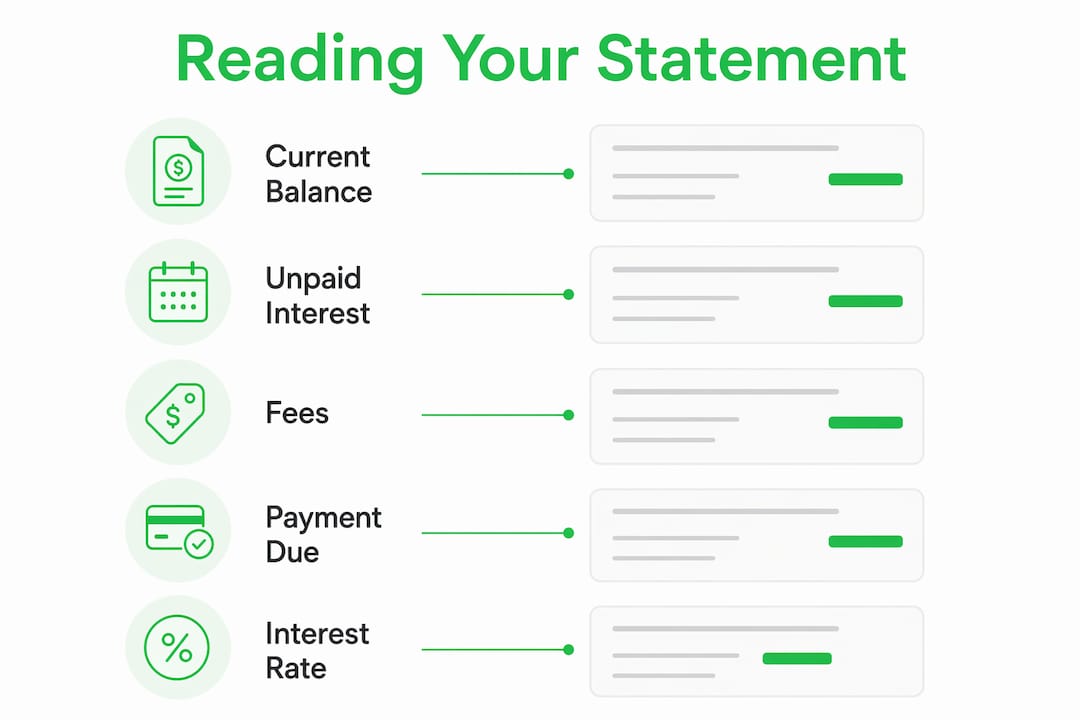
Payments do not always reduce principal immediately because unpaid interest and fees are cleared first. This is why borrowers on Income-Driven Repayment plans sometimes see their balance grow even while making on-time payments. The monthly payment covers accrued interest but leaves the principal untouched. Seeing this spelled out on your statement removes the mystery and helps you decide whether to make extra payments toward principal.
A common misconception is that a lower “amount due” means your balance is shrinking proportionally. It does not. Always check the unpaid principal line specifically to track actual debt reduction. Understanding the distinctions between unpaid interest and principal is one of the most practical skills you can develop as a borrower.
Where can you find your student loan statement?
Statements reach borrowers through two main channels: paper mail and electronic delivery through a servicer’s online account portal. Most servicers default to electronic delivery, which means your statement is waiting in your account dashboard rather than your mailbox.
Here is how to locate your statement depending on your loan type:
Federal loans: Log in to your servicer’s website directly. Common federal loan servicers include MOHELA, Nelnet, Aidvantage, and ECSI. Your servicer’s name and contact information appear on your Federal Student Aid account at studentaid.gov.
Federal loan overview: Visit studentaid.gov to see a summary of all your federal loans, including servicer assignments, loan types, and outstanding balances. This is not a billing statement, but it confirms who holds your loans.
Private loans: Contact your lender or servicer directly. Private loan servicers do not report to Federal Student Aid, so studentaid.gov will not show them. Check your original loan documents or your credit report to identify the servicer.
Missing statements: If you have not received a statement in more than 30 days and your loan is in repayment, contact your servicer immediately. A missing statement does not pause your payment obligation, and a missed payment can trigger fees or credit reporting consequences.
Switching servicers: If your loans were recently transferred, your new servicer is required to notify you. Check both your old and new servicer portals during the transition period to avoid missing a billing cycle.
Pro Tip: Set up autopay through your servicer’s portal. Federal loan servicers typically offer a 0.25% interest rate reduction for enrolling in automatic payments, and you eliminate the risk of a missed due date.
Understanding who services your loans matters because each servicer uses a different statement format and portal interface. Knowing the servicer’s role helps you interpret the document they send you.
How to use your statement to manage payments and plan ahead
Reading your statement is only half the work. The real value comes from using that information to make decisions that reduce your total repayment cost. Your statement gives you the raw data. What you do with it determines your financial outcome.
Start with your due date and payment amount. Record both in your budget for the month. If your payment amount changed from last month, check whether your repayment plan was adjusted or whether a fee was added. Payment amounts reflect principal, interest, and any fees or past due amounts, so a sudden increase usually signals one of those three factors changed.
Interest accrues daily on most student loans. Your statement shows the interest rate, but the daily cost is that rate divided by 365, multiplied by your current balance. On a $30,000 balance at 6.5%, you accrue roughly $5.34 in interest every single day. That figure clarifies why making even a small extra payment toward principal reduces your long-term cost significantly.
To verify that extra payments or autopay amounts are being applied correctly, compare the billing period payment summary and the unpaid interest and principal lines on your statement rather than relying only on the amount due. If you sent an extra $200 last month, confirm that the unpaid principal dropped by that amount after interest was covered.
Combining your statement data with a National Student Loan Data System (NSLDS) export gives you a reliable way to confirm repayment plan details and interest rates per loan, especially if you have multiple loans or recently changed plans. The NSLDS export is available through studentaid.gov and shows loan-level detail that your monthly statement may summarize.
Here are the most common mistakes borrowers make when reading their statements:
Ignoring the interest rate field: Borrowers on IDR plans sometimes do not realize their rate is higher than expected because a consolidation changed it.
Confusing current balance with amount due: These are two different numbers. One is your total debt; the other is what you owe this month.
Not checking payment application: Extra payments do not automatically go to principal. You may need to contact your servicer or specify allocation in writing.
Missing the billing period summary: This section confirms what was received and when. It is your proof of payment within the statement itself.
For practical guidance on using your statement data for repayment budgeting, building a monthly plan around your due date and interest accrual rate is the most direct path to staying on track.
Key takeaways
Reading your student loan statement accurately requires understanding five distinct fields: current balance, unpaid interest, unpaid principal, fees, and the billing period summary.
Point | Details |
Statement components | Every statement includes payment amount, due date, current balance, and interest rate as core fields. |
Unpaid interest comes first | Payments clear accrued interest and fees before reducing your principal balance. |
Verify extra payments | Check the billing period summary and unpaid principal line to confirm correct payment application. |
Use NSLDS alongside statements | Combining your statement with an NSLDS export confirms loan-level details across multiple loans. |
Find your servicer first | Federal loan servicers are listed on studentaid.gov; private loan servicers require direct contact. |
Why most borrowers are flying blind on their own loans
I have worked with enough borrowers to know that the statement is the most underused document in student loan management. People open it, see the amount due, and close it. That habit is expensive.
The detail that surprises borrowers most is the unpaid interest line. When you are on an IDR plan and your monthly payment does not cover all accruing interest, that gap compounds quietly. Your balance grows while you make every payment on time. The statement shows this clearly if you look at it. Most people do not look.
The second thing I have noticed is that borrowers rarely verify payment application. They assume the servicer applied their extra payment to principal. Sometimes it was applied to the next month’s scheduled payment instead. That is a meaningful difference in how fast your balance drops. The billing period summary on your statement is the only place you can catch this without calling your servicer.
My honest observation is that borrowers who read their statements monthly make better decisions. They catch servicer errors faster, they understand when their balance is not moving and why, and they are better prepared when they apply for programs like PSLF or IDR recertification. The statement is not intimidating once you know what each section does. It is actually one of the clearest financial documents you will receive.
For context on how interest restarts affect your payments, understanding your statement’s interest rate field becomes even more critical when rates resume after a pause period.
— Ellis
How TitanPrep helps you stay on top of your loans
Knowing what your statement says is the first step. Staying organized across multiple statements, deadlines, and program requirements is where many borrowers struggle. TitanPrep is a document preparation and support service that helps federal student loan borrowers organize paperwork, track deadlines, and submit applications for programs like IDR and PSLF. Through the TitanPrep client portal, you can upload documents, monitor your file status, and keep records of communications with your servicer in one place. If you want support staying organized and avoiding missed deadlines, see how it works and explore whether TitanPrep’s services fit your situation. TitanPrep does not guarantee loan forgiveness or specific outcomes. Eligibility is determined solely by the U.S. Department of Education or your loan servicer.
FAQ
What is included in a student loan statement?
A student loan statement includes your current balance, original balance, interest rate, monthly payment amount, due date, and a breakdown of unpaid interest, unpaid principal, and any fees. Statement contents vary slightly by servicer but cover these core fields consistently.
Why is my student loan balance not going down?
Your balance may not decrease because your payments are covering accrued interest and fees before touching the principal. On Income-Driven Repayment plans, monthly payments sometimes do not cover all accruing interest, causing the balance to grow even with on-time payments.
How do I find my student loan statement online?
Log in to your loan servicer’s website to access your statement. For federal loans, studentaid.gov lists your assigned servicer. For private loans, contact your lender directly or check your original loan documents.
How do I verify that my extra payment went to principal?
Check the billing period summary and the unpaid principal line on your next statement. Comparing these figures before and after your extra payment confirms whether the servicer applied it to principal or to a future scheduled payment.
What is the difference between current balance and amount due?
Your current balance is the total debt you owe on your loan today. The amount due is the specific payment required for the current billing cycle. These are two separate numbers, and paying the amount due does not mean you have paid off the current balance.
Recommended
Comments