
How to Enroll in Repayment Programs: 2026 Guide
- TitanPrep Official

- Jul 21
- 8 min read

Income-driven repayment (IDR) is defined as a federal program that sets your monthly student loan payment as a percentage of your discretionary income and family size. Knowing how to enroll in repayment programs is more urgent than ever in 2026, because the SAVE Plan has been struck down and borrowers face a 90-day window to move to a legal IDR plan. Missing that window means automatic enrollment in a Standard or Tiered Standard plan, which typically carries higher monthly payments. This guide walks you through eligibility, the step-by-step application process, annual recertification, and the key 2026 changes you need to act on now.
What are the eligibility requirements for enrolling in federal repayment programs?
Federal IDR plans are available to borrowers with eligible federal student loans, but not every loan type qualifies automatically. Understanding the requirements before you apply saves time and prevents rejected applications.
Eligible loan types include:
Direct Subsidized and Unsubsidized Loans
Direct PLUS Loans taken out by graduate or professional students
Direct Consolidation Loans
Parent PLUS Loans consolidated into a Direct Consolidation Loan (required for IDR access)
Federal Family Education Loans (FFEL) consolidated into a Direct Loan
Loans that do not qualify:
Private student loans from banks or credit unions
Unconsolidated Parent PLUS Loans
Perkins Loans unless consolidated into a Direct Loan
Beyond loan type, you must meet two additional conditions. Your loans must be in good standing or placed in administrative forbearance by your servicer. You must also provide income documentation and accurate family size information. The U.S. Department of Education uses these figures to calculate your payment amount.
Pro Tip: Parent PLUS borrowers should consolidate into a Direct Consolidation Loan now to access Income-Contingent Repayment before the ICR program sunsets in 2028. Waiting reduces your options significantly.
How to enroll in repayment programs through StudentAid.gov
The official enrollment process runs through StudentAid.gov. Submitting a free application at StudentAid.gov/idr takes most borrowers less than 30 minutes, with a typical processing time of 1–3 weeks. Here is the exact process, step by step.
Log in with your FSA ID. Go to StudentAid.gov and sign in using your Federal Student Aid ID. If you do not have one, create it first at the same site. Your FSA ID is your legal signature for all federal loan actions.
Start the IDR application. Navigate to the IDR application page. You will see an option to let the system recommend the best plan for you, or you can select a specific plan manually. The application tool recommends a plan based on your loan data and goals, which is useful if you are unsure which plan fits your situation.
Authorize the IRS Data Retrieval Tool. This step is the single most important action you can take to speed up your application. Authorizing IRS data access reduces processing time from weeks to a few business days. It pulls your most recent tax return income directly into the application, eliminating manual uploads and reducing errors.
Report your family size accurately. Family size affects your discretionary income calculation, which directly determines your monthly payment. Include yourself, your spouse if filing jointly, and any dependents you claim. Underreporting family size raises your payment unnecessarily.
Upload income documentation if needed. If you did not use the IRS Data Retrieval Tool, or if your income has changed significantly since your last tax return, upload supporting documents. Acceptable documents include recent pay stubs, a letter from your employer, or a self-certification form if you have no income.
Review and submit. Check every field before submitting. Errors in income or family size can delay processing or result in an incorrect payment amount.
Continue making payments during processing. Maintaining payments on your current plan while your application is reviewed protects you from delinquency. Do not stop paying because you submitted an application.
Pro Tip: If your income dropped recently due to job loss or a pay cut, use the IRS Data Retrieval Tool and then submit a separate income certification with current pay stubs. This combination gives you the fastest processing and the most accurate payment calculation.
How to recertify and maintain your IDR enrollment annually

Enrolling in an IDR plan is not a one-time task. You must recertify your income and family size every 12 months to keep your reduced payment amount. Missing this deadline has real financial consequences.
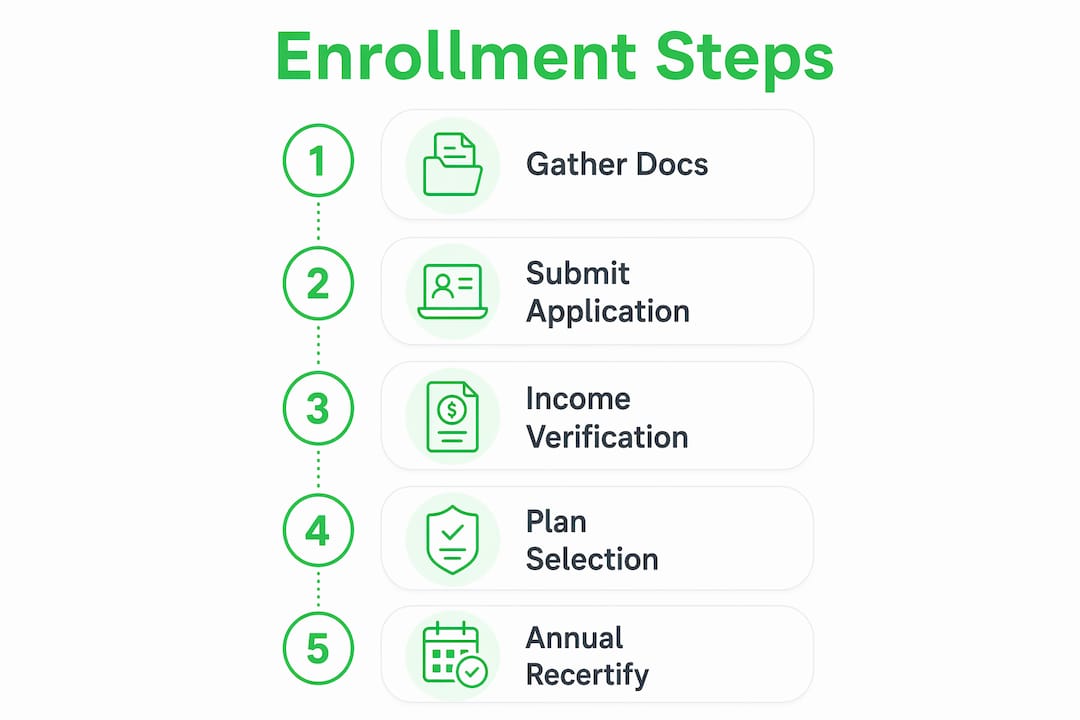
Your loan servicer sends recertification notices 0–90 days before your deadline. The timing varies by servicer, so do not rely solely on those notices. Set your own calendar reminder for 60 days before your anniversary date.
What happens if you miss recertification:
Your monthly payment reverts to the Standard Plan amount, which is almost always higher
Unpaid interest capitalizes, meaning it gets added to your principal balance
Your total loan cost increases, sometimes by thousands of dollars
Progress toward IDR forgiveness does not stop, but the higher payment strains your budget
Best practices to stay on track:
Mark your recertification deadline in your phone calendar the day you enroll
Use the IRS Data Retrieval Tool again at recertification to keep processing fast
Update your contact information with your servicer every time it changes
Check your StudentAid.gov account every few months to confirm your plan status
Financial counselors stress that proactive account management is the single most effective way to protect your benefits during federal program changes. Recertification is the clearest example of that principle in action.
Pro Tip: Set up a recurring annual reminder labeled “Student Loan Recertification Due” exactly 60 days before your deadline. Pair it with a second reminder at 30 days. Two alerts are harder to miss than one.
What changed in 2026: transitioning from SAVE and new plan options
The SAVE Plan is no longer a legal IDR option. The U.S. Department of Education confirmed that borrowers enrolled in SAVE must select a new legal IDR plan within a 90-day window starting July 1, 2026. Borrowers who do not act get automatically moved to the Standard or Tiered Standard plan. Both typically carry higher monthly payments than IDR alternatives.
The stakes are higher than just payment amounts. Months spent in administrative forbearance during the SAVE transition do not count toward qualifying payments for IDR forgiveness or Public Service Loan Forgiveness (PSLF). Every month of inaction extends your repayment timeline. If you are currently in administrative forbearance because of the SAVE situation, enrolling in a qualifying plan now stops the clock from working against you.
Two new plan options are now available for borrowers to consider.
Plan | Key feature | Best for |
Repayment Assistance Plan (RAP) | Payments based on income with a floor and ceiling | Borrowers with moderate to high income variability |
Tiered Standard Plan | Fixed payments in graduated tiers over time | Borrowers who want predictable payment increases |
Income-Based Repayment (IBR) | Payments capped at 10%–15% of discretionary income | Borrowers with older FFEL or Direct Loans |
Income-Contingent Repayment (ICR) | Only IDR option for consolidated Parent PLUS Loans | Parent PLUS borrowers before 2028 ICR sunset |
To change your repayment plan during the transition, follow the same StudentAid.gov application process described above. Select your new plan manually rather than using the auto-recommend feature, since you likely already know which plan fits your situation after reviewing the table above.
For Parent PLUS borrowers, the ICR deadline matters most. Consolidating into a Direct Consolidation Loan and enrolling in ICR before the 2028 sunset is the only path to IDR access for this loan type. Waiting past that date closes the door permanently.
You can also review financial aid updates from education resources to stay current on how these federal changes affect borrowers in your area.
Key Takeaways
Enrolling in a federal IDR plan requires accurate income documentation, timely recertification every 12 months, and immediate action if you were enrolled in the now-defunct SAVE Plan.
Point | Details |
Eligibility depends on loan type | Direct Loans and consolidated Parent PLUS Loans qualify; private loans do not. |
Apply free at StudentAid.gov | Submit your IDR application at StudentAid.gov/idr; processing takes 1–3 weeks. |
Use the IRS Data Retrieval Tool | Authorizing IRS data access cuts processing time to a few business days. |
Recertify every 12 months | Missing recertification causes interest capitalization and a higher monthly payment. |
Act on SAVE transition now | SAVE Plan borrowers must select a new legal IDR plan within the 90-day window starting July 1, 2026. |
Why I think most borrowers wait too long to act
The most common mistake I see borrowers make is treating their IDR enrollment as a set-it-and-forget-it task. They enroll once, feel relieved, and then miss their recertification deadline 12 months later because life got busy. That one missed deadline can add thousands of dollars to their principal balance overnight through interest capitalization. The relief of enrolling disappears fast when you see that number go up.
The 2026 SAVE transition makes this pattern even more costly. Borrowers sitting in administrative forbearance are not making qualifying payments toward forgiveness. Every month of delay is a month that does not count. I have seen borrowers lose a full year of progress simply because they assumed someone would handle it for them or that the government would extend the deadline again.
My honest advice: treat your student loan account the way you treat your bank account. Check it regularly. Know your recertification date the way you know your rent due date. Use the IRS Data Retrieval Tool every single time you recertify, because it is the fastest and most accurate option available. And if you are on SAVE right now, lower your monthly payments by moving to a qualifying plan before the 90-day window closes. Waiting is the only guaranteed way to make this harder on yourself.
— Ellis
How Titanprep supports borrowers through repayment changes
Titanprep is a document preparation and support service that helps borrowers organize, prepare, and submit paperwork for federal student loan programs, including IDR, PSLF, and discharge options. Titanprep is not affiliated with the U.S. Department of Education or any loan servicer. The service tracks deadlines, stores documents securely, and maintains records of submissions and servicer communications through a client portal. For borrowers navigating the SAVE transition or preparing a first IDR application, Titanprep’s student loan updates page provides current guidance on what has changed and what to do next. Eligibility for any federal program is determined solely by the U.S. Department of Education or your loan servicer.
FAQ
What loans qualify for income-driven repayment plans?
Direct Loans, Direct Consolidation Loans, and Parent PLUS Loans consolidated into a Direct Consolidation Loan qualify. Private student loans and unconsolidated Parent PLUS Loans do not.
How long does the IDR application take to process?
The typical processing time is 1–3 weeks, but using the IRS Data Retrieval Tool can shorten that to a few business days.
What happens if I miss my annual recertification deadline?
Your payment reverts to the Standard Plan amount and unpaid interest capitalizes, increasing your principal balance. Recertify before your deadline to avoid this.
I was enrolled in SAVE. What do I do now?
Select a new legal IDR plan at StudentAid.gov within the 90-day window that started July 1, 2026. Months in administrative forbearance do not count toward IDR or PSLF forgiveness, so acting quickly protects your progress.
Can I switch IDR plans after I enroll?
Yes. You can submit a new IDR application at StudentAid.gov at any time to change plans. Review your repayment plan options before switching to confirm the new plan fits your income and forgiveness goals.
Recommended
Comments