
Graduated Repayment Plan Explained for Borrowers
- TitanPrep Official

- Jul 21
- 8 min read

The Graduated Repayment Plan is a federal student loan repayment structure where monthly payments start lower than the Standard Plan and increase every two years until the loan is paid off within 10 years. Explaining graduated repayment clearly matters because many borrowers choose it without fully understanding how the payment increases work or what they cost over time. The plan applies to all Direct Loan borrowers regardless of income, requires no income documentation, and offers no loan forgiveness. If you expect your salary to grow steadily in the early years of your career, this plan may fit your budget. If your income stagnates, the rising payments can become a serious problem.
How does the Graduated Repayment Plan structure payments?
The Graduated Repayment Plan runs for exactly 10 years, with 120 total payments spread across that period. Payments increase every 24 months, and by the final payment period, your monthly amount will typically be close to double what you paid at the start. That structure is predictable, but it demands that your income keeps pace.
Here is how a typical payment progression works over the 10-year term:
Years 1 and 2: Your starting payment is set at its lowest point, often 25–50% lower than what you would pay under the Standard Repayment Plan. This gives you breathing room early in your career.
Years 3 and 4: Payments increase for the first time. The jump is calculated by your loan servicer based on your balance and interest rate, not your income.
Years 5 and 6: A second increase takes effect. At this stage, your payment may already exceed what the Standard Plan would have required at the start.
Years 7 through 10: Payments reach their highest levels. By year 10, you are paying significantly more per month than you did in year 1.
One risk that borrowers often overlook is negative amortization. Because early low payments may not fully cover the interest accruing on your loan, your balance can actually grow in the first year or two before it starts to shrink. That means you could owe more than your original loan amount before you ever reduce the principal.
Pro Tip: Ask your loan servicer to show you the full payment schedule before you enroll. Seeing the exact dollar amount for each two-year period helps you plan your budget years in advance rather than reacting to increases as they arrive.

What are the benefits and drawbacks of graduated repayment?
The Graduated Repayment Plan has real advantages for the right borrower, but it also carries costs that the Standard Plan does not.
Benefits worth considering
Lower starting payments. Your first payments are meaningfully smaller, which frees up cash for rent, transportation, or building an emergency fund right after graduation.
No income documentation required. The plan requires no annual recertification of your income, unlike Income-Driven Repayment plans. You enroll once and the schedule runs automatically.
Predictable schedule. Every increase is preset. You know exactly when your payment will rise and by roughly how much, which makes long-term budgeting possible.
Available to all Direct Loan borrowers. Eligibility is not tied to your income level, so you qualify regardless of what you earn.
Drawbacks to weigh carefully
Higher total interest costs. Because you pay less principal early on, interest accumulates faster than with the Standard Plan. You will pay more over the life of the loan.
No forgiveness option. The Graduated Plan does not offer loan forgiveness. You must repay the full principal and interest within 10 years, unlike Income-Driven Repayment plans that may offer forgiveness after 20–25 years.
Payment shock risk. If your income does not grow as expected, the mandatory payment increases can strain your budget significantly in later years.
No flexibility within the plan. Once payments increase, you cannot reduce them while staying on the Graduated Plan. Switching to a different plan is your only option if the amounts become unmanageable.
Graduated repayment vs standard: a direct comparison
Feature | Graduated Plan | Standard Plan |
Repayment term | 10 years | 10 years |
Starting payment | Lower (25–50% less) | Fixed from day one |
Total interest paid | Higher | Lower |
Income documentation | Not required | Not required |
Loan forgiveness | Not available | Not available |
Payment flexibility | Preset increases only | Fixed, no changes |
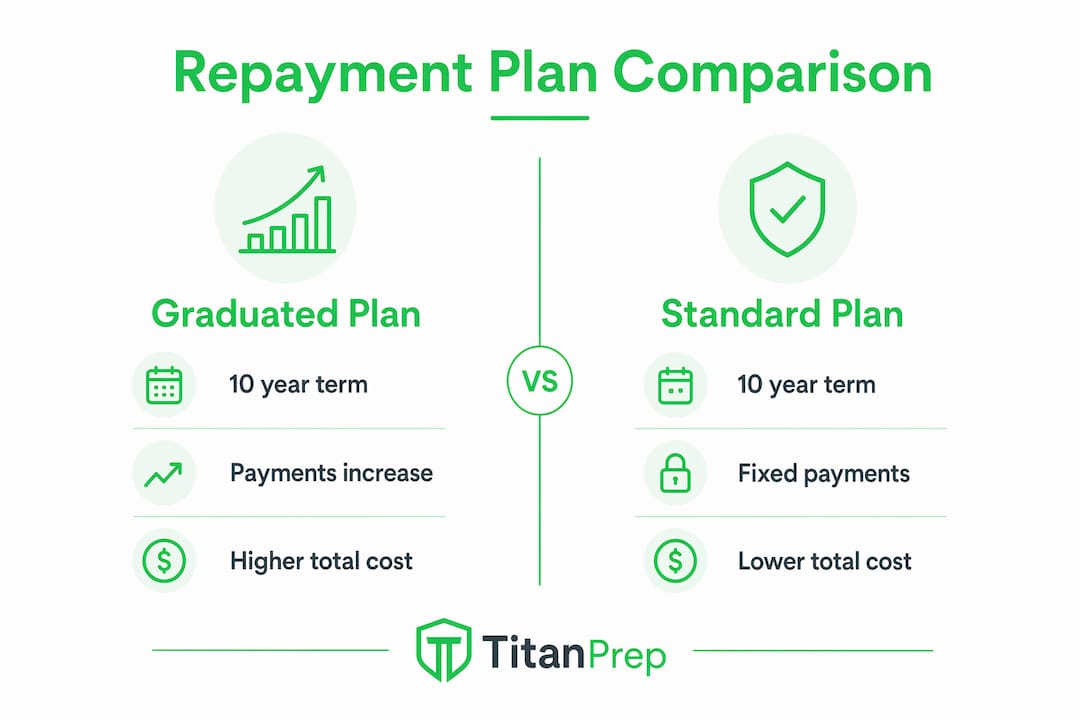
The Standard Plan costs less overall because you pay down principal faster. The Graduated Plan costs more but gives you lower payments when your income is at its lowest.
Pro Tip: If you are deciding between the two, calculate the total interest difference using your loan servicer’s repayment estimator. The gap can be thousands of dollars over 10 years, and seeing that number makes the trade-off concrete.
Who is eligible, and what changes in 2026?
Eligibility for the Graduated Repayment Plan is straightforward. The plan is available to all Direct Loan borrowers regardless of income level. You do not need to meet any earnings threshold or submit financial documents to qualify.
That said, a significant change is coming. The Graduated Repayment Plan will no longer be available for new federal student loans disbursed on or after july 1, 2026. Here is what that means for different groups of borrowers:
Existing borrowers with loans disbursed before july 1, 2026: You can stay on the Graduated Plan or switch to it if you have not already enrolled. Your access is protected.
New borrowers with loans disbursed on or after july 1, 2026: The Graduated Plan will not be an option for you. Your repayment choices will be limited to the Standard Plan and qualifying Income-Driven Repayment plans.
Borrowers who consolidate loans: Consolidation can affect your repayment term length and may change which plans you are eligible for. Check with your servicer before consolidating.
Borrowers currently on the Graduated Plan: No action is required to keep your current plan. The july 1, 2026 cutoff applies to new disbursements, not existing enrollments.
If you have loans disbursed before the cutoff and are considering the Graduated Plan, the window to enroll is still open. Reviewing your repayment timeline now gives you time to make an informed decision before the option closes.
How to switch repayment plans if payments become unaffordable
The Graduated Plan’s biggest structural weakness is that it cannot adapt to your circumstances once you are enrolled. Payments increase on a fixed schedule regardless of whether your income grew, stayed flat, or dropped. Knowing when and how to switch protects you from default.
Signs you should consider switching
Watch for these warning signs that the Graduated Plan is no longer working for your situation:
Your payment increase arrives and the new amount exceeds 10–15% of your monthly take-home pay.
You are skipping other financial obligations to make your loan payment.
Your income has not grown since you enrolled, and the next increase is approaching.
You are considering deferment or forbearance just to get through a payment period.
Steps to change your repayment plan
Log in to StudentAid.gov. This is the official federal portal where you can review all available repayment plans and run estimates for each one.
Compare Income-Driven Repayment options. Plans like Income-Based Repayment (IBR) and Pay As You Earn (PAYE) set your payment as a percentage of your discretionary income. If your income is low or stagnant, your payment drops accordingly. Switching to an IDR plan can provide immediate relief and may qualify you for forgiveness after 20–25 years.
Submit a repayment plan change request. Your loan servicer processes this request. You can do it online through your servicer’s portal or by submitting a paper form. Processing typically takes one billing cycle.
Gather any required documentation. IDR plans require proof of income, such as your most recent tax return or pay stubs. Have these ready before you apply.
Confirm your new payment amount and start date. Get written confirmation from your servicer before your next due date so there is no gap in your payment record.
If you need help organizing the paperwork for a plan change, Titanprep’s guide on changing your repayment plan walks through each step in detail.
Pro Tip: Do not wait until you miss a payment to switch plans. Contact your servicer the moment you see a payment increase coming that you cannot cover. Proactive switching keeps your credit record clean and avoids late fees.
Key Takeaways
The Graduated Repayment Plan works best for borrowers with strong, predictable income growth, but it costs more in total interest than the Standard Plan and offers no forgiveness.
Point | Details |
Payment structure | 120 payments over 10 years, increasing every 24 months, often doubling by the end. |
Starting payment advantage | Initial payments can be 25–50% lower than the Standard Plan, easing early budget pressure. |
Total interest cost | Graduated Plan borrowers pay more interest overall due to slower principal reduction early on. |
No forgiveness available | Full repayment of principal and interest is required; no forgiveness option exists on this plan. |
2026 eligibility cutoff | New loans disbursed on or after july 1, 2026 are no longer eligible for the Graduated Plan. |
The graduated plan is a calculated bet, not a safe default
I have worked with a lot of borrowers who chose the Graduated Plan because the starting payment was low and that felt like the right move in the moment. The problem is that “low payment now” and “good plan overall” are not the same thing. The Graduated Plan is a calculated bet that your income will grow on schedule. If that bet pays off, you get manageable early payments and a clean 10-year payoff. If it does not, you are locked into rising payments with no way to reduce them without switching plans entirely.
The borrowers I see struggle most are the ones who enrolled without running the numbers on years 7 through 10. Those final payment periods can be genuinely difficult, especially if a career change, health issue, or economic downturn interrupts the income growth they planned on. The plan has no safety valve built in.
My honest advice: use the Graduated Plan only if you have a specific, realistic reason to expect income growth, not just a general hope for it. A teacher, a nurse, or a federal employee with a defined salary scale has a concrete basis for that expectation. A recent graduate in a volatile industry does not. For borrowers in that second group, an Income-Driven Repayment plan offers the same low starting payment with the added protection of adjusting if your income does not cooperate. The Graduated Plan rewards optimism. IDR plans reward realism.
— Ellis
How Titanprep supports borrowers navigating repayment changes
Federal student loan repayment rules are shifting fast, and staying current matters. Titanprep publishes clear, up-to-date guidance on repayment plan changes, eligibility requirements, and the steps borrowers need to take as deadlines approach. Whether you are evaluating the Graduated Plan before the july 1, 2026 cutoff, considering a switch to an IDR plan, or trying to understand how recent federal changes affect your loans, Titanprep’s resources are built to help you stay organized and informed. Start with Titanprep’s student loan updates page for the latest on repayment plan changes and what they mean for your situation.
FAQ
What is the Graduated Repayment Plan?
The Graduated Repayment Plan is a federal student loan repayment option with 120 payments over 10 years, where monthly payments start lower and increase every 24 months until the loan is fully repaid.
How does graduated repayment differ from the Standard Plan?
Both plans run for 10 years, but the Graduated Plan starts with lower payments that rise over time, while the Standard Plan keeps payments fixed. The Graduated Plan typically results in higher total interest paid.
Does the Graduated Repayment Plan offer loan forgiveness?
No. The Graduated Plan requires full repayment of principal and interest within 10 years and does not offer any loan forgiveness, unlike Income-Driven Repayment plans that may forgive remaining balances after 20–25 years.
Can I switch from the Graduated Plan to an Income-Driven Repayment plan?
Yes. If your payments become unaffordable, you can switch to an IDR plan through your loan servicer or StudentAid.gov. IDR plans adjust your payment based on income and may qualify you for eventual forgiveness.
Who can still enroll in the Graduated Repayment Plan in 2026?
Borrowers with federal Direct Loans disbursed before july 1, 2026 can still enroll in or remain on the Graduated Plan. Borrowers with loans disbursed on or after that date are no longer eligible for this plan.
Recommended
Comments