
Extended Repayment Plans for Federal Loans: 2026 Guide
- TitanPrep Official

- Jul 21
- 8 min read

The Extended Repayment Plan is defined as a federal student loan repayment option that stretches your payment term up to 25 years, reducing your monthly obligation by spreading principal and interest over a longer period. Understanding extended repayment plans matters more than ever in 2026, because new federal legislation has permanently changed who can access this plan. If you have federal student loans and want predictable payments without annual income recertification, this guide covers everything you need to make a confident decision.
How does the Extended Repayment Plan work and who qualifies?
The Extended Repayment Plan is available to borrowers who carry at least $30,000 in outstanding federal student loans. That threshold applies separately to Direct Loans and Federal Family Education Loan (FFEL) loans, so you cannot combine both portfolios to meet the minimum. If your balance falls short, consolidating your loans can help you reach the threshold, but consolidation averages your interest rates and resets your repayment clock.
Once you qualify, you choose between two payment structures:
Fixed payments: Your monthly amount stays the same for the full 25-year term. This makes budgeting straightforward because nothing changes from month to month.
Graduated payments: Your payments start lower and increase every two years. This structure suits borrowers who expect their income to grow steadily over time.
Both structures are available through your loan servicer or StudentAid.gov, and enrollment requires no annual income re-evaluation. That administrative simplicity is one of the plan’s clearest advantages over income-driven options.
Pro Tip: If your loan balance is just under $30,000, ask your servicer whether consolidation makes sense before assuming you are ineligible. The math on interest rate averaging matters, so run the numbers first.

One critical eligibility rule took effect in 2026. Borrowers who take out new federal loans after july 1, 2026 lose access to the Extended Repayment Plan for those new loans. Your loan origination date now determines which plans are available to you.
What are the benefits and drawbacks of the Extended Repayment Plan?
Lower monthly payments are the plan’s primary benefit. On a $60,000 loan at 6% interest, the Extended fixed payment reduces your monthly bill by 42% compared to the standard 10-year plan. That difference can free up hundreds of dollars each month for rent, savings, or other financial priorities.
The plan also offers predictability. You know exactly what you owe each month, and you never have to submit income documentation to stay enrolled. For borrowers with stable salaries who find income-driven recertification burdensome, that simplicity has real value.
The trade-off is steep. On a $50,000 loan at 6.5% interest, the Extended Repayment Plan generates roughly $47,500 in total interest over 25 years, compared to about $17,700 on the standard 10-year plan. That is a difference of nearly $30,000 paid purely in interest.
The drawbacks go beyond cost. The Extended Repayment Plan does not qualify for Public Service Loan Forgiveness (PSLF), and it carries no income-driven forgiveness pathway either. Borrowers who switch to this plan from an income-driven repayment (IDR) plan also reset any forgiveness progress they had accumulated.
Feature | Extended Repayment Plan | Income-driven repayment plans |
Repayment term | Up to 25 years | 20–25 years |
Monthly payment basis | Fixed or graduated amount | Percentage of discretionary income |
Annual income recertification | Not required | Required every year |
PSLF eligibility | No | Yes |
IDR forgiveness eligibility | No | Yes |
Total interest cost | Significantly higher | Varies; can be lower with forgiveness |
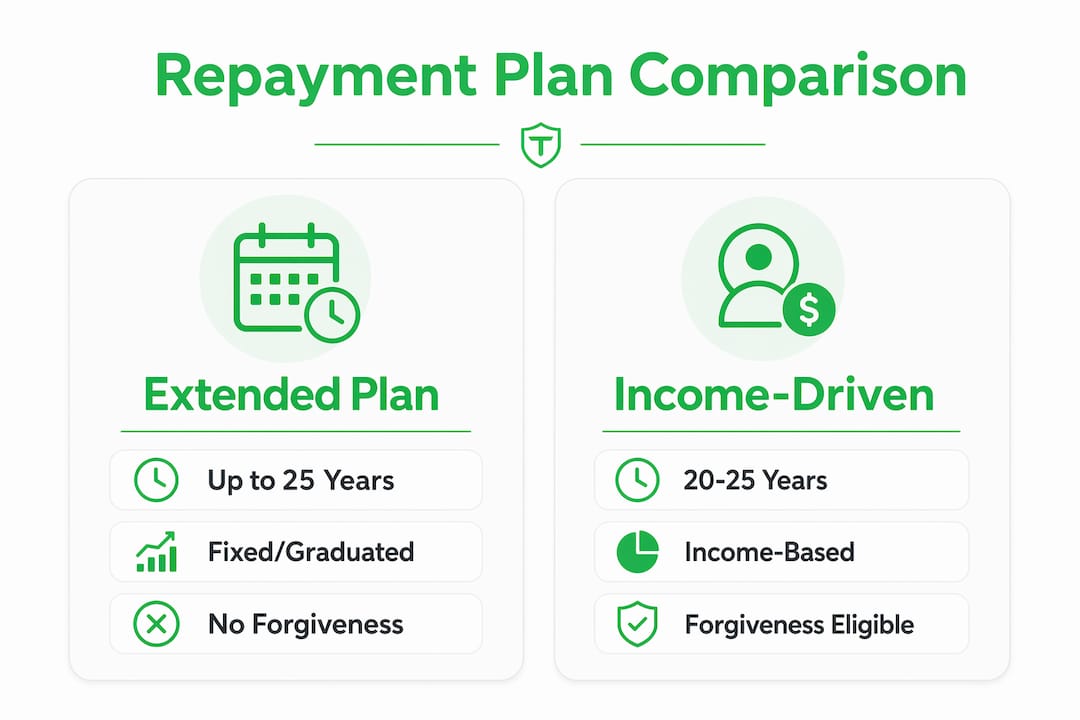
Income-driven repayment plans cap payments based on your income and offer forgiveness after 20 or 25 years of qualifying payments. The Extended Plan offers simplicity but no forgiveness. That distinction shapes every comparison between the two approaches.
How have 2026 federal student loan policy changes affected access?
The FY2025 budget reconciliation law reshaped the federal repayment landscape starting july 1, 2026. The changes are significant, and your loan origination date now determines your options in ways that were not true before.
Here is what the law changed:
New borrowers who take out federal loans after july 1, 2026 are limited to the Tiered Standard Plan and the Repayment Assistance Plan (RAP). The Extended Repayment Plan is not available to them.
Existing borrowers with loans originated before july 1, 2026 retain access to the Extended Repayment Plan, provided they do not take out new federal loans after that date.
RAP replaces income-driven plans for new borrowers. It uses a flat percentage of income and offers 30-year forgiveness, making it the new default for income-sensitive repayment.
Some legacy repayment plans face sunset dates by 2028. Borrowers on those plans should confirm their current status with their servicer.
Consolidation after july 1, 2026 may affect your eligibility. If consolidation creates a new loan with a post-cutoff origination date, you could lose access to the Extended Plan.
Policy specialists note that the changing federal loan landscape in 2026 demands careful borrower awareness, especially regarding legacy plan access. If you are unsure whether your loans qualify, contact your servicer and ask specifically about your loan origination dates. You can also review the 2026 federal loan policy changes on Titanprep for a plain-language breakdown.
How do you decide if the Extended Repayment Plan fits your situation?
Choosing the right repayment plan depends on your income, your loan balance, and your long-term financial goals. The Extended Repayment Plan is not the right fit for every borrower, but it is the right fit for some.
Work through these decision steps:
Check your loan balance. You need at least $30,000 in qualifying federal loans. Borrowers under that threshold do not qualify unless they consolidate. Weigh the interest rate averaging trade-off before consolidating.
Assess your income stability. The Extended Plan works best when your income is steady and predictable. If your income fluctuates, an IDR plan that adjusts payments to your earnings may protect you better during low-income periods.
Clarify your forgiveness goals. If you work in public service or plan to, the Extended Plan disqualifies you from PSLF. Choosing it resets forgiveness progress you may have already built. That cost is often invisible until it is too late to reverse.
Compare total cost, not just monthly payments. Use the loan simulator at StudentAid.gov to model your total repayment under the Extended Plan versus IDR options like Income-Based Repayment (IBR) or Pay As You Earn (PAYE). The monthly savings on the Extended Plan can look attractive until you see the total interest column.
Factor in your career trajectory. If you expect significant income growth, graduated payments under the Extended Plan may align well with your earnings curve. If your income is likely to stay moderate, an IDR plan with forgiveness may cost less over time.
Talk to your loan servicer. Your servicer can pull your specific loan data and show you side-by-side projections. That conversation costs nothing and can save you thousands.
Financial advisors recommend comparing Extended Repayment with income-driven options by weighing income variability and forgiveness goals together. Neither factor alone tells the full story. You can also review a debt management overview to understand how loan repayment fits into your broader financial picture.
Pro Tip: Map out your expected income for the next five years before choosing a plan. If you anticipate a raise or career change, that projection changes which plan costs less in total, not just month to month.
The Extended Plan is appropriate when you have a large balance, stable income, no forgiveness goals, and want to avoid annual recertification paperwork. It is the wrong choice when you work in public service, expect income volatility, or carry a balance under $30,000 without consolidating.
Key Takeaways
The Extended Repayment Plan lowers monthly federal student loan payments by stretching the term to 25 years, but it costs significantly more in total interest and eliminates eligibility for PSLF and IDR forgiveness.
Point | Details |
Eligibility threshold | You need at least $30,000 in qualifying federal loans to enroll. |
Two payment structures | Choose fixed payments for consistency or graduated payments if your income will grow. |
Total interest cost | Extending to 25 years can add tens of thousands in interest compared to the standard plan. |
No forgiveness pathway | This plan disqualifies you from PSLF and resets any IDR forgiveness progress. |
2026 policy cutoff | Borrowers who take new loans after july 1, 2026 lose access to the Extended Plan. |
What I have learned watching borrowers choose the Extended Repayment Plan
Most borrowers who choose the Extended Repayment Plan do so for the right reason: they need breathing room in their monthly budget. That is a legitimate goal. Where I see things go wrong is when borrowers treat lower monthly payments as a sign that they are paying less overall. They are not. They are paying more, just more slowly.
The forgiveness blind spot is the most costly mistake I encounter. A borrower who has made three years of qualifying payments toward PSLF and then switches to the Extended Plan does not just pause their progress. They erase it. That is a decision that cannot be undone without restarting the clock on an income-driven plan.
The 2026 policy changes add another layer of complexity. Borrowers with pre-cutoff loans now hold access to a plan that new borrowers cannot touch. That access is worth protecting. Taking out even one new federal loan after july 1, 2026 can change your eligibility picture permanently. Before you borrow again or consolidate, verify the impact with your servicer.
My honest recommendation: use the Extended Plan only after you have ruled out IDR options and confirmed you have no forgiveness goals. The repayment plan comparison on Titanprep is a good starting point for that analysis. Predictability is valuable, but not at the cost of tens of thousands of dollars and a forgiveness pathway you did not realize you were giving up.
— Ellis
How Titanprep can help you stay on track with repayment
Repayment plan decisions carry real financial consequences, and the 2026 policy changes have made the rules more complex than they were a year ago. Titanprep helps borrowers organize their loan documents, track deadlines, and prepare paperwork for federal repayment programs including IDR applications and PSLF submissions. The Titanprep client portal keeps your records in one place so nothing falls through the cracks. For the latest guidance on how recent legislation affects your options, visit the student loan updates page. If you want personalized support, Titanprep’s team is ready to help you understand your choices and stay organized through every step.
FAQ
What is the minimum balance for Extended Repayment Plan eligibility?
You need at least $30,000 in outstanding federal student loans to qualify. Direct Loans and FFEL loans are evaluated separately, so you cannot combine both to meet the threshold without consolidating.
Does the Extended Repayment Plan qualify for loan forgiveness?
No. The Extended Repayment Plan does not qualify for Public Service Loan Forgiveness or income-driven repayment forgiveness. Enrolling in this plan also resets any forgiveness progress you have already accumulated.
How do 2026 policy changes affect the Extended Repayment Plan?
Borrowers who take out new federal loans after july 1, 2026 can no longer access the Extended Repayment Plan for those loans. Existing borrowers with pre-cutoff loans retain access as long as they do not borrow again after that date.
What is the difference between fixed and graduated Extended Repayment payments?
Fixed payments stay the same for the full 25-year term. Graduated payments start lower and increase every two years, making them better suited for borrowers who expect their income to grow over time.
How do I enroll in the Extended Repayment Plan?
You enroll through your loan servicer or at StudentAid.gov. The process does not require income documentation, and you do not need to recertify your income annually to stay enrolled.
Recommended
Comments