
Explaining PSLF Requirements: Your 2026 Eligibility Guide
- TitanPrep Official

- Jul 21
- 7 min read

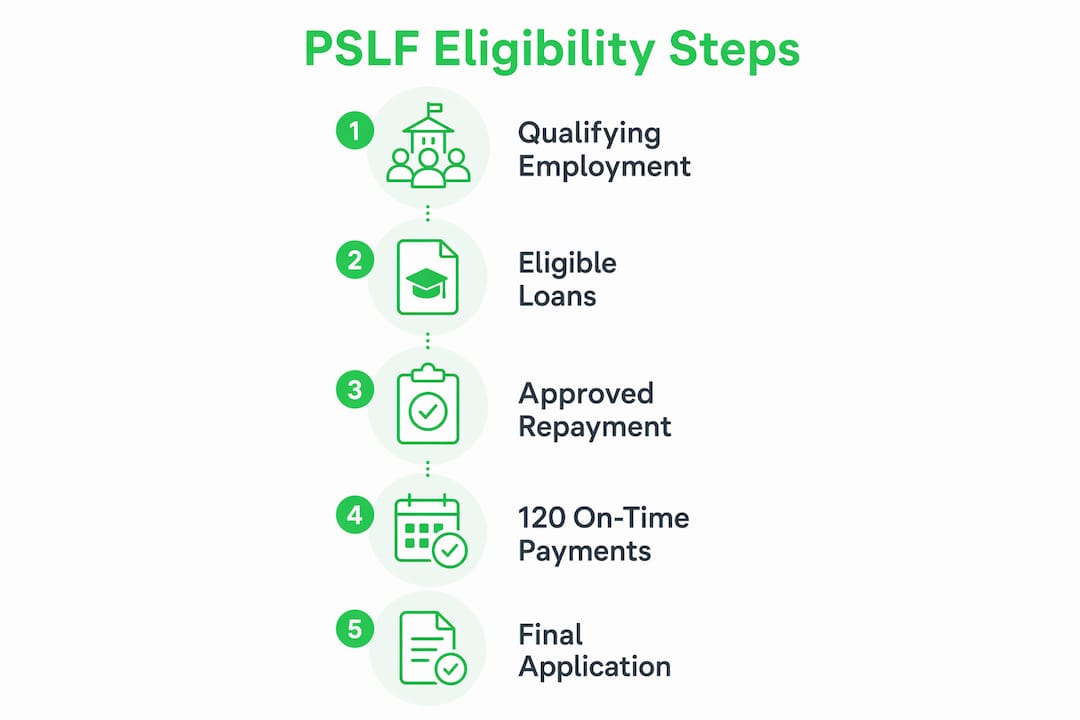
Public Service Loan Forgiveness (PSLF) is a federal program that forgives the remaining balance of eligible Direct Loans after you make 120 qualifying monthly payments while working full-time for a qualifying employer. Explaining PSLF requirements clearly matters because missing even one condition can disqualify payments you have already made. Three criteria must all be met at the same time: qualifying employment, eligible loan types, and an approved repayment plan. Get all three right, and you are on track for forgiveness after 10 years of payments.
Explaining PSLF requirements: which employers qualify?
PSLF eligibility depends on your employer’s status, not your job title or duties. A janitor at a qualifying government agency earns credit just as a physician at a qualifying nonprofit hospital does. Employer eligibility is strictly defined by the organization’s taxpayer identification and tax-exempt status. Roles performed within a larger organization that does not meet PSLF standards do not count toward forgiveness, even if your specific work serves the public.
Which organizations count as qualifying employers?
Qualifying employers fall into three categories:
Government employers: Federal, state, local, and tribal government agencies at any level qualify. This includes public schools, public universities, and public hospitals operated by government entities.
501©(3) nonprofit organizations: Any organization with IRS 501©(3) tax-exempt status qualifies, regardless of the services it provides. An IRS tax-exempt determination letter confirms this status.
Non-501©(3) nonprofits providing qualifying public services: Organizations without 501©(3) status may still qualify if they provide certain public services, such as public health, public education, public safety, or law enforcement.
One detail borrowers frequently miss: if your employer loses its 501©(3) status while you work there, payments made after that date stop qualifying. Verify your employer’s current status each year, not just when you first accept the job.
Pro Tip: Use the PSLF Help Tool on StudentAid.gov to check employer eligibility before accepting a new position. The tool searches a database of qualifying employers and lets you submit your Employment Certification Form digitally.
Combining part-time jobs to meet the full-time threshold
Full-time work for PSLF means at least 30 hours per week or your employer’s own full-time standard, whichever is greater. If you work two part-time qualifying jobs, you can add those hours together to meet the threshold. For example, 20 hours per week at a public university plus 15 hours per week at a 501©(3) clinic equals 35 hours total, which satisfies the requirement. Both employers must independently qualify for PSLF for the combined hours to count.

What loans and repayment plans qualify for PSLF?
Only federal Direct Loans qualify for PSLF. This is one of the most common sources of confusion among borrowers. FFEL and Perkins loans must be consolidated into a Direct Consolidation Loan to become eligible. Consolidation resets your payment count to zero, so any payments made before consolidation do not count toward the 120 required.
Eligible and ineligible loan types
Loan type | PSLF eligible? | Notes |
Direct Subsidized Loans | Yes | Qualify as-is |
Direct Unsubsidized Loans | Yes | Qualify as-is |
Direct Grad PLUS Loans | Yes | Qualify as-is |
Direct Consolidation Loans | Yes | Resets payment count |
FFEL Loans | No | Must consolidate first |
Perkins Loans | No | Must consolidate first |
Parent PLUS Loans | Conditional | Must use Income-Contingent Repayment |
Parent PLUS loans present a specific challenge. They qualify only under Income-Contingent Repayment (ICR) after consolidation into a Direct Consolidation Loan. The parent borrower, not the student, must work for a qualifying employer.
Which repayment plans count toward PSLF?
Income-driven repayment (IDR) plans are the most practical choice for most borrowers pursuing PSLF. These include Income-Based Repayment (IBR), Pay As You Earn (PAYE), Income-Contingent Repayment (ICR), and SAVE (when available). The Standard 10-Year Plan also qualifies, but payments under it are typically high enough to pay off the loan before reaching 120 payments, leaving little or nothing to forgive. Extended and Graduated repayment plans do not qualify unless counted through limited waivers.
Pro Tip: If you consolidate FFEL loans to become PSLF-eligible, choose an IDR plan immediately after consolidation. Starting on a non-qualifying plan delays your progress and wastes months of payments.
What counts as a qualifying payment?
A qualifying payment is one that meets four conditions at the same time. Payments must be made on time (no later than 15 days after the due date), for the full required amount, while you are employed full-time by a qualifying employer, and under an eligible repayment plan. Miss any one condition and that month does not count.
The 120-payment rule explained
Follow these steps to understand how the 120-payment count works:
Payments do not need to be consecutive. If you leave a qualifying employer for a year and return, your prior qualifying payments still count. You simply stop accumulating new qualifying payments during the gap.
Periods of deferment, forbearance, or in-school status do not count. Time spent in these statuses does not advance your payment count, even if no payment is due.
Grace periods after graduation do not count. Payments must be actively made under an eligible plan while working for a qualifying employer.
Overpayments do not count as future payments. Paying more than the required amount in one month does not credit you for the next month.
Lump-sum payments count as one payment. Even if you pay 12 months’ worth at once, that counts as a single qualifying payment.
Full-time employment during every payment
Your qualifying employment status must be active at the time each payment is made. You cannot retroactively qualify a payment by later working for a qualifying employer. This means if you switch to a private-sector job mid-year and make payments during that period, those payments do not count even if you return to public service afterward.
Pro Tip: If you are between qualifying jobs, consider requesting a deferment or income-driven forbearance rather than making payments that will not count. Protect your payment count by only making payments when your employment qualifies.
How to maintain compliance and track your progress
Tracking your PSLF progress requires consistent action throughout your repayment period, not just at the end. Submit an Employment Certification Form annually or whenever you change jobs. Annual submission lets your loan servicer update your qualifying payment count and flag any eligibility problems early. Waiting until you reach 120 payments to submit your first form is a common and costly mistake.
Record-keeping practices that protect your progress
Keep the following documents in a secure personal file:
Pay stubs: Maintain at least 12 months of pay stubs at all times to verify full-time employment.
W-2 forms: Keep W-2s for every year you are pursuing PSLF. They confirm your employer and annual earnings.
Copies of submitted certification forms: Save every Employment Certification Form you submit, along with the servicer’s written confirmation.
Servicer correspondence: Print or save emails and letters from your loan servicer confirming payment counts.
Borrower-maintained documentation is a vital safeguard against servicer errors. The Department of Education and servicers maintain records, but discrepancies do occur. Your personal file is your evidence if a dispute arises.
Applying for forgiveness after 120 payments
PSLF forgiveness is not automatic. After making your 120th qualifying payment, you must submit a final PSLF application form and remain employed by a qualifying employer while your application is processed. Borrowers may request forbearance during processing to avoid making additional payments while waiting for approval. Do not assume forgiveness happens on its own. Submit the final form promptly and follow up with your servicer.
Key Takeaways
PSLF requires qualifying employment, eligible Direct Loans, an approved repayment plan, and 120 on-time monthly payments made simultaneously under all four conditions.
Point | Details |
Employer eligibility drives qualification | Your employer’s tax status determines PSLF eligibility, not your job title or duties. |
Only Direct Loans qualify | FFEL and Perkins loans must be consolidated first, which resets your payment count to zero. |
IDR plans are the practical choice | Income-driven repayment plans maximize forgiveness by keeping payments low over 10 years. |
Annual certification prevents surprises | Submit Employment Certification Forms every year to catch eligibility problems early. |
Forgiveness requires a final application | After 120 payments, you must submit a PSLF application form and remain employed during processing. |
What I have learned from watching borrowers navigate PSLF
The single biggest mistake I see borrowers make is treating PSLF as a set-it-and-forget-it program. They enroll in an IDR plan, start making payments, and assume everything is running correctly. Years later, they discover their employer lost its 501©(3) status, or their loan servicer miscounted payments, or they were on the wrong repayment plan for two years. By then, the damage is done.
PSLF is an ongoing management process. Verify your employer’s eligibility every year, not just when you accept the job. Submit your Employment Certification Form annually even when nothing has changed. Check your qualifying payment count after each submission and compare it to your own records. If the numbers do not match, resolve the discrepancy immediately rather than waiting.
One more thing borrowers underestimate: consolidation timing matters enormously. Consolidating too early can reset a payment count you have spent years building. Consolidating too late means years of ineligible payments. Before you consolidate anything, map out exactly how many qualifying payments you already have and what you stand to lose. The PSLF limited waiver history shows how even past program errors can sometimes be corrected, but proactive management is always better than relying on a fix later.
— Ellis
How Titanprep supports borrowers pursuing PSLF
Staying organized across 10 years of payments, employer changes, and certification submissions is genuinely difficult. Titanprep is a document preparation and support service that helps federal student loan borrowers organize, prepare, and submit paperwork for programs like PSLF and Income-Driven Repayment. The service tracks deadlines, stores records securely, and helps borrowers maintain compliance throughout repayment. Titanprep is not affiliated with the U.S. Department of Education, and eligibility for any federal program is determined solely by the Department or your loan servicer. To understand how the service works and whether it fits your situation, visit the Titanprep how-it-works page or browse the federal forgiveness guide for a broader look at your options.
FAQ
What is the PSLF Help Tool and how does it work?
The PSLF Help Tool is an online resource on StudentAid.gov that lets borrowers check employer eligibility and submit Employment Certification Forms digitally. It is the most authoritative resource for verifying qualifying employment and tracking your payment count.
Does my job title affect PSLF eligibility?
No. PSLF eligibility depends on your employer’s status, not your specific role or duties. Any position at a qualifying government agency or 501©(3) nonprofit counts toward forgiveness.
Can I qualify for PSLF with a part-time job?
You can qualify if you combine hours from multiple part-time qualifying employers to reach at least 30 hours per week total. Each employer must independently meet PSLF eligibility standards.
What happens if I consolidate my loans for PSLF?
Consolidating FFEL or Perkins loans into a Direct Consolidation Loan makes them PSLF-eligible, but resets your payment count to zero. Any payments made before consolidation do not carry over.
Do I need to apply for PSLF after making 120 payments?
Yes. Forgiveness is not automatic. You must submit a final PSLF application form and remain employed by a qualifying employer while the Department of Education processes your request.
Recommended
Comments