
Closed School Discharge Student Loans: Your Relief Guide


Closed school discharge is a federal program that cancels your student loan balance if your school shut down while you were enrolled or within a qualifying window after you left. This applies to Direct Loans, Federal Family Education Loans (FFEL), and Perkins Loans. Unlike income-driven forgiveness programs that require years of qualifying payments, discharge cancels debt based solely on the school’s closure event. If your college or trade school closed and you never finished your program, you may owe nothing. This guide walks you through who qualifies, how to apply, and what to do if your application gets denied.
Who qualifies for closed school discharge?

Eligibility for closed school discharge student loans rests on a specific set of conditions tied to your enrollment status and the timing of your school’s closure. The U.S. Department of Education does not require you to have a perfect payment history or meet an income threshold. The qualifying event is the closure itself.
You are eligible if you meet one of these conditions:
You were enrolled at the school on the date it closed.
You were on an approved leave of absence when the school closed.
You withdrew within 120 days before the school closed (for loans disbursed before July 1, 2020).
You withdrew within 180 days before the school closed (for loans disbursed on or after July 1, 2020).
The 120-day versus 180-day distinction matters more than most borrowers realize. Your loan disbursement date, not your enrollment date, determines which window applies to you. Check your loan records carefully before assuming which rule governs your situation.
You are not eligible if any of the following apply:
You completed your program or received a degree before the school closed.
You withdrew outside the window of 120 or 180 days before closure, except in rare circumstances.
You transferred your credits and completed a comparable program at another school through a teach-out agreement.
You accepted a teach-out offer and finished your studies at an approved institution.
The teach-out disqualification catches many borrowers off guard. If your school arranged for you to complete your program elsewhere before it closed, the Department of Education treats that as a completed education, not an interrupted one. Teach-out completions at approved schools disqualify borrowers from this relief, making precise verification of your enrollment period critical.
How to apply for closed school discharge
The application process is straightforward once you have your documents organized. Here is the step-by-step path from start to submission.
Identify your loan servicer. Log in to StudentAid.gov to find your current servicer. Your loans may have been transferred since you last made a payment, so verify your servicer before doing anything else. Servicers like Aidvantage, MOHELA, and Nelnet each have their own submission procedures.
Gather your documentation. Required evidence includes your enrollment agreement, transcripts or attendance records, any closure notices you received from the school, and payment receipts. Collect everything that proves you were enrolled during the qualifying period.
Pair your closure notice with your last date of attendance. This step is where many applications succeed or fail. Submitting a closure letter alone is not enough. You need to show the timeline connecting your active enrollment to the school’s closure date.
Request the discharge application form. Contact your servicer directly and ask for the closed school discharge application. Some servicers allow online submission through their portal; others require mail or fax. Confirm the accepted method before you send anything.
Submit and follow up. After submission, request written confirmation that your application was received. Keep a copy of everything you send. Follow up every 30 days until you receive a decision.
Request a forbearance while you wait. Ask your servicer to place your loans in forbearance during the review period so you are not required to make payments while your application is pending.
Pro Tip: Create a single folder, physical or digital, that contains your enrollment agreement, last date of attendance record, and the school’s closure notice together. Servicers confirm eligibility faster when the enrollment-to-closure timeline is immediately visible in one place.
For a detailed breakdown of accepted evidence types, Titanprep’s guide on discharge documentation covers what servicers typically look for in a complete application file.
Common reasons applications get denied
Denial is frustrating, but it is rarely final. Most rejections come from a small set of preventable problems.
The most common reasons for denial include:
Missing disbursement timing proof. Many claims are denied because borrowers fail to show that their loan disbursement falls within the 120 or 180-day eligibility window. Your servicer needs to see the disbursement date, not just the enrollment date.
Submitting only a closure letter. A generic school closure letter without supporting attendance and disbursement records almost always results in rejection. The letter proves the school closed. It does not prove you were enrolled at the right time.
Graduation or program completion. If your records show you received a degree or certificate, the Department of Education considers your education complete regardless of the school’s later closure.
Teach-out completion. As noted above, finishing your program through a teach-out arrangement at another school disqualifies you from this specific relief.
Pro Tip: If your application is denied, request the specific reason in writing. Servicers are required to explain the basis for denial, and that explanation tells you exactly what supplemental evidence to gather for an appeal.
If you believe the denial was incorrect, you have options. Filing a complaint with the FSA Ombudsman Group creates an official case number and documents your dispute. The Ombudsman does not guarantee approval, but the record it creates can support further escalation. You can also explore whether borrower defense to repayment applies to your situation, particularly if the school engaged in misconduct before closing.
Titanprep’s resource on disputing student loan debt walks through the escalation process in practical terms, including how to communicate effectively with servicers when a dispute is unresolved.
How closed school discharge compares to other relief programs
Closed school discharge is one of several federal student loan forgiveness options, but it works differently from most of them. Understanding the distinction helps you choose the right path.
Program | Trigger | Payment history required | Typical timeline |
Closed school discharge | School closure event | No | Months after application |
Borrower defense to repayment | School misconduct or fraud | No | Often 1 to 3 years |
Total and permanent disability discharge | Medical condition | No | Months after approval |
Unpaid refund discharge | School failed to return funds | No | Varies by servicer |
Public Service Loan Forgiveness (PSLF) | 120 qualifying payments | Yes | 10 or more years |
Income-driven repayment forgiveness | 20 to 25 years of payments | Yes | 20 to 25 years |
The core distinction is that discharge is event-based cancellation, not tied to payment history or employment. Forgiveness programs like PSLF require years of qualifying payments and specific job types. Discharge programs, including closed school discharge, cancel debt because something happened to you or your school, not because you earned relief through a payment track record.
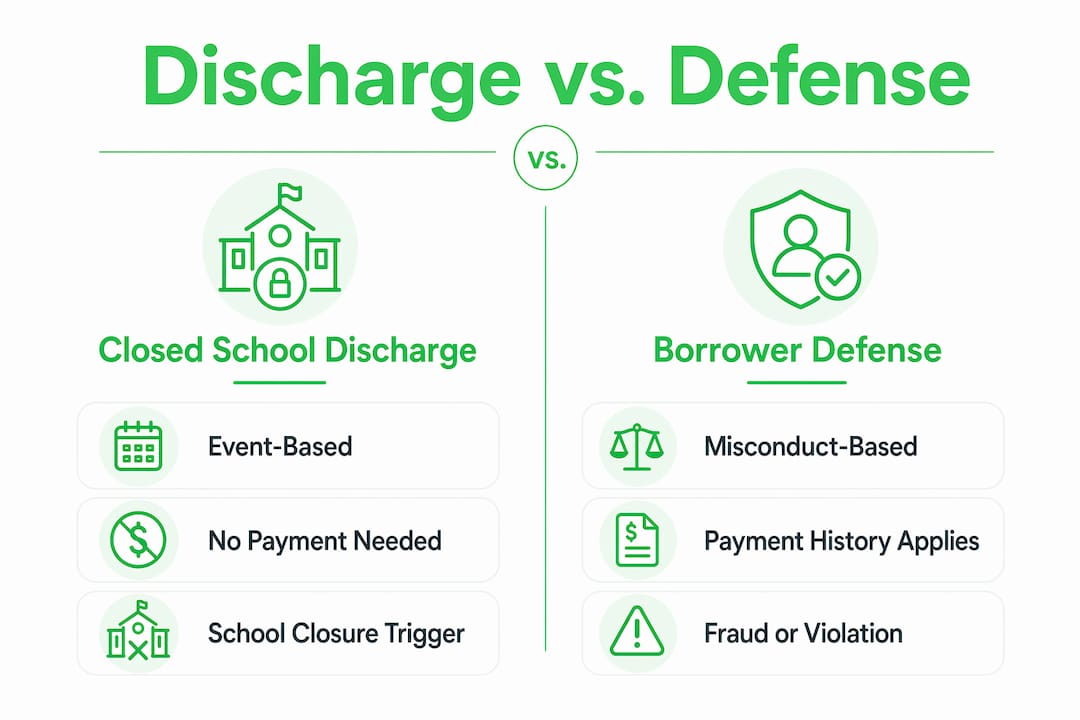
Borrower defense to repayment is the closest relative to closed school discharge. Both apply when a school fails its students. The difference is that closed school discharge requires only that the school closed during your enrollment window. Borrower defense requires proof that the school made false or misleading representations that caused you to take out loans. If your school closed due to fraud, you may qualify for both, and it is worth exploring which provides faster or more complete relief.
Closed school discharge also affects your credit report differently than forgiveness. When a discharge is approved, the loans are removed from your repayment obligation. Any payments you already made may be refunded. Your credit report should reflect the discharge, though the timeline for updates varies by servicer and credit bureau. For a broader view of how discharge paths compare, Titanprep’s overview of discharge types lays out the key differences clearly.
Key takeaways
Closed school discharge cancels your federal student loan balance based on your school’s closure, with no payment history required, making it one of the most direct forms of debt relief available to former students.
Point | Details |
Eligibility depends on timing | Your loan disbursement date determines whether the 120-day or 180-day withdrawal window applies. |
Teach-outs disqualify borrowers | Completing a program through a teach-out arrangement at another school removes eligibility for this discharge. |
Documentation is the deciding factor | Pairing your closure notice with your last date of attendance record is what most approved applications have in common. |
Denial is not final | Filing a complaint with the FSA Ombudsman creates a documented dispute and opens the door to appeal. |
Discharge differs from forgiveness | Closed school discharge requires no payment history. Forgiveness programs like PSLF require 10 or more years of qualifying payments. |
What I’ve learned helping borrowers through this process
The borrowers who succeed with closed school discharge applications are almost always the ones who treated documentation like a legal case file from day one. They did not wait for a denial to start gathering evidence. They collected their enrollment agreement, their last attendance record, and the school’s closure notice before they ever contacted their servicer.
The most common mistake I see is submitting a single closure letter and expecting it to carry the application. That letter proves the school closed. It does not prove you were there at the right time. Servicers need to see the full picture, and they will not piece it together for you.
Realistic timelines matter too. Closed school discharge applications are not processed overnight. Expect several months from submission to decision, sometimes longer if your servicer has a backlog or requests additional documentation. Request forbearance the moment you submit so you are not accumulating missed payments while you wait.
If you receive a denial, do not treat it as a final answer. Read the denial letter carefully, identify the specific gap, and gather the evidence that fills it. The FSA Ombudsman is a real escalation path, not just a complaint box. Use it. Persistence through the process is what separates borrowers who get relief from those who give up one step too early.
— Ellis
How Titanprep can help you stay organized
Applying for closed school discharge means managing multiple documents, tracking submission deadlines, and staying in contact with your servicer over several months. Titanprep helps borrowers organize and submit paperwork for federal discharge programs, including school closure cases, so nothing falls through the cracks. The client portal lets you upload documents, track your file status, and maintain records of every communication with your servicer.
If you are dealing with a servicer dispute or need help understanding your next steps, check Titanprep’s student loan updates page for current guidance on federal programs. For a full overview of forgiveness and discharge options available to you, the federal forgiveness guide is a practical starting point. Titanprep does not guarantee outcomes. Eligibility is determined solely by the U.S. Department of Education or your loan servicer.
FAQ
What is closed school discharge for student loans?
Closed school discharge is a federal program that cancels your Direct Loan, FFEL, or Perkins Loan balance if your school closed while you were enrolled or within 120 to 180 days after you withdrew, depending on your disbursement date.
Does graduating disqualify me from closed school discharge?
Yes. Borrowers who completed their program or received a degree before the school closed are not eligible, because the Department of Education considers the education delivered even if the school later shut down.
How long does the closed school discharge process take?
Processing times vary by servicer and case complexity, but most applications take several months from submission to decision. Requesting forbearance while your application is under review prevents missed payments from accumulating during that period.
What if my closed school discharge application is denied?
Request the denial reason in writing, gather the specific documentation that addresses the gap identified, and resubmit. You can also file a complaint with the FSA Ombudsman Group to create an official record of your dispute and support further escalation.
Is closed school discharge the same as borrower defense?
No. Closed school discharge requires only that the school closed during your qualifying enrollment window. Borrower defense to repayment requires proof that the school made false or misleading statements that caused you financial harm, which is a higher evidentiary standard.
Recommended
Comments