
Certified Employment for PSLF: What Borrowers Must Know


Certified employment for PSLF is the official process of confirming that you work full-time for a qualifying public service employer so your loan payments count toward forgiveness. The formal term used by the U.S. Department of Education is “employment certification,” and it is the foundation of the entire Public Service Loan Forgiveness program. Without it, no payment you make gets credited. Understanding what qualifies for PSLF and how to certify correctly protects years of progress toward a zero balance.
What is certified employment for PSLF?
Certified employment for PSLF means your employer has officially verified that you meet the full-time employment requirement of at least 30 hours per week, or your employer’s own definition of full-time, whichever is greater. That verification is submitted to your loan servicer, currently MOHELA, through the PSLF Help Tool on the Federal Student Aid website. Only after that confirmation do your qualifying payments get counted.
The program was created under the College Cost Reduction and Access Act of 2007. It promises loan forgiveness after 120 qualifying monthly payments made while working for an eligible employer. Certification is the mechanism that proves you were at the right employer during those payments.

Two categories of employers qualify under PSLF eligible employment rules. Government agencies at any level, federal, state, local, or tribal, qualify automatically. Private nonprofits with 501©(3) tax-exempt status also qualify. Other private nonprofits may qualify if they provide certain public services, such as public health, public safety, or early childhood education, but they require closer review.
What organizations and job roles qualify for PSLF?
The type of work you do matters less than who employs you. PSLF certified jobs span a wide range of roles because eligibility is employer-based, not occupation-based. A social worker, accountant, or IT specialist at a qualifying government agency all count equally.
Common qualifying employer categories include:
Federal, state, local, and tribal government agencies, including public schools, public universities, and public hospitals
501©(3) nonprofit organizations, regardless of the specific services they provide
AmeriCorps and Peace Corps positions, which qualify as government service
Private nonprofits without 501©(3) status that provide qualifying public services such as emergency management, public library services, or public interest law
Job title does not determine eligibility. A nurse at a public hospital and a janitor at the same hospital both qualify. What matters is that the employer is on the approved list and you work full-time.
One important nuance involves part-time work. If you hold two qualifying part-time jobs that together add up to 30 or more hours per week, you can combine them to meet the full-time threshold. You would need a separate certification form for each employer.
Contractor status is a common trap. If a staffing agency places you at a qualifying nonprofit, your employer of record is the staffing agency, not the nonprofit. The staffing agency’s EIN is what appears on your paycheck, and that EIN almost certainly does not qualify. Workers in this situation must get certification from the qualifying employer where the work is performed, using that organization’s EIN, not the agency’s.
How does the employment certification process work?
The PSLF Help Tool, available at studentaid.gov, is the official starting point for PSLF employment certification. It walks you through a series of questions and then generates a pre-filled form based on your answers. Since april 2023, digital signatures through the tool have significantly sped up processing compared to mailing paper forms.
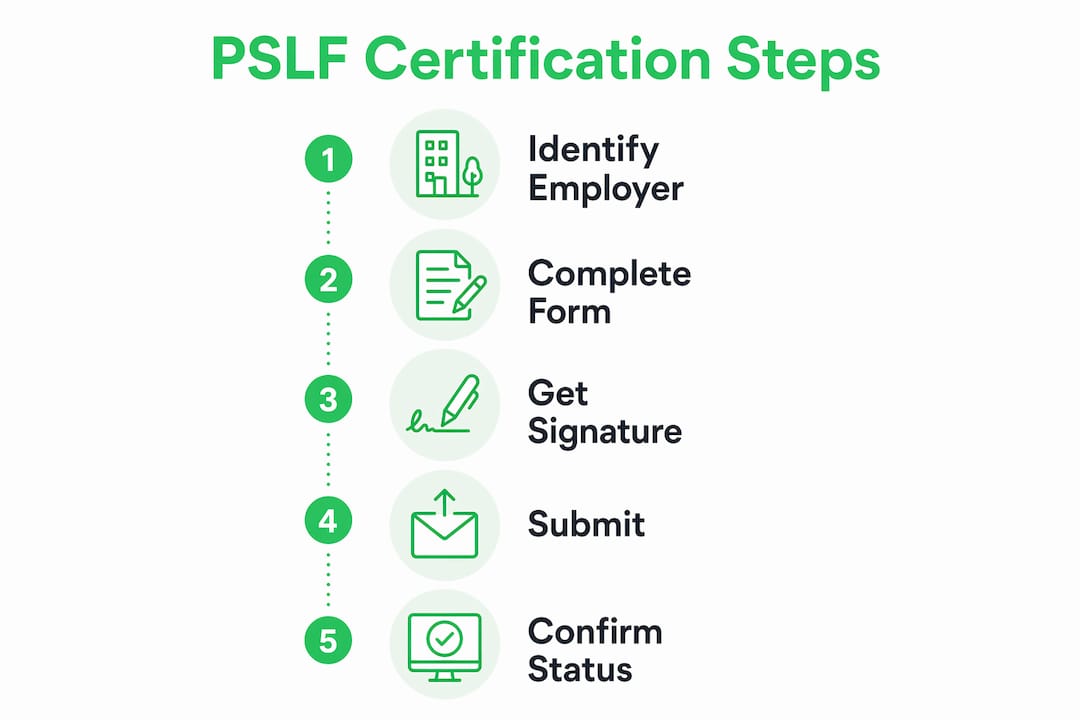
Follow these steps to certify correctly:
Log in to studentaid.gov using your FSA ID and open the PSLF Help Tool.
Enter your employer’s information, including the Employer Identification Number (EIN), organization name, your job title, and your start and end dates of employment.
Confirm your full-time status and indicate whether you are currently employed or have left that job.
Identify your authorized official. This person must have access to your employment records, typically someone in HR or payroll. They sign the form to verify your employment records.
Submit digitally through the tool or print and mail the completed form to MOHELA.
The EIN is critical. It is the number the Department of Education uses to confirm your employer’s eligibility. An incorrect EIN can cause your certification to be rejected or delayed. You can find your employer’s EIN on your W-2 form or by asking your HR department directly.
Pro Tip: Identify your authorized official before you need them. HR turnover is common, and finding the right signer after the fact can delay your certification by weeks or even months.
After submission, MOHELA reviews the form and updates your qualifying payment count. You will receive a notice showing how many payments have been credited. Review that count carefully and flag any discrepancies right away.
Why ongoing certification and record-keeping matter for PSLF success
Certification is not a one-time task. Federal guidance recommends submitting employment certification at least once a year or whenever you leave a job. Treating it as an annual maintenance step protects your payment count and creates a clear audit trail.
Waiting until you are ready to apply for forgiveness is a serious risk. Employers close, HR staff leave, and records get lost. If you try to certify ten years of employment all at once, you may find that a former employer no longer exists or that no one at the organization can verify your dates of service.
Strong record-keeping habits reduce that risk significantly. Keep personal copies of the following:
W-2 forms for every year you worked at a qualifying employer
Pay stubs showing your hours and employer name
Copies of every certification form you submitted, along with the confirmation number
MOHELA correspondence showing your updated payment count after each certification
These documents become critical if your employer refuses to sign or shuts down. Personal copies of W-2s and pay stubs can support a manual review request and help get payments credited even without an employer signature.
Pro Tip: Set a calendar reminder every october to submit your annual certification. Pairing it with a recurring date makes it a habit rather than an afterthought.
Employer changes also require prompt action. When you move from one qualifying employer to another, certify your old employment before your last day if possible. Getting a signature from a current HR contact is far easier than tracking one down after you have left.
Common challenges and misconceptions about PSLF employment certification
Many borrowers lose qualifying payments not because they worked at the wrong employer, but because of avoidable paperwork errors. The table below compares the most common misconceptions against the correct understanding.
Common misconception | What is actually true |
Any nonprofit employer qualifies | Only 501©(3) nonprofits qualify automatically; other nonprofits require a public service function review |
Your job title determines eligibility | Employer type determines eligibility, not your specific role or occupation |
Contractor work at a nonprofit counts | You must be directly employed by the qualifying organization, not a staffing agency |
You only need to certify once | Annual certification is recommended to protect your payment count and avoid record gaps |
All federal loans qualify automatically | Only Direct Loans qualify; FFEL or Perkins loans must be consolidated first, which resets your payment count |
The contractor issue deserves extra attention. Using a staffing agency’s EIN on your certification form typically disqualifies that employment for PSLF purposes. If you are in a contracted role, ask the qualifying nonprofit directly whether they will sign your certification form using their own EIN.
Employer legal status changes are another risk that many borrowers overlook. Since october 2025, employers found to be involved in substantial illegal activities can lose PSLF eligibility effective the date of that determination. Payments made before the disqualification date remain credited. Payments made after do not count. Staying current on your employer’s status is part of protecting your progress.
Loan type errors also disqualify payments. Only Direct Loans qualify for PSLF. If you have Federal Family Education Loan (FFEL) or Perkins Loans, you must consolidate them into a Direct Consolidation Loan first. Consolidation resets your payment count to zero, so timing matters. Review your loan types at studentaid.gov before certifying.
Key takeaways
Certified employment for PSLF requires full-time work at a qualifying government or 501©(3) nonprofit employer, officially verified through the PSLF Help Tool at least once a year to protect your payment count.
Point | Details |
Employer type determines eligibility | Government agencies and 501©(3) nonprofits qualify; contractor roles and staffing agencies typically do not. |
Annual certification protects your count | Submit a certification form every year and whenever you change jobs to avoid record gaps. |
EIN accuracy is non-negotiable | Use your qualifying employer’s EIN, not a staffing agency’s, or your certification will be rejected. |
Keep personal copies of all records | W-2s and pay stubs support manual review if your employer cannot or will not sign. |
Loan type must be Direct | Only Direct Loans qualify; consolidate FFEL or Perkins Loans first, knowing it resets your payment count. |
The certification habit that most borrowers skip
Most borrowers I work with understand the big picture of PSLF. They know they need 120 payments and a qualifying employer. What catches them off guard is how much the certification process depends on people, not just paperwork.
The authorized official who signs your form is often one specific person in HR. When that person leaves, retires, or moves to a different role, the next person may have no idea where your records are or whether they are even authorized to sign. I have seen borrowers lose months of progress because they waited too long and could not locate anyone at a former employer willing to verify their dates of service.
My strongest advice is to certify while you are still actively employed, every single year, and to get the name and contact information of your authorized official in writing. If your employer changes its HR software or restructures its payroll department, you want a paper trail that predates the chaos. The PSLF compliance guide from Titanprep lays out a practical schedule for doing exactly that.
The other thing borrowers underestimate is the impact of employer status changes. The 2025 rule update allowing disqualification of employers involved in illegal activities is real. If your employer’s legal standing changes, your future payments stop counting from that date forward. Staying informed is not optional. It is part of the job of managing your own forgiveness timeline.
— Ellis
How Titanprep can help you stay on track with PSLF
PSLF paperwork is detailed, time-sensitive, and easy to get wrong. Titanprep is a document preparation and support service that helps borrowers organize, submit, and track their federal student loan paperwork, including PSLF employment certification forms. The team helps clients identify the right forms, gather the correct employer information, and maintain records of every submission.
Titanprep also tracks deadlines and stores copies of your documents securely, so you are not scrambling to find a W-2 from five years ago when you need it most. For borrowers dealing with servicer issues during the certification process, Titanprep provides guidance on resolving servicer complaints and keeping your file moving forward. Check the latest student loan updates to stay current on program changes that could affect your eligibility.
Titanprep does not guarantee forgiveness or specific outcomes. Eligibility is determined solely by the U.S. Department of Education or your loan servicer.
FAQ
What is the definition of certified employment for PSLF?
Certified employment for PSLF is the official confirmation that you work full-time for a qualifying government or 501©(3) nonprofit employer. This verification is submitted through the PSLF Help Tool and tells your loan servicer which payments count toward forgiveness.
How often should I submit a PSLF employment certification form?
Federal guidance recommends certifying at least annually and whenever you leave a job. Waiting until you apply for forgiveness creates serious risks if employer records are unavailable.
Does contractor work at a nonprofit qualify for PSLF?
Contractor work through a staffing agency does not qualify using the agency’s EIN. You must be directly employed by the qualifying organization and use that organization’s EIN on your certification form.
What loans qualify for PSLF employment certification?
Only Direct Loans qualify. FFEL and Perkins Loans must be consolidated into a Direct Consolidation Loan first, which resets your qualifying payment count to zero.
What happens if my employer loses PSLF eligibility?
Payments made before the disqualification date remain credited toward your 120-payment total. Payments made after the employer loses eligibility do not count, so monitoring your employer’s status is part of protecting your progress.
Recommended
Comments