
Why student loan forgiveness is limited: A guide for borrowers


Student loan forgiveness sounds straightforward until you actually try to qualify for it. Millions of borrowers discover that why student loan forgiveness is limited goes far deeper than fine print. The rules are strict, the timelines are long, and recent regulatory changes in 2026 have made the landscape even more restrictive. If you are in public service, managing Parent PLUS loans, or navigating a complex financial situation, understanding exactly what blocks forgiveness, and what you can do about it, is not optional. This guide gives you that clarity.
Table of Contents
Administrative and procedural hurdles affecting forgiveness eligibility
Comparing repayment and forgiveness options for complex borrowers
Practical strategies for making forgiveness work despite limitations
Why student loan forgiveness remains limited despite growing debt burdens
How TitanPrep can help navigate limited student loan forgiveness
Key Takeaways
Point | Details |
Limited forgiveness options | New rules narrow forgiveness eligibility with longer repayment timelines and stricter plan requirements. |
RAP extends repayment | Repayment Assistance Plan requires 30 years of payments and disallows credit transfer back to shorter plans. |
PSLF remains complex | Public Service Loan Forgiveness requires exact 120 qualifying payments with full certification and timely employer documentation. |
Administrative barriers | Backlogs and forbearance periods from SAVE plan suspension cause delays and lost forgiveness credit. |
Tax implications | Starting 2026, forgiven loan balances under PSLF are taxable income, increasing borrowers’ overall costs. |
Understanding the key student loan forgiveness programs
Two federal programs carry most of the weight when it comes to student loan forgiveness: Public Service Loan Forgiveness (PSLF) and Income-Driven Repayment (IDR) forgiveness. Both exist to help borrowers reduce their long-term debt burden, but neither is simple to access.
PSLF forgives your remaining federal student loan balance after you make 120 qualifying payments while working full-time for a qualifying employer, such as a government agency or nonprofit organization. That is 10 years of consecutive, on-time payments. Miss a payment, work part-time, or use a non-qualifying repayment plan, and that month does not count.
IDR forgiveness works differently. Under legacy plans such as Income-Based Repayment (IBR) or Pay As You Earn (PAYE), your remaining balance is forgiven after 20 to 25 years of qualifying payments. It is a longer road, but it does not require a specific employer type.
Here is a side-by-side breakdown to clarify the key differences:
Feature | PSLF | Legacy IDR (IBR/PAYE) |
Forgiveness timeline | 10 years (120 payments) | 20 to 25 years |
Employer requirement | Yes, qualifying public/nonprofit | No |
Qualifying loan types | Direct Loans only | Direct Loans (some restrictions) |
Tax status of forgiven balance | Taxable starting 2026 | Taxable |
Payment plan requirement | Qualifying IDR plan | Any IDR plan |
Credit transfer between plans | Limited | Varies by plan |
Key eligibility factors to keep in mind:
Loan type matters. Only Direct Loans qualify for both PSLF and most IDR plans. FFEL loans require consolidation first.
Your repayment plan must be a qualifying IDR plan for PSLF. Standard repayment counts only in specific circumstances.
Even one ineligible payment can break your qualifying streak under PSLF.
Check out the latest PSLF program updates to see how recent changes affect your timeline.
Now that you know the main forgiveness programs, let’s explore recent regulatory changes that restrict these benefits.
Recent regulatory changes limiting forgiveness benefits
The limitations of student loan forgiveness have grown sharper in 2026. Several regulatory changes have reshaped repayment options, extended timelines, and introduced new financial costs that borrowers did not expect.

The most significant shift is the introduction of the Repayment Assistance Plan (RAP). Under this new structure, most IDR plans are being phased out after July 2026, replaced by RAP. The critical catch: RAP requires 30 years of payments before forgiveness is granted, and any credits earned under RAP do not transfer back to IBR. If you switch back to IBR after accumulating years of RAP payments, you lose all of that forgiveness progress.
New loan limits add another layer of restriction. The Department of Education has capped graduate borrowing, which means fewer borrowers will accumulate the large balances that once made forgiveness particularly valuable. Lower debt ceilings reduce the financial incentive for forgiveness in certain cases.
Then there is the tax change. Starting in 2026, PSLF forgiven balances are counted as taxable income. Previously, PSLF forgiveness was one of the few programs where the forgiven amount was tax-free. That advantage is now gone, meaning borrowers who reach forgiveness will owe income tax on whatever balance is canceled. For someone with $80,000 forgiven, that could mean a significant tax bill in a single year.
These changes represent real student debt relief constraints, not just technical adjustments.
Pro Tip: Be very cautious about switching between RAP and IBR plans. Moving from RAP back to IBR forfeits all RAP payment credits, resetting your forgiveness timeline and potentially adding years to your repayment.
See the full breakdown of 2026 Education Department changes and how they affect your specific situation.
With these regulatory changes in place, the forgiveness process has become more complex and restrictive. Let’s look at administrative challenges affecting borrowers’ progress.
Administrative and procedural hurdles affecting forgiveness eligibility
Even borrowers who meet every technical criterion for forgiveness often run into a wall. The challenges in loan forgiveness are not just about rules; they are about the systems responsible for enforcing those rules.
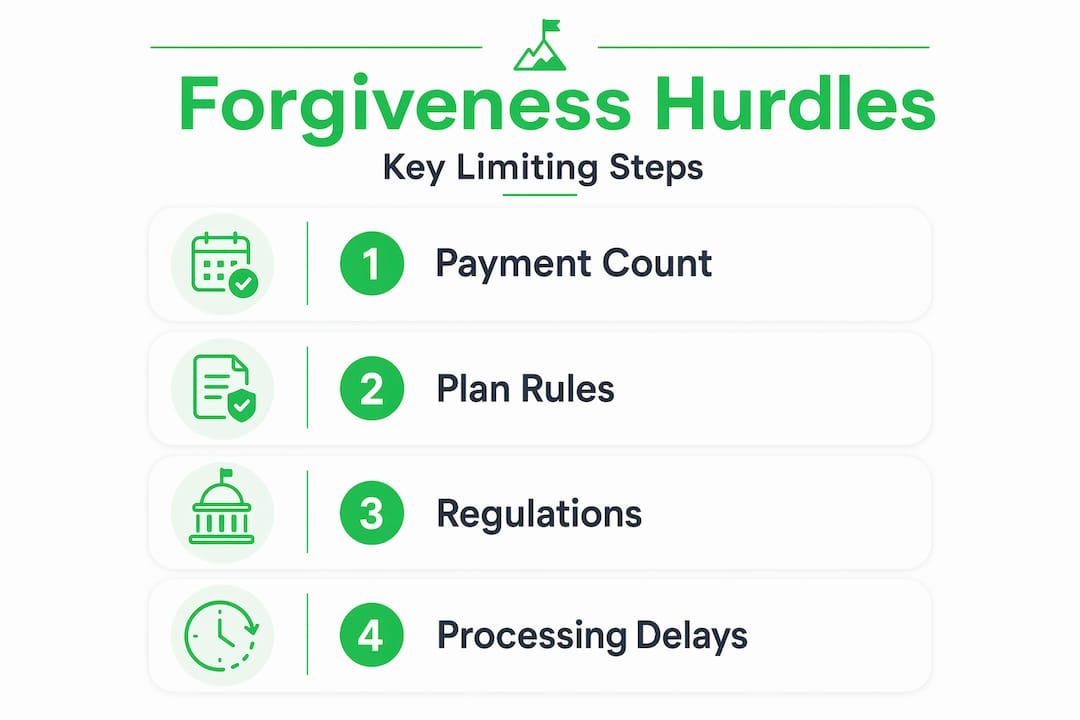
The SAVE plan is the clearest recent example. Court rulings ended the program, and the result was that 7.5 million borrowers were placed into forbearance where payments no longer count toward forgiveness. If you were on SAVE and did not switch to a qualifying plan within the 90-day action window, your forgiveness progress effectively paused or stopped.
PSLF has its own ongoing administrative problems. Tens of thousands of borrowers are waiting on buyback decisions as of late 2025, caught in processing backlogs that have nothing to do with their eligibility. Doing everything right does not guarantee timely forgiveness when the processing pipeline is this congested.
Employment certification is another common stumbling block. PSLF requires you to regularly verify that your employer qualifies and that your payments meet program standards. A late certification, a partial payment, or even a brief gap in full-time employment can disqualify months of progress. These are the kinds of factors affecting loan forgiveness that rarely get explained upfront.
“Despite progress, the administration of PSLF remains dysfunctional, limiting program effectiveness and borrower confidence.”
The result is that many borrowers are technically eligible but practically unable to access forgiveness without close attention to deadlines and paperwork.
Pro Tip: If you are in public service, submit your Employment Certification Form (ECF) every year, not just at the end. Annual certification catches errors early and confirms your employer still qualifies.
Stay informed about PSLF processing delays and what you can do to protect your progress.
Understanding administrative challenges helps explain why many borrowers face limited forgiveness despite program eligibility. Next, we’ll compare forgiveness options and how to navigate them.
Comparing repayment and forgiveness options for complex borrowers
If your situation involves Parent PLUS loans, graduate debt, or recent plan transitions, the standard advice rarely fits. Here is a structured comparison to help you assess your options clearly.
Feature | RAP | IBR | PSLF |
Forgiveness timeline | 30 years | 20 to 25 years | 10 years (120 payments) |
Payment cap | Based on income formula | 10% to 15% of discretionary income | No specific cap |
Employer requirement | No | No | Yes, qualifying public/nonprofit |
Credit transfer | Not to IBR | Some portability | Separate credit track |
Tax on forgiven balance | Yes | Yes | Yes (starting 2026) |
Available for new borrowers | Yes | Yes | Yes |
When choosing or switching plans, consider these factors in order:
How many qualifying payments have you already made? Switching plans can reset or forfeit those credits under certain conditions.
Do you work for a qualifying PSLF employer? If yes, PSLF may still be your shortest path to forgiveness even with the new tax rules.
What is your loan type? Parent PLUS loans cannot directly access IDR or PSLF without consolidation. Switching from RAP to IBR forfeits all RAP credits, extending your repayment to 30 years.
Do you have a Parent PLUS loan? You must consolidate by June 30, 2026 to access IDR or PSLF. After July 2026, new Parent PLUS loans will be permanently barred from IDR.
What is your expected income trajectory? Higher future income reduces the benefit of IDR forgiveness but may not affect PSLF if you stay in public service.
Pro Tip: Before switching any repayment plan, calculate the total long-term cost under each option, including the tax liability on the forgiven balance. A plan that saves money monthly can cost more overall.
Review the 2026 forgiveness rules to see how each option applies to your loan type and timeline.
With a clear comparison of options, you can better plan your path through limited forgiveness opportunities. Finally, let’s summarize key strategies.
Practical strategies for making forgiveness work despite limitations
Knowing why loan forgiveness is restricted matters. But knowing what to do about it matters more. Here are the steps that protect your eligibility and keep your timeline on track.
Switch from SAVE immediately. If you are still in SAVE plan forbearance, switch to IBR or RAP within the 90-day window. Every month in non-qualifying forbearance is a month that does not count toward forgiveness.
Certify your employment every year. Annual PSLF certification confirms your employer qualifies and flags any payment issues before they compound.
Meet the Parent PLUS consolidation deadline. If you hold Parent PLUS loans, consolidate by June 30, 2026 or lose access to IDR and PSLF permanently.
Do not switch repayment plans without professional input. One misinformed plan change can add years to your repayment or wipe out credits you spent years building.
Pro Tip: Keep a personal file of every payment confirmation, servicer communication, and certification form you submit. If your servicer makes an error, your records are the only way to dispute it successfully.
Use the forgiveness eligibility checklist to audit your current status and spot any gaps before they become problems.
Why student loan forgiveness remains limited despite growing debt burdens
Here is the uncomfortable truth most articles skip: the limitations of student loan forgiveness are not accidents or oversights. They are choices, and understanding why they were made helps you navigate the system more realistically.
Policy designers built restrictions into forgiveness programs to prevent what economists call moral hazard. If full forgiveness were easy to obtain, it would incentivize borrowing without regard to repayment. Loan limits and longer repayment timelines are deliberate brakes on unsustainable debt growth. Taxpayers ultimately absorb forgiven balances, and policymakers have consistently pushed back against broad cancellation for that reason.
But there is a second problem that policy intent does not explain: the administration of these programs is genuinely broken in places. Administrative dysfunction and ongoing litigation create backlogs and uncertainty that have nothing to do with a borrower’s eligibility. People do everything right and still wait years for a decision.
“The administrative complexity and ongoing litigation are key unseen barriers limiting borrower access to forgiveness.”
What makes this inequitable is that the system heavily rewards borrowers who have access to good information and professional guidance. A borrower who knows about the 90-day SAVE window, the RAP credit transfer rules, and the Parent PLUS consolidation deadline will come out far better than one who does not. The rules do not discriminate, but access to knowledge does.
The practical implication: do not wait for clarity to come to you. Stay informed, stay organized, and treat your student loans the same way you would treat a tax return. The details matter, and the student loan forgiveness challenges are real enough that passive borrowers consistently lose ground.
How TitanPrep can help navigate limited student loan forgiveness
The regulations, deadlines, and plan comparisons covered in this guide represent a lot to track on your own. That is where TitanPrep comes in. We help borrowers organize their paperwork, understand their eligibility, and stay ahead of critical deadlines for programs like PSLF and IDR. Our service is not affiliated with the Department of Education or any government agency, and we do not guarantee specific outcomes. What we do is help you stay organized and informed so nothing falls through the cracks. Learn how TitanPrep works and explore important loan updates for 2026. You can also browse our student loan FAQs for quick answers to the questions borrowers ask most.
Frequently asked questions
Why does switching from RAP back to IBR reset my forgiveness timeline?
Under 2026 rules, RAP payments do not transfer as qualifying credits toward IBR forgiveness, so any progress you built under RAP is lost the moment you switch back to IBR.
How does the end of the SAVE plan affect my loan forgiveness progress?
The SAVE plan ended due to court rulings, placing 7.5 million borrowers into forbearance where payments do not count toward forgiveness. Switching to IBR or RAP within 90 days is the only way to resume qualifying progress.
Is forgiven loan balance under PSLF taxable?
Yes. Starting in 2026, PSLF forgiven balances count as taxable income, so you will owe income taxes on the amount canceled in the year forgiveness is granted.
What should Parent PLUS loan borrowers do to maintain forgiveness eligibility?
Parent PLUS borrowers must consolidate by June 30, 2026 to access IDR or PSLF. After that date, new Parent PLUS loans are permanently barred from income-driven repayment.
Recommended
Comments