
Public vs private loan forgiveness: Know your options


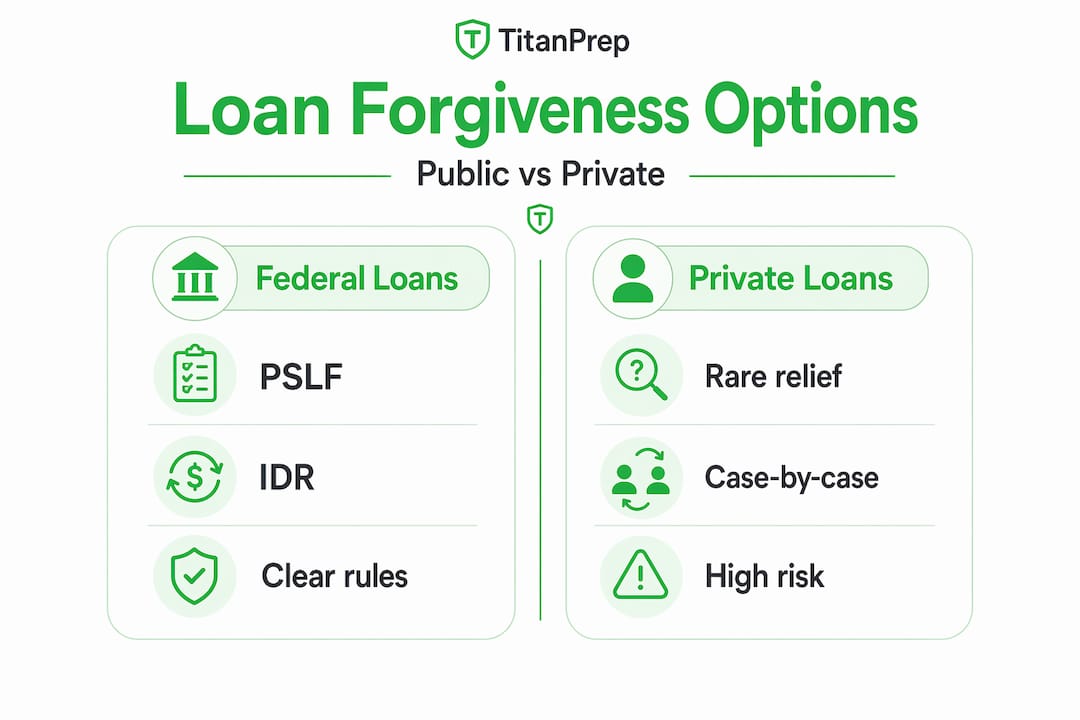
If you have student loans, you’ve probably heard that forgiveness is possible. But here’s what most borrowers don’t realize: public (federal) and private student loan forgiveness are completely different animals, and assuming they work the same way can cost you years of planning and thousands of dollars. Federal programs offer structured, rule-based pathways. Private lender options are rare, often informal, and frequently misunderstood. Understanding exactly where your loans stand and what relief is realistically available to you is the first step toward making a smart plan.
Table of Contents
Private student loan forgiveness: What’s actually available?
Key documentation, eligibility, and pitfalls for public loan forgiveness
Financial impacts: How loan forgiveness affects your credit and life
Why most borrowers misunderstand private vs public loan forgiveness
Get personalized help understanding your forgiveness options
Key Takeaways
Point | Details |
Federal forgiveness is structured | Federal student loan forgiveness follows strict rules and repayment plans like PSLF and IDR. |
Private forgiveness is rare | Private student loans offer very limited forgiveness, mainly for hardship cases. |
Documentation is critical | Missing or incorrect paperwork is the top cause of lost eligibility and application delays. |
Financial relief is real | Loan forgiveness can lead to easier access to credit and short-term financial improvement. |
Expert help is available | Resources like TitanPrep can help navigate eligibility and documentation challenges. |
Understanding public (federal) loan forgiveness programs
Now that we’ve set the stage, let’s dig into how federal programs are structured and how you might qualify.
Federal student loan forgiveness is not a lottery. It’s a structured process with clear eligibility rules that borrowers can plan around. The two main tracks are Public Service Loan Forgiveness (PSLF) and Income-Driven Repayment (IDR) forgiveness. Federal student loan forgiveness may occur via qualifying employment through PSLF or via income-driven repayment timelines. Both programs are administered by the U.S. Department of Education, not your lender.
PSLF is designed for borrowers who work full-time for qualifying employers, primarily government agencies and nonprofit organizations. PSLF applies to Direct Loans and generally requires qualifying full-time work for a qualifying employer and 120 qualifying monthly payments, which works out to 10 years of on-time payments. The remaining balance is then forgiven, tax-free at the federal level.
IDR forgiveness is available to borrowers on income-driven repayment plans, such as SAVE, PAYE, or IBR. Federal repayment-plan mechanics strongly affect forgiveness eligibility, so choosing the right plan from the start matters. After 20 or 25 years of qualifying payments, any remaining balance is discharged. Unlike PSLF, IDR forgiveness may be treated as taxable income, so it’s worth planning ahead with a tax professional.
Key requirements for federal loan forgiveness
Here’s a quick look at how PSLF and IDR compare at a glance:
Feature | PSLF | IDR forgiveness |
Loan type required | Direct Loans only | Most federal loans |
Payment timeline | 120 payments (10 years) | 20 to 25 years |
Employer requirement | Qualifying public/nonprofit | None |
Repayment plan required | Qualifying IDR plan | IDR plan |
Tax treatment | Tax-free (federal) | May be taxable |
Forgiveness amount | Remaining balance | Remaining balance |
The core eligibility factors for federal forgiveness come down to these points:
Your loans must be federal Direct Loans (PSLF) or eligible federal loans (IDR)
You must be enrolled in a qualifying repayment plan
For PSLF, your employer must be a government agency, 501©(3) nonprofit, or other qualifying organization
Your payments must be made on time, for the full required amount, and during qualifying employment
You need to submit the right forms at the right times to track your progress
One detail that trips up many borrowers: credit score and income level do not determine eligibility for federal forgiveness. The Department of Education applies standardized rules, which means your path forward is based on documented compliance, not lender discretion. That’s actually great news, because it means the process is predictable if you stay organized.
Check out the PSLF eligibility guide for a step-by-step breakdown of how to verify your eligibility and stay compliant. You may also want to review whether you qualify for part of DOE’s forgiveness rounds, as well as new Education Department guidance that may affect your timeline.
Pro Tip: Use the Federal Student Aid website’s PSLF Help Tool to check whether your employer qualifies before changing jobs or assuming you’re on the right track.
Private student loan forgiveness: What’s actually available?
With federal forgiveness explained, let’s contrast what, if anything, is available for private student loans.
The short answer: very little. For private student loans, there is no generally available federal-style forgiveness program. Private lenders are banks, credit unions, and financial companies. They aren’t bound by federal rules, and they don’t participate in PSLF or IDR. Each lender sets its own policies, and most offer no forgiveness at all under normal circumstances.
That said, some limited options do exist. They aren’t standardized, but knowing about them can help you navigate a difficult situation.
“Private student loan relief typically comes in the form of modification, not forgiveness. Expect to negotiate, document your hardship thoroughly, and be prepared for the lender to say no.”
Here’s a comparison of what each loan type realistically offers:
Consideration | Federal loans | Private loans |
Standard forgiveness programs | Yes (PSLF, IDR) | No |
Disability discharge | Yes (TPD program) | Sometimes, lender-specific |
Death discharge | Yes | Sometimes, lender-specific |
Bankruptcy discharge | Rarely, very difficult | Possible but difficult |
Settlement option | Not standard | Possible in hardship |
Scam risk | Moderate | High |
What private loan borrowers can sometimes access:
Hardship forbearance or deferment: Temporary pauses in payments, not forgiveness
Loan modification: Lowering your interest rate or extending your repayment term
Settlement: If your loan is in default, some lenders may accept a lump sum for less than the full balance
Disability or death discharge: Some private lenders have their own discharge policies, but these vary widely
Bankruptcy discharge: Courts may discharge private student loans if you can prove “undue hardship,” but this is rare and requires litigation
Be especially careful about scams. Companies that promise to forgive or reduce your private student loans for an upfront fee are almost always fraudulent. Review these forgiveness scam alerts so you know what red flags to watch for. You should also review the loan eligibility list to understand which of your loans might qualify for any form of federal relief.
For a detailed breakdown of what private lenders may offer, Credible’s private loan guide walks through lender-specific options and how to approach each one.
Key documentation, eligibility, and pitfalls for public loan forgiveness
Knowing what forgiveness is possible is only half the battle. The documentation details trip up most applicants.
Even borrowers who are technically eligible for PSLF or IDR forgiveness often run into problems because of paperwork errors, incorrect assumptions about their employer, or poor payment tracking. Documentation and eligibility verification, especially employer and payment-count correctness, are core practical challenges for PSLF applicants.

PSLF application processing has faced substantial volume and documentation-flow issues, meaning errors in your file can lead to long delays that set back your forgiveness timeline significantly.
Here are the most critical steps to stay on track:
Confirm your loan type first. Only Direct Loans qualify for PSLF. If you have FFEL or Perkins loans, you may need to consolidate into a Direct Consolidation Loan before your payments start counting.
Enroll in a qualifying repayment plan. Not all federal repayment plans count for PSLF. You must be on an income-driven repayment plan or the Standard 10-year plan to accumulate qualifying payments.
Verify your employer’s eligibility using the PSLF Help Tool. Don’t assume your employer qualifies. Government jobs generally do; hospitals, schools, and nonprofits may also qualify. For-profit employers do not.
Submit the Employment Certification Form (now called the PSLF Form) annually. This is your proof of qualifying employment and lets your servicer track your payment count. Waiting until you’ve reached 120 payments to submit is a common and costly mistake.
Track your payment count proactively. Review your annual payment count statements and compare them against your own records. Discrepancies should be disputed as soon as possible.
Keep copies of everything. Store physical and digital copies of every submission, every confirmation, and every communication with your loan servicer.
Pro Tip: Submit your PSLF Form every single year without exception, not just at the end. Annual submissions let you catch employer eligibility problems and payment count errors early, while there’s still time to fix them.
A common scenario involves teachers who discover after several years that their school’s nonprofit status wasn’t correctly documented, or nurses who didn’t realize their hospital had changed ownership to a for-profit entity. These situations are avoidable with annual verification. See the complete breakdown for teachers loan forgiveness and get the top federal forgiveness guide for a full overview of program requirements.
Financial impacts: How loan forgiveness affects your credit and life
Beyond eligibility and paperwork, what does actual forgiveness mean for your financial life? Let’s look at the data.
There is empirical evidence on forgiveness outcomes showing real-world effects of large-scale federal student loan forgiveness on consumption, credit activity, and borrower wellbeing. The findings are meaningful and worth understanding before you factor forgiveness into your broader financial plan.
Here’s what the research shows:
Financial outcome | Observed effect |
Mortgage borrowing | Increased after forgiveness |
Auto loan borrowing | Increased after forgiveness |
Credit card use | Short-term increase observed |
Credit score change | Variable, not guaranteed |
Consumption spending | Rose in the short term |
Share of borrowers affected | Approximately 6% in the studied cohort |
What this means for you in practical terms:
Access to other credit improves. When your student loan balance disappears, your debt-to-income ratio drops. That makes you a more attractive borrower for mortgages, auto loans, and other credit products.
Spending tends to increase. Borrowers who receive forgiveness often increase spending, particularly on housing and transportation. This reflects the genuine financial relief that forgiveness provides.
Credit scores don’t always go up automatically. Losing a long-standing account (your student loan) can sometimes reduce average account age on your credit report. Monitor your credit and plan accordingly.
Tax implications vary. PSLF forgiveness is currently tax-free at the federal level. IDR forgiveness may be counted as taxable income in certain circumstances. This is a real financial planning consideration.
Only a fraction of eligible borrowers currently receive forgiveness. About 6% of borrowers in the studied group actually received forgiveness, which reflects how many people face documentation gaps, ineligible loan types, or missed requirements along the way.
Explore popular forgiveness programs to understand which options see the highest participation and why they resonate with borrowers in different situations.
Why most borrowers misunderstand private vs public loan forgiveness
Having reviewed both federal and private pathways, here is a hard-won perspective on what actually works and what most borrowers miss.
The single biggest mistake borrowers make is assuming their loan type is flexible. It isn’t. Federal and private loans don’t mix, and treating them as interchangeable when you’re planning for forgiveness leads to serious miscalculations. We’ve seen borrowers spend years working in a qualifying job for PSLF, only to find out their loans were private all along. That realization is devastating, and it’s entirely preventable.
Federal loan forgiveness is something you can genuinely plan for. The rules are published, the timelines are defined, and the documentation requirements are consistent. Private loan relief, by contrast, depends entirely on your lender’s willingness to negotiate and the specific circumstances of your hardship. It’s not a program; it’s a conversation.
Here’s the uncomfortable truth: many borrowers don’t discover which type of loans they have until they’re already deep into a repayment plan. That’s too late to avoid the confusion, but it’s not too late to act strategically.
The practical wisdom here is to start verifying eligibility and collecting documentation long before you think you need to. Don’t wait until your 119th payment to check whether your employer certified correctly. Don’t assume your servicer has been counting your payments accurately. And don’t wait for a financial crisis to investigate private loan modification options if that’s the path you’re on.
Be realistic about loan relief timelines and take concrete steps now to lower your payments if you’re struggling. The borrowers who successfully reach forgiveness are almost always the ones who treated it as a long-term project, not a last-minute application.
Get personalized help understanding your forgiveness options
Navigating student loan forgiveness on your own can feel overwhelming, especially when the rules are complex and the stakes are high. At TitanPrep, we help borrowers get organized, stay on track, and avoid the documentation mistakes that derail forgiveness applications. We’re not affiliated with the U.S. Department of Education, and we don’t make guarantees about outcomes. What we do is make the process clearer and more manageable. Start with our top federal forgiveness guide for a plain-language walkthrough of your options. Visit our student loan FAQ for answers to the questions we hear most often. And if you’re ready to understand the full process, see how forgiveness works through our service. You don’t have to navigate this alone.
Frequently asked questions
Can private student loans ever be forgiven?
Private student loan forgiveness is extremely rare and usually only happens in hardship cases like disability or bankruptcy. Private loan forgiveness is uncommon, and most lenders offer modification options rather than true principal forgiveness.
What documents are required for PSLF eligibility?
PSLF applicants need to submit the PSLF Form (formerly the Employment Certification Form) and maintain records of qualifying payments. Documentation errors, particularly around employer eligibility and payment counts, are the most common reasons applications are delayed or denied.
How long does federal loan forgiveness take?
Federal loan forgiveness via PSLF requires 120 qualifying payments, typically spread over 10 years, while IDR forgiveness timelines range from 20 to 25 years depending on the plan you’re enrolled in.
Will loan forgiveness improve my credit score?
A credit score boost is not guaranteed after forgiveness. Research shows that forgiven borrowers increased mortgage, auto, and credit card borrowing, suggesting improved credit access, but individual credit score changes vary based on your full credit profile.
What happens if my employer loses PSLF eligibility?
Payments made before the employer lost eligibility may still count toward your 120-payment total. Loss of qualifying credit is typically tied to the date of the eligibility determination, so past qualifying payments are generally protected under current rules.
Recommended
Comments