
How to lower your student loan payments step by step


Federal student loan payments have resumed for millions of borrowers, and many are finding that their bills are significantly higher than they expected. If you are staring at a monthly statement that feels impossible, you are not alone. The good news is that the federal government offers legitimate, structured programs to reduce what you owe each month, sometimes all the way down to $0. This guide walks you through Income-Driven Repayment (IDR) plans, the upcoming Repayment Assistance Plan (RAP), and Public Service Loan Forgiveness (PSLF) so you can make an informed decision and take action with confidence.
Table of Contents
Key Takeaways
Point | Details |
IDR can lower payments | Income-driven plans may set your payment to a small percentage of your discretionary income, sometimes as low as $0. |
Annual recertification required | Always update your income and family size yearly to keep your reduced payment and avoid payment increases. |
2026 RAP brings changes | New federal loans after July 2026 have stricter minimum payments but offer greater balance protections. |
PSLF offers faster forgiveness | Qualifying government and nonprofit workers may have their loans erased after 10 years of correct payments. |
Avoid common mistakes | Missing recertification or consolidating at the wrong time can reset progress and cost you years toward forgiveness. |
Understanding student loan repayment options
Once you know that lower payments are possible, the next step is understanding exactly which options are available and how they work. Not every plan fits every borrower, and the differences between them matter.
IDR plans set your monthly payment as a percentage of discretionary income, typically between 10% and 20%, and offer forgiveness after 20 to 25 years of qualifying payments. If your income is low relative to your debt, your payment could be as little as $0 per month.
Here is how the main IDR options compare:
Plan | Payment rate | Forgiveness timeline | Who qualifies |
IBR (Income-Based Repayment) | 10-15% of discretionary income | 20-25 years | Direct and FFEL Loans |
PAYE (Pay As You Earn) | 10% of discretionary income | 20 years | Direct Loans, new borrowers |
ICR (Income-Contingent Repayment) | Lesser of 20% or 12-year fixed | 25 years | Direct Loans, Parent PLUS via consolidation |
RAP (Repayment Assistance Plan) | 1-10% of AGI, min $10/month | 30 years | New loans disbursed after July 2026 |
As the federal IDR overview explains, IBR, PAYE, and ICR each have different income thresholds and loan eligibility rules. Many borrowers with older FFEL or Perkins Loans need to consolidate into a Direct Loan first before they can access most of these plans.
Key eligibility facts to keep in mind:
IBR is available to the widest group, including some FFEL borrowers, and calculates at 10% if you are a new borrower after July 1, 2014, or 15% if you borrowed earlier.
PAYE requires that you be a new borrower as of October 1, 2007, and have received a disbursement on or after October 1, 2011.
ICR is the only plan that accommodates Parent PLUS Loans, but only after they are consolidated.
A helpful IBR sign-up guide can walk you through the specifics of that particular plan.
If you are also thinking about forgiveness options tied to public service work, a PSLF forgiveness overview can give you a sense of how IDR and PSLF interact to reduce your debt faster.
How to apply for an Income-Driven Repayment (IDR) plan
With your preferred plan in mind, you need to know exactly how to start the application process and what documents to have ready. The process is simpler than many borrowers expect.

The federal IDR application is free and available online at studentaid.gov/idr. You will need to provide your income information, and granting IRS data access is strongly recommended because it allows for automatic recertification each year without requiring you to manually submit tax documents.
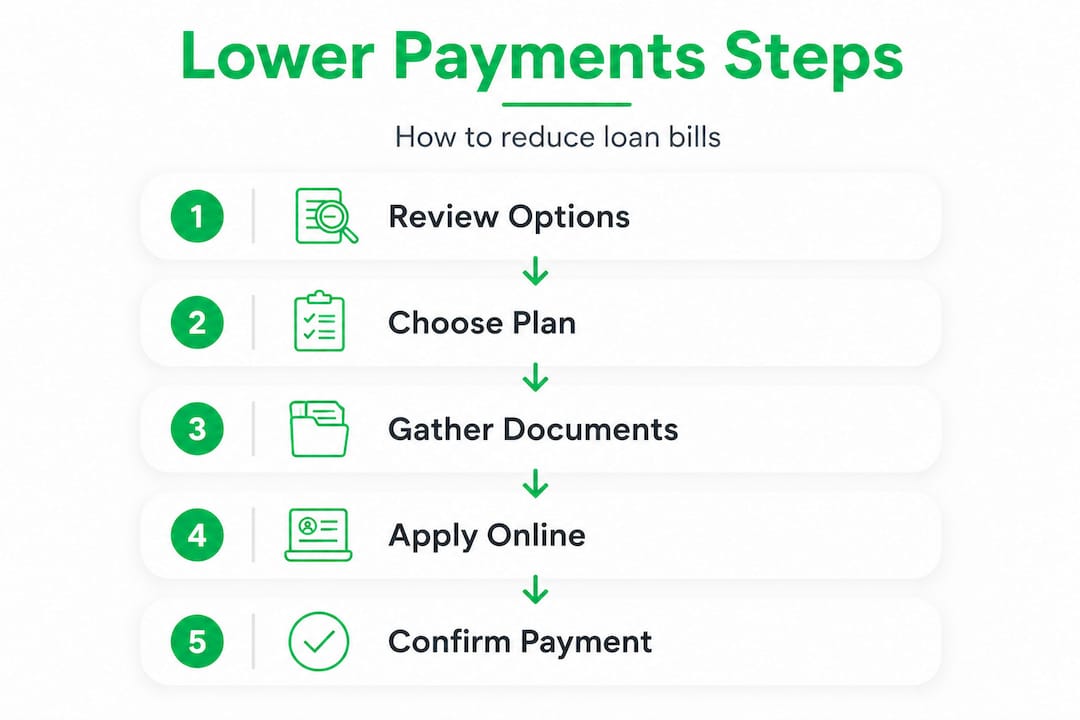
Here is a step-by-step breakdown of the enrollment process:
Log in to studentaid.gov using your FSA ID. If you do not have one, create it before starting the application.
Select the IDR application and choose your preferred plan, or let the system recommend the plan with the lowest payment.
Provide income information by either linking your IRS tax data directly or uploading recent pay stubs if your income has changed significantly since you last filed taxes.
List your family size accurately, since this affects the poverty guideline used to calculate your discretionary income.
Review and submit. Your loan servicer will process the application and notify you of your new payment amount, typically within a few weeks.
Set up annual recertification reminders. Your plan requires yearly renewal based on updated income and family size. Missing this deadline can push you back to a standard payment temporarily.
To understand what that payment actually looks like in dollars, consider this example. A single borrower earning $50,000 per year on the PAYE plan would have a discretionary income of roughly $26,500 after subtracting 150% of the federal poverty guideline (approximately $23,500). At 10%, that works out to about $221 per month, regardless of how large the total loan balance is.
Borrower scenario | Gross income | Discretionary income | Plan rate | Monthly payment |
Single, no dependents | $50,000 | ~$26,500 | 10% (PAYE) | ~$221 |
Married, 2 dependents | $60,000 | ~$18,000 | 10% (IBR) | ~$150 |
Very low income | $25,000 | ~$1,500 | 10% (PAYE) | ~$13 |
Pro Tip: If your income dropped recently due to job loss, reduced hours, or a career change, do not wait for your annual recertification date. You can request an income recalculation at any time by contacting your loan servicer and submitting updated income documentation.
Our annual recertification guide covers exactly what to submit and when, so you do not accidentally lose your lower payment due to a missed deadline.
New changes in 2026: The Repayment Assistance Plan (RAP)
The student loan landscape is changing significantly in 2026. All new loans will see important shifts in available repayment options, and even current borrowers should understand what is coming.
Under the One Big Beautiful Budget Act (OBBBA) passed in 2025, the RAP launches July 1, 2026 as the primary IDR option for loans disbursed after that date. Unlike earlier IDR plans, RAP sets payments at 1% to 10% of your adjusted gross income (AGI) with a minimum of $10 per month. That means the $0 payment floor that some borrowers currently benefit from will no longer exist for new borrowers under RAP.
Here is how RAP differs from existing plans:
Feature | Existing IDR plans | RAP (July 2026 onward) |
Minimum payment | $0 possible | $10/month minimum |
Payment rate | 10-20% of discretionary income | 1-10% of AGI |
Forgiveness window | 20-25 years | 30 years |
Interest protection | Limited | Interest subsidy included |
Principal reduction | Not guaranteed | $50/month principal matching |
The 30-year forgiveness window under RAP is longer than what most current plans offer. However, the built-in interest subsidy is a meaningful protection. Under older IDR plans, many borrowers watched their balances grow even while making payments because interest accumulated faster than they could pay it down. That problem, known as negative amortization, led to a troubling pattern where IDR enrollment quadrupled to 42% by 2023, and many of those borrowers saw their balances increase rather than decrease.
RAP attempts to fix this by ensuring that each $50 in monthly payments triggers a matching $50 reduction in principal, even if interest would otherwise prevent that from happening.
Pro Tip: If you are currently enrolled in SAVE, IBR, PAYE, or ICR, you are generally not automatically moved to RAP. Check our student loan updates page for the latest guidance on how the transition affects current borrowers.
Maximizing forgiveness: Public Service Loan Forgiveness (PSLF)
While IDR lowers payments for everyone, PSLF offers a much shorter path to eliminating your debt if you work in specific fields and follow the rules precisely. Ten years of qualifying payments is significantly better than 20 to 30 years.
PSLF forgives your remaining Direct Loan balance after 120 qualifying payments made over 10 years while working full time (at least 30 hours per week) for an eligible employer. Qualifying employers include all levels of government, 501©(3) nonprofit organizations, and certain nonprofits that provide qualifying public services even without tax-exempt status.
Here is how to pursue PSLF successfully:
Confirm your loans are Direct Loans. If you have FFEL or Perkins Loans, you must consolidate into a Direct Loan first, but know that consolidation resets your qualifying payment count to zero.
Enroll in an eligible IDR plan. PSLF requires that your payments be made under a qualifying repayment plan, which includes all IDR plans and the standard 10-year plan (though standard plan payments leave nothing to forgive after 120 payments).
Submit Employment Certification Forms (ECFs) regularly. Do not wait until year 10 to verify your employer. Submit ECFs annually or every time you change jobs. This helps you catch problems early.
Use the PSLF Help Tool. The PSLF Help Tool at studentaid.gov lets you search for your employer by EIN (Employer Identification Number) to confirm eligibility before you apply. Surprises at the end of 10 years can be devastating.
Apply for forgiveness through MOHELA. After completing 120 qualifying payments, submit your formal forgiveness application to MOHELA, the servicer designated to manage PSLF accounts.
Important: Consolidating loans to access PSLF resets your count. If you have been making qualifying payments on Direct Loans for several years and then consolidate them with other loans, the clock starts over. Think carefully before consolidating, and consult a professional if you are unsure.
There are important edge cases to know. For-profit employers and government contractors are ineligible even if the work you do is public-facing. Religious roles may not qualify if the primary duties involve proselytizing. And under new rules effective post-July 2026, employers with a “substantial illegal purpose” (such as organizations linked to terrorism support) are explicitly excluded.
Teachers should also review the teacher PSLF advice section on our site, which addresses how Teacher Loan Forgiveness interacts with PSLF and whether pursuing both simultaneously makes sense. You can also access a full PSLF eligibility guide to review the specific requirements for your situation.
The truth about lowering student loan payments: What most guides miss
Here is the honest perspective that most lenders and official guides gloss over. Lowering your monthly payment is not automatically the best move for your long-term financial health. It depends entirely on your income trajectory and your goals.
IDR plans do lower your payments in the short term, but they extend your repayment period to 20 to 30 years. If your income grows faster than expected, you may end up paying more in total interest over time than you would have under a standard 10-year plan. The relief is real, but so is the extended timeline.
This is not an argument against IDR. For borrowers with high debt relative to income, IDR is often the only practical choice. But we have seen borrowers stay on IDR well past the point where they could afford a higher payment, simply because they never revisited the decision. The monthly relief becomes the permanent default, and the forgiveness horizon stays 20 years away.
RAP changes this dynamic meaningfully. The minimum payment structure and the interest subsidy features mean borrowers are more likely to actually reduce their balance over time, not just tread water. The 2026 reforms prioritize repayment progress over maximum short-term relief, and that is actually a more sustainable design even if it feels less generous on paper.
For PSLF borrowers specifically, the biggest risk is not the plan itself. It is poor recordkeeping. People lose years of qualifying payment credit because of mismanaged employment certifications, incorrect loan types, or servicer errors that go undetected. Our guide on IDR recertification challenges and our recent forgiveness guidance both address how to stay on top of your file so those years count.
The bottom line: lowering your payment is a powerful tool. But it works best when combined with regular check-ins on your income, your goals, and the state of your file.
Get expert help with student loan repayment
Navigating IDR applications, PSLF certifications, and the changes coming with RAP in 2026 can feel like a lot to manage on your own. That is where TitanPrep comes in. We help borrowers organize, prepare, and submit the paperwork needed to enroll in or maintain federal repayment programs, including IDR, PSLF, and applicable discharge options. Stay informed with our important student loan updates page, browse our student loan FAQs for quick answers, or review the Save Plan repeal update to understand how recent court decisions affect your current enrollment. TitanPrep does not guarantee specific outcomes, but we do help ensure your paperwork is complete, your deadlines are tracked, and your file stays organized.
Frequently asked questions
Can I get my student loan payment reduced to $0?
Yes, under current IDR plans like PAYE and IBR, your payment can be as low as $0 if your income falls below 150% of the federal poverty guideline. However, the new RAP plan launching July 2026 requires a minimum $10/month payment for all borrowers.
Does consolidating my loans help lower payments?
Consolidating FFEL or Perkins Loans into a Direct Loan can open up access to IDR and PSLF programs, but be aware that consolidation resets your PSLF qualifying payment count to zero, so weigh that tradeoff carefully before proceeding.
How is my payment amount calculated under IDR?
Your payment is calculated as a percentage of discretionary income (typically 10% to 20%), where discretionary income equals your AGI minus 150% of the federal poverty guideline. For example, a single borrower earning $50,000 would pay roughly $221 per month under PAYE.
Who qualifies for Public Service Loan Forgiveness?
Borrowers who work full time for government agencies, 501©(3) nonprofits, or qualifying public service organizations, and who make 120 payments on Direct Loans only under an eligible repayment plan, are eligible for PSLF forgiveness.
Recommended
Comments