
Disability Forgiveness Eligibility: Who Qualifies and How
- TitanPrep Official

- May 4
- 10 min read

If you have a total and permanent disability, you may be carrying federal student loan debt that you simply don’t have to pay. Many borrowers assume you must already be receiving Social Security Disability Insurance to qualify for relief, but that’s not accurate. There are three distinct pathways to eligibility, and 633,000 borrowers received $18.7 billion in Total and Permanent Disability (TPD) discharges between 2020 and 2025. Understanding which path applies to your situation could mean the difference between decades of unmanageable debt and a complete federal loan discharge.
Table of Contents
Key Takeaways
Point | Details |
Multiple eligibility paths | You can prove disability through Social Security, the VA, or your doctor—not just SSDI alone. |
Federal loans only | Only federal student loans and TEACH Grants qualify for disability discharge—not private loans. |
Beware common pitfalls | Incomplete documents and missed deadlines cause most denials—attention to detail is crucial. |
Tax implications differ | Federally tax-free through 2025, but state rules may still apply to forgiven loans. |
Three-year monitoring | After discharge, you must avoid new federal loans for three years or risk reinstatement. |
What is total and permanent disability (TPD) discharge?
TPD discharge is a federal program that cancels your remaining federal student loan balance if you have a qualifying disability. It is not a repayment plan or a pause on payments. It is a full discharge, meaning the debt is eliminated.
The federal definition is specific, and it matters. According to official TPD discharge guidance, eligibility requires the inability to engage in any substantial gainful activity due to a medically determinable physical or mental impairment. That impairment must either be expected to result in death, have lasted continuously for at least 60 months, or be expected to last for at least 60 continuous months going forward.
“A total and permanent disability is the inability to engage in any substantial gainful activity by reason of any medically determinable physical or mental impairment that can be expected to result in death, has lasted for a continuous period of not less than 60 months, or can be expected to last for a continuous period of not less than 60 months.” — U.S. Department of Education
Substantial gainful activity (SGA) is a key term here. In plain language, it refers to work that earns above a certain income threshold set by the Social Security Administration. As of 2026, the monthly SGA limit for non-blind individuals is $1,620. If your disability prevents you from earning that amount consistently through competitive employment, you may meet this standard.
Here’s what makes federal TPD rules different from SSDI or SSI rules:
TPD is its own standard. The federal government does not require you to have an SSA disability award to qualify.
The 60-month rule applies differently. SSDI has its own duration test; TPD requires the impairment to have lasted or be expected to last 60 continuous months.
You can qualify through a physician’s certification, without any government agency determination.
If you want to understand how new federal disability loan guidance has changed the landscape in recent years, it is worth reviewing what has shifted and how it affects your options today.
Three ways to prove disability for loan forgiveness
Now that the core definition is clear, here is exactly how you can prove you meet the TPD standard. There are three official certification paths, and the right one for you depends on your situation.
Certification path | Who it applies to | Key requirement |
Social Security Administration (SSA) | SSDI or SSI recipients | SSA determination with 5 to 7 year review or Compassionate Allowances |
Department of Veterans Affairs (VA) | Veterans | VA rating of 100% disabled or individual unemployability |
Licensed medical professional | Anyone with a qualifying diagnosis | Signed certification from MD, DO, NP, PA, or licensed psychologist |
Here’s how each path works in practice:
SSA path. If you already receive SSDI or SSI, the SSA may have already sent your information to the Department of Education through a data match. You may qualify automatically. One important detail: your SSA award must show either a 5 to 7 year review cycle or a Compassionate Allowances designation (which covers severe conditions like ALS or certain cancers). A standard 1 to 3 year review cycle alone is generally not enough.
VA path. If you are a veteran and the VA has rated you as 100% permanently and totally disabled, or determined you are individually unemployable due to a service-connected condition, you qualify. VA data matches also run quarterly, so you may be contacted automatically.
Medical professional certification path. This is the most widely used path for non-veterans. A licensed medical doctor (MD), doctor of osteopathic medicine (DO), nurse practitioner (NP), physician assistant (PA), or licensed psychologist can certify your disability. They must confirm that your condition meets the federal definition, including the 60-month duration requirement. The certification form is the TPD application itself, and it must be completed carefully.
Pro Tip: If your doctor is completing the certification, make sure they document why you cannot sustain substantial gainful activity, not just what your diagnosis is. Vague certifications are one of the top reasons applications get denied.
For more detail on how automatic disability discharge works through SSA and VA data matches, it is worth understanding the opt-out process and what it means if you choose to proceed manually instead.
Which loans and grants qualify for TPD discharge?
Not every type of student debt can be wiped out this way. Here is exactly what is covered and what is not.

Eligible loan and grant types:
Loan or grant type | Notes |
Direct Loans | All types including subsidized, unsubsidized, and PLUS |
Federal Family Education Loans (FFEL) | Includes Stafford and FFEL PLUS loans |
Federal Perkins Loans | School-held loans may require separate contact with the school |
TEACH Grants | Converted to a loan if service requirement not met; discharge available |
Parent PLUS Loans | Eligible based on the parent’s disability only |
As federal guidance confirms, eligible loans include Direct Loans, FFEL Loans, Perkins Loans, and TEACH Grants, with Parent PLUS loans eligible only based on the parent’s own disability.
What is not eligible:
Private student loans from banks or private lenders
Parent PLUS loans based on a child’s disability (the parent must be disabled)
State-based loans
Any loan already in default that has been assigned to a collection agency in certain situations (check with your servicer)
The Parent PLUS detail trips up a lot of families. If your child has a disability but you are the borrower on a Parent PLUS loan, your child’s condition does not qualify the loan for discharge. Only your own disability as the parent borrower would count. For a deeper look at how Parent PLUS discharge rules work more broadly, that resource covers additional forgiveness options available to parent borrowers.
How to apply and common pitfalls
Once you confirm your loans are eligible, it is time to apply. Here is how the process actually works and what to watch out for.
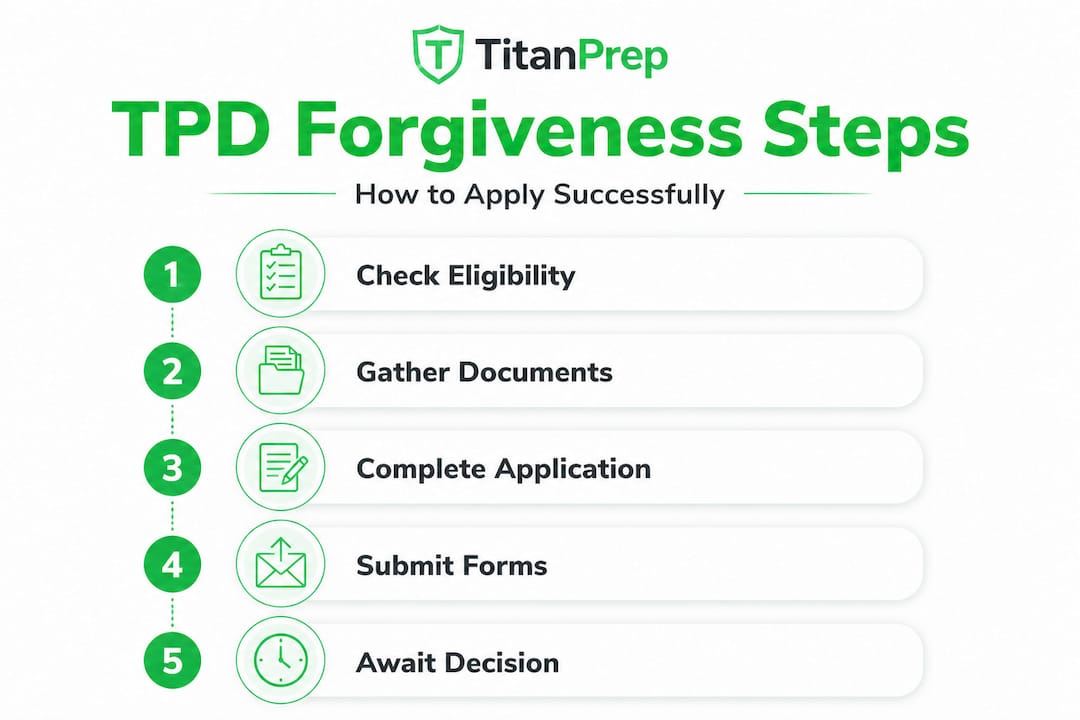
Automatic vs. manual review:
The Department of Education runs quarterly data matches with both the SSA and the VA. If you appear in those matches as a qualifying borrower, you may receive a notice and your discharge may be processed automatically. You do have the right to opt out if you prefer not to have the discharge processed, though most borrowers benefit from accepting it.
Step-by-step for a manual application:
Download and complete the TPD discharge application from StudentAid.gov.
Have your certifying medical professional complete their section of the form carefully and thoroughly.
Submit the completed application to Nelnet, which currently administers the TPD discharge program on behalf of the Department of Education.
Continue making any required payments or stay in contact with your servicer until you receive confirmation that your discharge is approved and active.
Keep copies of everything you submit, including the signed certification form.
“Common denial reasons include submitting the application more than 90 days after the medical professional’s signature date, providing illegible or incomplete documentation, missing license information for the certifying provider, failure to return documents within 120 days, and certifications that are too vague to confirm TPD eligibility.” — TICAS Application Tips
Most common pitfalls to avoid:
Submitting an application with a certification that was signed more than 90 days ago
Incomplete provider information, such as missing license numbers or missing NPI codes
A certification that states a diagnosis but does not address the 60-month duration or SGA standard
Failing to respond to requests for additional documentation within the 120-day window
If your application is denied, do not stop there. You can dispute a denied application or reapply using a different certification path. Denial is not the end of the road. Also be aware that the TPD process has attracted bad actors. Learn what scams to avoid so you do not fall victim to someone charging fees for services that are free through official channels.
Pro Tip: Set a calendar reminder for your application submission date. The 90-day window from the doctor’s signature closes fast, especially if you are dealing with health challenges at the same time.
After approval: taxes, new loans, and monitoring periods
Once your application is accepted, awareness of what comes next is key to protecting your new financial freedom.
Here is what you need to know about life after a TPD discharge approval:
Federal taxes are currently waived. The federal tax exemption on forgiven TPD balances has been extended through 2025. Whether Congress extends it further is uncertain. Check with a tax professional about your state, because some states do still treat forgiven amounts as taxable income.
No new federal student loans for three years. After your discharge, you cannot take out new federal student loans for a three-year period without risking reinstatement of your original debt. This applies even if you return to school during that time.
Monitoring period for physician certifications. If your discharge was approved through the medical professional path rather than SSA or VA, you enter a three-year monitoring period. During this time, the government may check whether your income exceeds the SGA threshold. If it does, your loans could be reinstated.
Processing delays are real. Due to recent program transitions and backlogs at Nelnet and the Department of Education, some borrowers have experienced erroneous denials, forbearance failures, and delayed processing. Stay patient and stay in contact with your servicer.
Pro Tip: Save every letter, email, and document related to your discharge, including proof of submission and any notices from Nelnet or the Department of Education. You will want this paper trail during the monitoring period.
If you are wondering whether you might qualify for other recent relief actions, take a look at what forgiveness programs have recently expanded and whether your situation aligns with any of those announcements.
A reality check: What most guidance leaves out about TPD eligibility
Here is something that most summaries skip over. The borrowers who get denied are usually not denied because they don’t have a real disability. They are denied because the paperwork doesn’t tell the right story.
A diagnosis is a label. What the Department of Education needs to see is a documented explanation of functional limitations, specifically why your condition prevents you from sustaining substantial gainful activity over time. A doctor who writes “patient has fibromyalgia” without explaining how that prevents the patient from working consistently above SGA levels has not completed the certification in a way that will hold up.
This is worth emphasizing: TPD is independent of SSDI and SSI standards. You can be working part-time and still qualify if a licensed professional certifies that you are unable to sustain substantial gainful activity. The distinction is between doing some activity and being able to hold competitive employment above the SGA threshold on an ongoing basis.
A few edge cases that come up often:
You were denied and want to reapply. You can reapply after denial with new documentation or through a different certification path entirely. If your SSA path was rejected, your doctor may be able to certify you through the medical path.
Parent PLUS and family confusion. The parent, not the child, must be disabled. Many families learn this the hard way after assuming the child’s SSDI award would qualify a parent’s loan.
Private loans will never qualify. No matter how severe the disability, private loans are ineligible for TPD discharge under federal rules. Those require separate negotiation with private lenders.
The single most valuable thing you can do before submitting is review a sample of successful certifications and make sure your provider is documenting functional impact, not just diagnosis. The detailed application steps on TitanPrep’s site walk through what strong documentation looks like. Most mistakes are preventable with a little extra preparation upfront.
Need help with your disability forgiveness application?
Navigating TPD discharge paperwork is manageable, but it takes careful attention to detail. TitanPrep helps borrowers organize their documentation, prepare their applications, and stay on top of deadlines throughout the process. Whether you are applying for the first time, reapplying after a denial, or trying to make sense of the three-year monitoring period, having organized records and clear next steps makes a real difference.
Check out the latest loan eligibility updates to stay current on any new rules or program changes that could affect your case. And if you want a clear, step-by-step breakdown of the forgiveness process from start to finish, download the free forgiveness guide to get a full picture of your options. TitanPrep does not guarantee outcomes, but it does help you show up to the process prepared.
Frequently asked questions
Can I work and still qualify for TPD discharge?
Yes, you may still qualify if a licensed medical professional certifies that you are unable to sustain substantial gainful activity, even if you do some part-time work or earn a small amount of income.
Are private student loans eligible for disability forgiveness?
No. Only federal student loans and TEACH Grants qualify for TPD discharge. Private loans are ineligible regardless of the severity of your disability.
What happens if I’m denied for TPD discharge?
You can reapply using new documentation or a different certification path. Reapplying after denial is allowed, so review the denial reason carefully and address it directly in your next submission.
Does a TPD discharge count as taxable income?
Federal taxes on TPD discharges are waived through the 2025 extension, but your state may handle it differently. Consult a tax professional to understand your specific state tax obligations.
Can Parent PLUS loans be forgiven due to a child’s disability?
No. Parent PLUS loans are only eligible if the parent borrower is disabled. A child’s disability, even if severe, does not qualify the parent’s loan for discharge.
Recommended
Comments